
From Wikipedia, the free encyclopedia
Content deleted Content added
| Line 22: | Line 22: | ||
|
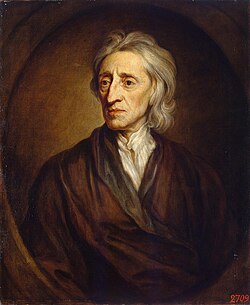
[[File:Godfrey Kneller – Portrait of John Locke (Hermitage).jpg|thumb|John Locke, whose natural rights philosophy influenced libertarian thought.]] |
[[File:Godfrey Kneller – Portrait of John Locke (Hermitage).jpg|thumb|John Locke, whose natural rights philosophy influenced libertarian thought.]] |
||
|
The works of philosopher John Locke are considered founding documents for natural rights-based libertarianism.<ref name=”autogenerated4″>Meany, Paul [https://www.libertarianism.org/articles/introduction-lockes-two-treatises “An Introduction to Locke’s Two Treatises”] Libertarianism.org</ref><ref name=”autogenerated3″>Boaz, David [https://www.cato.org/commentary/key-concepts-libertarianism “Key Concepts of Libertarianism”] Cato.org</ref> |
The works of philosopher John Locke are considered founding documents for natural rights-based libertarianism.<ref name=”autogenerated4″>Meany, Paul [https://www.libertarianism.org/articles/introduction-lockes-two-treatises “An Introduction to Locke’s Two Treatises”] Libertarianism.org</ref><ref name=”autogenerated3″>Boaz, David [https://www.cato.org/commentary/key-concepts-libertarianism “Key Concepts of Libertarianism”] Cato.org</ref> |
||
|
=== 18th century === |
|||
|
In the United States, American revolutionaries drew inspiration from the ideas of liberty which flourished in England. <ref>Garbooshian, Adrina Michelle (2006). ”The Concept of Human Dignity in the French and American Enlightenments: Religion, Virtue, Liberty”. ProQuest. [https://books.google.com/books?id=e1vAW-Ie58YC&pg=PA472 p. 472] {{dead link|date=June 2022|bot=medic}}{{cbignore|bot=medic}}. {{ISBN|978-0542851605}}. “Influenced by Locke and Smith, certain segments of society affirmed classical liberalism, with a libertarian bent.”</ref><ref>Cantor, Paul A. (2012). ”The Invisible Hand in Popular Culture: Liberty Vs. Authority in American Film and TV”. [[University Press of Kentucky]]. [https://books.google.com/books?id=pZjuIM7ziMkC&pg=PR13 p. xiii]. {{ISBN|978-0813140827}}. “[T]he roots of libertarianism lie in […] the classical liberal tradition”.</ref> |
|||
|
=== 19th century === |
=== 19th century === |
||
Revision as of 16:11, 6 November 2025
National occurrence of libertarianism
Libertarianism in England is a political philosophy promoting individual liberty.
History
Anglo Saxons
Anglo-Saxon England is cited by anarcho-capitalists and libertarians as an example of a prototype anarcho-capitalist society.[1]
17th century
English Civil War and Levellers
Roderick T. Long writes that libertarians “claim the seventeenth century English Levellers and the eighteenth century French Encyclopedists among their ideological forebears” [2][3][4] The Levellers are cited as an early libertarian movement, advocating for common law, legal equality, and government’s necessity to have the consent of the governed.[5] Nathan B. Gilson [further explanation needed] writes that a “blurred understanding of the realms of the religious and the secular […] allowed Lilburne to seamlessly connect the ideas of religious persecution with his own commitment to libertarian political ideology regarding personal property, which Levellers like Lilburne understood to be an inalienable, natural right”.[6] Christopher Hill summarized this principle by
simply stating that the Levellers “fused Biblical and constitutional theories.”[7]
The Levellers inspired both libertarians and socialists.[8]
.jpg)
The works of philosopher John Locke are considered founding documents for natural rights-based libertarianism.[9][10]
19th century
Auberon Herbert advocated a voluntary-funded government, coining the phrase voluntaryism.[11] Hans-Hermann Hoppe, believes that Herbert “develops the Spencerian idea of equal freedom to its logically consistent anarcho-capitalist end”.[12]
Murray Rothbard wrote “The tradition of voluntarism was at its strongest in England. So strong was it that, not only was there no compulsory education in England until the late nineteenth century, but there was not even a public school system. Before the 1830s, the State did not interfere in education at all.”[13]
The English Catholic historian and Liberal Party statesman Lord Acton was described by Murray Rothbard as “the great Catholic libertarian historian”.[14] The Acton Institute, an American Christian conservative libertarian think tank, is named after him.[15]
Organisations
See also
References
- ^ Morriss, Andrew P. “Anarcho-Capitalism” Libertarianism.org
- ^ Rocker, Rudolf (1949). Pioneers of American Freedom: Origin of Liberal and Radical Thought in America. New York: J.J. Little & Ives Co., p. 13. “It was the great service of liberal thinkers like Jefferson and Paine that they recognized the natural limitations of every form of government. That is why they did not want to see the state become a terrestrial Providence which in its infallibility would make on its own every decision, thereby not only blocking the road to higher forms of social development, but also crippling the natural sense of responsibility of the people which is the essential condition for every prosperous society”.
- ^ Tucker, Benjamin (1926) [1976]. Individual Liberty. New York: Vanguard Press. p. 13. “The Anarchists are simply unterrified Jeffersonian Democrats. They believe that ‘the best government is that which governs least,’ and that that which governs least is no government at all”.
- ^ Scott, James C. (2012). Two Cheers for Anarchism: Six Easy Pieces on Autonomy, Dignity, and Meaningful Work and Play. Princeton University Press. pp. 79–80. “At one end of an institutional continuum one can place the total institutions that routinely destroy the autonomy and initiative of their subjects. At the other end of this continuum lies, perhaps, some ideal version of Jeffersonian democracy composed of independent, self-reliant, self-respecting, landowning farmers, managers of their own small enterprises, answerable to themselves, free of debt, and more generally with no institutional reason for servility or deference. Such free-standing farmers, Jefferson thought, were the basis of a vigorous and independent public sphere where citizens could speak their mind without fear or favor. Somewhere in between these two poles lies the contemporary situation of most citizens of Western democracies: a relatively open public sphere but a quotidian institutional experience that is largely at cross purposes with the implicit assumptions behind this public sphere and encouraging and often rewarding caution, deference, servility, and conformity”.
- ^ Elliott, Nicholas “The Levellers: Libertarian Revolutionaries”
- ^ The Enthusiast Protestant Roots of the Modern Concept of “Freedom of Religion.”
- ^ Hill, Christopher. Puritanism and Revolution. p. 75.
- ^ Foxley, Rachel (November 4, 2019). “Resilient Radicalism: The Levellers and Popular Sovereignty”. Liberty Fund. Retrieved November 6, 2025.
- ^ Meany, Paul “An Introduction to Locke’s Two Treatises” Libertarianism.org
- ^ Boaz, David “Key Concepts of Libertarianism” Cato.org
- ^ Perry, Sarah (2020-02-03). “What is Voluntaryism?”. Voluntaryism in Action.
- ^ Anarcho-Capitalism: An Annotated Bibliography, 2002. Retrieved from LewRockwell.com
- ^ Rothbard, Murray “Education: Free and Compulsory” Mises.org
- ^ Flood, Anthony “Lord Acton: Libertarian Hero” Mises.org
- ^ Cite error: The named reference
acton.orgwas invoked but never defined (see the help page). - ^ “About”. Libertarian Party UK.

