
=== Primary sources ===
=== Primary sources ===
· Edward Carpenter, ”From Adam’s Peak to Elephanta: Sketches in Ceylon and India”. London: Swan Sonnenschein & Co. Limited, 1892, pp. 135–203 (“A Visit to a Gñani”).
Edward Carpenter, ”From Adam’s Peak to Elephanta: Sketches in Ceylon and India”. London: Swan Sonnenschein & Co. Limited, 1892, pp. 135–203 (“A Visit to a Gñani”).
· Edward Carpenter, ”A Visit to a Gñani: From Adam’s Peak to Elephanta”. Chicago: Alice B. Stockham & Company, [1900].
Edward Carpenter, ”A Visit to a : ”. : & Company, .
—-
=== Secondary literature ===
=== Secondary literature ===
· P[onnambalam] Ramanathan, ”The Culture of the Soul among Western Nations”. New York: G. P. Putnam’s Sons, 1906.
P[onnambalam] Ramanathan, ”The Culture of the Soul among Western Nations”. New York: G. P. Putnam’s Sons, 1906.
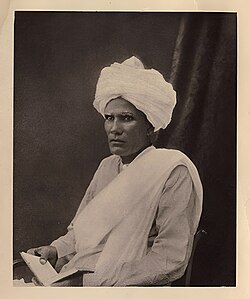
Sri Arulparananda Swamigal
[edit]
|
Sri Arulparananda Swamigal |
|
|---|---|
 |
|
| Born | c. 1823
Thanjavur |
| Died | 18 July 1893
Thanjavur |
| Notable work(s) | A Visit to a Gñani (as described by Edward Carpenter) |
| Religion | Hinduism |
| Philosophy | Shaiva Siddhanta, Advaita Vedanta |
Sri Arulparananda Swamigal (Tamil: ஸ்ரீ அருள்பரானந்த சுவாமிகள்; IAST: Śrī Aruḷparāṉanta Cuvāmikaḷ), originally known as (Ilakkanam) Ramaswami Pillai (Tamil: [இலக்கணம்] இராமசாமி பிள்ளை; IAST: [Ilakkaṇam] Irāmacāmi Piḷḷai) (probably Thanjavur, c. 1823 – Thanjavur, 18 July 1893), was a diplomat, advisor to the last Raja of Tanjore, scholar of traditional sciences, grammarian, jñānī, and guru. Arulparananda had an extraordinary impact on two prominent figures in Ceylonese politics and culture—Ponnambalam Ramanathan and Ponnambalam Arunachalam—as well as on the English social thinker Edward Carpenter. He is also the first jñānī whose life, personality, and teachings were described in detail by a Western author (Carpenter) on the basis of first-hand experience.
Arulparananda Swamigal was born between 1820 and 1825, most probably in Tanjore (present-day Thanjavur). His family background is uncertain, though the head of the household is believed to have served the local raja. According to traditional accounts, the birth of the child was revealed to his mother in a dream by the god Murugan. From the age of sixteen, Arulparananda became a devoted worshipper of Murugan. A few years later, while at the Brihadīśvara Temple, he reportedly fell asleep and, like his mother, saw Murugan in a dream. The deity was said to have placed his foot on the young man’s head, inscribed letters upon his tongue, and told him: “We will come to you to initiate you.” Following this, Arulparananda is said to have mastered various sacred sciences and the philosophies of Śaiva Siddhānta and Advaita Vedānta. Under the guidance of the eminent Tamil scholar Mīṉākṣī Sundaram Piḷḷai (1815–1876), he attained a high level of proficiency in Tamil language and literature. Thereafter, he became widely known by the epithet Ilakkaṇam (“the Grammarian”). His learning and reputation for holiness led to his appointment as advisor to the Raja of Tanjore, Śivāji II (r. 1832–1855), who also employed him in diplomatic affairs. After the Raja’s death in 1855, he continued in the same capacity under the senior Mahārāṇī Kāmakṣī Bai Sāhibā (?–1892). Around 1858, acting on the Mahārāṇī’s behalf, he visited the Tamil political leader in Ceylon, Sir Muthu Coomaraswamy (1834–1879), to request his mediation with the British authorities in a matter of royal succession. On another occasion, while on a diplomatic mission from Tanjore to Kumbakonam, Murugan was believed to have fulfilled his promise by appearing before him in the form of an earthly guru, Tillaināthan Swami. The guru bestowed on him the initiatory name Arulparānanda. His period of discipleship lasted about three years, during which he alternated between residing in Tanjore and travelling with his master to various South Indian pilgrimage sites. Around 1860, he is said to have attained the ultimate goal of liberation (mokṣa).
After attaining final realization, he did not become a wandering ascetic (saṃnyāsin) like his master, but remained at home in Tanjore with his family. He spent most of his time either absorbed in samādhi or engaged in instructing his disciples, particularly in Tamil language and literature. As advisor to the widowed senior Mahārāṇī, he occasionally undertook diplomatic missions on her behalf. He was known simply as Ilakkaṇam, and kept his exalted spiritual status secret.
In 1888, for reasons unknown, he visited Muthu Coomaraswamy’s nephew and foster child, Ponnambalam Ramanathan (1851–1930), at his Colombo residence, Sukhasthān. From that time onward, Ramanathan, together with his younger brother Ponnambalam Arunachalam (1853–1924), became his disciple. At Arunachalam’s invitation, his friend Edward Carpenter (1844–1929) travelled to Ceylon in 1890 to meet Arulparananda. Assisted by Arunachalam’s interpretation, Carpenter listened to Arulparananda daily for several weeks, as the latter expounded on the philosophies of Śaiva Siddhānta and Advaita Vedānta, as well as on Yoga. Carpenter published his experiences in Ceylon and India in his 1892 travelogue From Adam’s Peak to Elephanta, in which he devoted four chapters to the life and teachings of Arulparananda. These four chapters were later published separately as A Visit to a Gñāni (1900). Until Arulparananda’s death in 1893, Ramanathan and Arunachalam maintained regular contact with him; either Arulparananda visited them in Ceylon, or they visited him in Tanjore.
During his stay in Kurunegala (Ceylon), Arulparananda contracted what was then known as “Kurunegala fever” (now identified as rat-bite fever). Owing to his robust constitution and his proficiency in traditional medicine, he resisted the illness for three years before it finally overcame him. After his death and paripūraṇam (“final consummation”), a samādhi was erected for him in Tanjore, where daily rituals were performed for several decades. The samādhi no longer exists; it was most likely washed away by flooding of the Vennar River.
His talented grandson, Naganathan (1895–1965), was invited by Ramanathan to Ceylon in 1923. Under the name S. Natesan (Subaiya Natesan), he initially served as Ramanathan’s personal secretary and later held increasingly senior positions in the Ceylonese government: he became a member of the State Council of Ceylon, Minister of Posts and Information, later Minister of Posts and Broadcasting, and was eventually elected to the Senate.
The teachings of Arulparananda—being in every respect a continuation of tradition—are not distinguished by novelty, which one should not even seek in them, but rather by the fact that he embodied his doctrine with his whole being, especially in its practical aspect. Practical realisation, he taught, is determined by the ultimate goal itself. The goal is to attain the universal, thought-free consciousness that lies behind the individual, thought-bound consciousness. This universal consciousness, as it were, “sees through” the surface ripples of the phenomenal world, and in the light of the divine numinous substratum underlying them, the differences between individual phenomena lose their significance. Arulparananda expressed this divine substratum through the symbol of undifferentiated space—free from all distinctions—while the elements of the phenomenal world correspond to the manifold objects contained within it, which, although they exist in space, do not affect it. Space thus serves as a kind of witness (sākṣin) to the objects it contains. It is precisely this attitude that the yogi, striving toward the ultimate goal, must cultivate—a stance that may rightly be called “the wisdom of non-discrimination”—in order to raise consciousness from particularity to universality.
According to Arulparananda, there are two principal means of accomplishing this. The first is the suspension of thought—the gradual stilling of mental fluctuations. This essentially corresponds to Patañjali’s classical definition of yoga: yogaḥ citta-vṛtti-nirodhaḥ (Yoga Sūtra 1:2)—“Yoga is the cessation of the modifications of the mind.” However, the elimination of thought cannot even begin until the yogi makes a serious effort to eradicate desire. This is the second essential means of realisation. Desire is just as capable of disturbing the mirror-like surface of the lake of the soul as thought; and thus it can only reflect the moon in a distorted way. The elimination of thought and desire—of attraction and aversion—must therefore proceed hand in hand, according to Arulparananda’s practical teaching.
In addition, Arulparananda attached particular importance to transcending the subject–object dichotomy. An intense opposition to the objective world naturally strengthens its counterpart—the subjective pole of the dichotomy, namely individual consciousness. Of course, in its perfection, such transcendence can be attained only in the final realisation.
Beyond his practical teachings on yoga in the strict sense, Arulparananda naturally shared the traditional cosmological and metaphysical outlook of Vedānta and Śaiva Siddhānta, and either remained unfamiliar with the physical, chemical, biological, and cosmological discoveries of Western science, or, if he was aware of them, he rejected them—partly on the basis of his traditional learning and partly on that of his own experience. Although Arulparananda, from his own spiritual standpoint, rejected caste distinctions, he was by no means a revolutionary; he regarded caste regulations as necessary for the social order and for the spiritual guidance of the masses.
Since Arulparananda kept his high spiritual attainment concealed and never appeared publicly as a jñānī or guru, his influence manifested only indirectly—through his two principal disciples, the Ponnambalam brothers, and through Edward Carpenter. All three were remarkable figures of their time.
Sir Ponnambalam Ramanathan served for several terms as a member of the Legislative Council and for many years as Solicitor-General of Ceylon—both among the highest offices attainable by Ceylonese under the British colonial administration. Alongside his official duties, he wrote numerous books and essays, approaching each subject—including certain books of the Christian Scriptures—in the light of Arulparananda’s teaching, while at all times keeping the identity of his master a secret.
His brother, Sir Ponnambalam Arunachalam, conducted Ceylon’s first census. Like his brother, Arunachalam served as a member of the Legislative Council and was among the founders of the Ceylon National Congress, of which he became the first president. He was also the first Ceylonese to be elected president of the Ceylon Branch of the Royal Asiatic Society. In addition to his political and scholarly duties, he expressed his master’s teaching chiefly through inspired translations and commentaries on classical Tamil poetry, as well as through his various historical, cultural, and philosophical studies.
While the Ponnambalam brothers devoted their whole being to the spiritual principles they had learned from their master, they nevertheless led a twofold existence: an outward, socio-political life, and an inner life guided by their striving for spiritual perfection.
Although Carpenter was not as profoundly influenced by his encounter with Arulparananda as were the Ponnambalam brothers, he did not keep his acquaintance with the Tanjore jñānī a secret; rather, he wrote in detail about his life and teaching in his travelogue on Ceylon and India. This was the first account by a Western author of an Indian jñānī based on direct personal experience. He is also to be credited for publishing the letters addressed to him by his friend Arunachalam, which contain a wealth of information about Arulparananda’s life and teaching.
- Edward Carpenter, From Adam’s Peak to Elephanta: Sketches in Ceylon and India. London: Swan Sonnenschein & Co. Limited, 1892, pp. 135–203 (“A Visit to a Gñani”).
- Edward Carpenter, A Visit to a Gñani: From Adam’s Peak to Elephanta. Chicago: Alice B. Stockham & Company, [1900].
- Edward Carpenter, A Visit to a Gñáni: Or Wise Man of the East. London: George Allen & Company, 1911.
- P[onnambalam] Arunachalam, Light from the East: Being Letters in Gñanam, the Divine Knowledge. London: George Allen & Unwin, 1927. Edited by Edward Carpenter.
Secondary literature
[edit]
- P[onnambalam] Ramanathan, The Culture of the Soul among Western Nations. New York: G. P. Putnam’s Sons, 1906.
- P[onnambalam] Ramanathan, The Spirit of the East Contrasted with the Spirit of the West. New York: Brooklyn Institute of Arts and Sciences, 1906.
- Buji Ferenc, “Srí Arulparánanda Szvámigal és a meg nem különböztetés bölcsessége I–II.” Életünk (Szombathely) 2019/1, pp. 60–84; 2019/2, pp. 6–35.
- Ferenc Buji, Sri Arulparananda Swamigal and the Wisdom of Non-Discrimination (unpublished).

