
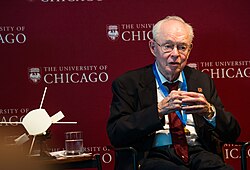
== Biography ==
== Biography ==
Eugene Newman Parker was born in [[Houghton, Michigan]] to Glenn and Helen (MacNair) Parker on June 10, 1927.<ref name=”NYTobit” />
In the mid-1950s, Parker developed the theory of supersonic [[solar wind]] and predicted the [[Heliospheric current sheet|Parker spiral]] shape of the solar magnetic field in the [[outer Solar System]]. His theoretical modeling was not immediately accepted by the astronomical community: when he submitted the results<ref name=”Parker 1958″>{{cite journal |last=Parker |first=Eugene N. |bibcode=1958ApJ…128..664P |title=Dynamics of the Interplanetary Gas and Magnetic Fields |journal=The Astrophysical Journal |volume=128 |pages=664–676 |date=November 1958 |doi=10.1086/146579}}</ref> to ”[[The Astrophysical Journal]]”, two reviewers recommended its rejection. The editor of the journal, [[Subrahmanyan Chandrasekhar]], finding no obvious errors in the paper, overruled the reviewers and published the paper anyway.<ref>{{Citation | title = The martial art of scientific publication | year = 1997 | last1 = Parker | first1 = E. N. | journal = [[Eos (magazine)|EOS Transactions]] | volume = 78 | issue = 37 | pages = 391–395 | doi = 10.1029/97EO00251 | bibcode = 1997EOSTr..78..391P}}</ref><ref>{{cite web|last1=Roach|first1=John|title=Astrophysicist Recognized for Discovery of Solar Wind|url=http://news.nationalgeographic.com/news/2003/08/0827_030827_kyotoprizeparker.html|archive-url=https://web.archive.org/web/20030830010454/http://news.nationalgeographic.com/news/2003/08/0827_030827_kyotoprizeparker.html|url-status=dead|archive-date=August 30, 2003|website=National Geographic News|publisher=National Geographic|access-date=June 2, 2017}}</ref> Parker’s theoretical predictions were confirmed by satellite observations a few years later, especially the 1962 [[Mariner 2]] mission.<ref>{{cite news|url=https://www.nytimes.com/2018/08/10/science/eugene-parker-solar-wind-nasa-probe.html|title= NASA’s Parker Solar Probe Is Named for Him. 60 Years Ago, No One Believed His Ideas About the Sun |first=Kenneth|last= Chang|work=The New York Times|date=August 10, 2018|quote=After Mariner 2, ‘everyone agreed the solar wind existed,’ Dr. Parker said.}}</ref>
In the mid-1950s, Parker developed the theory of supersonic [[solar wind]] and predicted the [[Heliospheric current sheet|Parker spiral]] shape of the solar magnetic field in the [[outer Solar System]]. His theoretical modeling was not immediately accepted by the astronomical community: when he submitted the results<ref name=”Parker 1958″>{{cite journal |last=Parker |first=Eugene N. |bibcode=1958ApJ…128..664P |title=Dynamics of the Interplanetary Gas and Magnetic Fields |journal=The Astrophysical Journal |volume=128 |pages=664–676 |date=November 1958 |doi=10.1086/146579}}</ref> to ”[[The Astrophysical Journal]]”, two reviewers recommended its rejection. The editor of the journal, [[Subrahmanyan Chandrasekhar]], finding no obvious errors in the paper, overruled the reviewers and published the paper anyway.<ref>{{Citation | title = The martial art of scientific publication | year = 1997 | last1 = Parker | first1 = E. N. | journal = [[Eos (magazine)|EOS Transactions]] | volume = 78 | issue = 37 | pages = 391–395 | doi = 10.1029/97EO00251 | bibcode = 1997EOSTr..78..391P}}</ref><ref>{{cite web|last1=Roach|first1=John|title=Astrophysicist Recognized for Discovery of Solar Wind|url=http://news.nationalgeographic.com/news/2003/08/0827_030827_kyotoprizeparker.html|archive-url=https://web.archive.org/web/20030830010454/http://news.nationalgeographic.com/news/2003/08/0827_030827_kyotoprizeparker.html|url-status=dead|archive-date=August 30, 2003|website=National Geographic News|publisher=National Geographic|access-date=June 2, 2017}}</ref> Parker’s theoretical predictions were confirmed by satellite observations a few years later, especially the 1962 [[Mariner 2]] mission.<ref>{{cite news|url=https://www.nytimes.com/2018/08/10/science/eugene-parker-solar-wind-nasa-probe.html|title= NASA’s Parker Solar Probe Is Named for Him. 60 Years Ago, No One Believed His Ideas About the Sun |first=Kenneth|last= Chang|work=The New York Times|date=August 10, 2018|quote=After Mariner 2, ‘everyone agreed the solar wind existed,’ Dr. Parker said.}}</ref>
Parker’s work increased understanding of the [[Stellar corona|solar corona]], the [[solar wind]], the [[magnetic field]]s of both the Earth and the Sun, and their complex electromagnetic interactions. In 1972, he formulated what became known as the [[Parker theorem]], which showed how the [[topology]] of [[magnetic field lines]] in the [[solar corona]] of the Sun (and similar stars) can produce [[solar flare|flares]] at [[X-ray]] energies.<ref>{{Citation |last=Parker |first=E. N. |title=Formal mathematical solutions of the force-free equations, spontaneous discontinuities, and dissipation in large-scale magnetic fields |date=1990 |url=http://dx.doi.org/10.1029/gm058p0195 |work=Physics of Magnetic Flux Ropes |series=Geophysical Monograph Series |volume=58 |pages=195–202 |access-date=2024-01-07 |place=Washington, D. C. |publisher=American Geophysical Union|doi=10.1029/gm058p0195 |isbn=0-87590-026-7 |url-access=subscription }}</ref><ref>{{Cite web |last=Chhabra |first=Sherry |date=2022-04-30 |title=Obituary: Eugene N. Parker (1927 – 2022) |url=https://solarnews.nso.edu/obituary-eugene-n-parker-1927-2022/ |access-date=2024-01-07 |website=SolarNews |language=en-US}}</ref>
Parker’s work increased understanding of the [[Stellar corona|solar corona]], the [[solar wind]], the [[magnetic field]]s of both the Earth and the Sun, and their complex electromagnetic interactions. In 1972, he formulated what became known as the [[Parker theorem]], which showed how the [[topology]] of [[magnetic field lines]] in the [[solar corona]] of the Sun (and similar stars) can produce [[solar flare|flares]] at [[X-ray]] energies.<ref>{{Citation |last=Parker |first=E. N. |title=Formal mathematical solutions of the force-free equations, spontaneous discontinuities, and dissipation in large-scale magnetic fields |date=1990 |url=http://dx.doi.org/10.1029/gm058p0195 |work=Physics of Magnetic Flux Ropes |series=Geophysical Monograph Series |volume=58 |pages=195–202 |access-date=2024-01-07 |place=Washington, D. C. |publisher=American Geophysical Union|doi=10.1029/gm058p0195 |isbn=0-87590-026-7 |url-access=subscription }}</ref><ref>{{Cite web |last=Chhabra |first=Sherry |date=2022-04-30 |title=Obituary: Eugene N. Parker (1927 – 2022) |url=https://solarnews.nso.edu/obituary-eugene-n-parker-1927-2022/ |access-date=2024-01-07 |website=SolarNews |language=en-US}}</ref>
He published several [[textbook]]s, including ”Cosmical Magnetic Fields” in 1979, and one on magnetic fields in [[X-ray astronomy]] in 1994.<ref name=”bruce” /> Seeking to address the [[coronal heating problem]], in 1987 Parker proposed that the solar corona might be heated by myriad tiny “[[nanoflare]]s”, miniature brightenings resembling [[solar flare]]s that would occur all over the surface of the Sun. Parker’s theory became a leading candidate to explain the problem.<ref name=”agu” /><ref name=”bruce” />
Seeking to address the [[coronal heating problem]], in 1987 Parker proposed that the solar corona might be heated by myriad tiny “[[nanoflare]]s”, miniature brightenings resembling [[solar flare]]s that would occur all over the surface of the Sun. Parker’s theory became a leading candidate to explain the problem.<ref name=”agu” /><ref name=”bruce” />
=== Personal life ===
== Personal life ==
Parker was married for 67 years to his wife, Niesje, with whom he had two children. He died in Chicago on March 15, 2022, at the age of 94.<ref name=”NYTobit”>{{cite web|title=Eugene N. Parker, 94, Dies; Predicted the Existence of Solar Wind|url=https://www.nytimes.com/2022/03/17/science/space/eugene-n-parker-dead.html|work=The New York Times|last=Chang|first=Kenneth|date=March 17, 2022|accessdate=March 17, 2022}}</ref><ref name=death>{{Cite web |last1=Lerner |first1=Louise |title=Eugene Parker, ‘legendary figure’ in solar science and namesake of Parker Solar Probe, 1927–2022 |url=https://news.uchicago.edu/story/eugene-parker-legendary-figure-solar-science-and-namesake-parker-solar-probe-1927-2022 |publisher=University of Chicago |access-date=March 16, 2022 |language=en |date=March 16, 2022}}</ref>
Parker was married for 67 years to his wife, Niesje, with whom he had two children. He died in Chicago on March 15, 2022, at the age of 94.<ref name=”NYTobit”>{{cite web|title=Eugene N. Parker, 94, Dies; Predicted the Existence of Solar Wind|url=https://www.nytimes.com/2022/03/17/science/space/eugene-n-parker-dead.html|work=The New York Times|last=Chang|first=Kenneth|date=March 17, 2022|accessdate=March 17, 2022}}</ref><ref name=death>{{Cite web |last1=Lerner |first1=Louise |title=Eugene Parker, ‘legendary figure’ in solar science and namesake of Parker Solar Probe, 1927–2022 |url=https://news.uchicago.edu/story/eugene-parker-legendary-figure-solar-science-and-namesake-parker-solar-probe-1927-2022 |publisher=University of Chicago |access-date=March 16, 2022 |language=en |date=March 16, 2022}}</ref>
_____
American solar physicist (1927–2022)
Eugene Newman Parker (June 10, 1927 – March 15, 2022) was an American solar and plasma physicist. In the 1950s he proposed the existence of the solar wind and that the magnetic field in the outer Solar System would be in the shape of a Parker spiral, predictions that were later confirmed by spacecraft measurements. In 1987, Parker proposed the existence of nanoflares, a leading candidate to explain the coronal heating problem.
Parker obtained his PhD from Caltech and spent four years as a postdoctoral researcher at the University of Utah. He joined University of Chicago in 1955 and spent the rest of his career there, holding positions in the physics department, the astronomy and astrophysics department, and the Enrico Fermi Institute. Parker was elected to the National Academy of Sciences in 1967. In 2017, NASA named its Parker Solar Probe in his honor, the first NASA spacecraft named after a living person.[7]
Biography
Eugene Newman Parker was born in Houghton, Michigan to Glenn and Helen (MacNair) Parker on June 10, 1927.[8]
He received his Bachelor of Science degree in physics from Michigan State University in 1948 and a Doctor of Philosophy (PhD) degree from Caltech in 1951.[9] Parker spent four years at the University of Utah before joining the University of Chicago in 1955, where he spent the rest of his career.[9] He held positions in Chicago’s physics department, astronomy and astrophysics department, and the Enrico Fermi Institute.[10] Parker was elected to the National Academy of Sciences in 1967.[10]
Solar physics research
In the mid-1950s, Parker developed the theory of supersonic solar wind and predicted the Parker spiral shape of the solar magnetic field in the outer Solar System. His theoretical modeling was not immediately accepted by the astronomical community: when he submitted the results[11] to The Astrophysical Journal, two reviewers recommended its rejection. The editor of the journal, Subrahmanyan Chandrasekhar, finding no obvious errors in the paper, overruled the reviewers and published the paper anyway.[12][13] Parker’s theoretical predictions were confirmed by satellite observations a few years later, especially the 1962 Mariner 2 mission.[14]
Parker’s work increased understanding of the solar corona, the solar wind, the magnetic fields of both the Earth and the Sun, and their complex electromagnetic interactions. In 1972, he formulated what became known as the Parker theorem, which showed how the topology of magnetic field lines in the solar corona of the Sun (and similar stars) can produce flares at X-ray energies.[15][16]
Seeking to address the coronal heating problem, in 1987 Parker proposed that the solar corona might be heated by myriad tiny “nanoflares“, miniature brightenings resembling solar flares that would occur all over the surface of the Sun. Parker’s theory became a leading candidate to explain the problem.[10][17]
Personal life
Parker was married for 67 years to his wife, Niesje, with whom he had two children. He died in Chicago on March 15, 2022, at the age of 94.[8][9]
Honors and awards
.jpg)
- 1969: Arctowski Medal of the National Academy of Sciences[18]
- 1969: Henry Norris Russell Lectureship of the American Astronomical Society[19]
- 1978: George Ellery Hale Prize, Solar Physics Division of the American Astronomical Society, first time this prize was awarded[20]
- 1979: Chapman Medal, Royal Astronomical Society[21]
- 1989: National Medal of Science[22]
- 1990: William Bowie Medal[10]
- 1992: Gold Medal of the Royal Astronomical Society[23]
- 1997: Bruce Medal[17]
- 2003: Kyoto Prize[24][25]
- 2003: James Clerk Maxwell Prize of the American Physical Society. Citation: “For seminal contributions in plasma astrophysics, including predicting the solar wind, explaining the solar dynamo, formulating the theory of magnetic reconnection, and the instability which predicts the escape of the magnetic fields from the galaxy.”[26]
- 2010: Member of the Norwegian Academy of Science and Letters.[27]
- 2017: NASA renamed its Solar Probe Plus mission to Parker Solar Probe,[28] the first time that a spacecraft was named after a living person.[29][8] Parker was present at its launch on August 12, 2018.
- 2018: Medal for Exceptional Achievement in Research of the American Physical Society. Citation: “For fundamental contributions to space physics, plasma physics, solar physics and astrophysics for over 60 years.”[30]
- 2020: Crafoord Prize in Astronomy[31]
Books
- Interplanetary Dynamical Processes, 1963, Interscience Publishers. ISBN 978-0-47-065916-8.
- Cosmical Magnetic Fields: Their Origin and their Activity, 1979, Oxford University Press. ISBN 978-0-19-851290-5.
- Spontaneous Current Sheets in Magnetic Fields: With Applications to Stellar X-rays, 1994, Oxford University Press. ISBN 978-0-19-507371-3.
- Conversations on Electric and Magnetic Fields in the Cosmos, 2007, Princeton University Press. ISBN 978-0-691-12841-2.
References
- ^ Choudhuri, Arnab Rai (March 9, 2024). ““Gene”: a personal tribute to the life and science of Eugene Newman Parker”. Reviews of Modern Plasma Physics. 8 (1): 6. doi:10.1007/s41614-024-00143-w – via Springer Link.
- ^ Rosner, Robert; Turner, Michael S. (August 1, 2022). “Eugene Newman Parker”. Physics Today. 75 (8): 59–59. doi:10.1063/PT.3.5068.
- ^ ““Nature Has Become More Beautiful.” Physicist Eugene Parker and his Life Unlocking Secrets Of The Sun”. April 12, 2022.
- ^ [1]
- ^ [2]
- ^ Tsinganos, Kanaris (January 1, 2022). “Eugene N. Parker (1927–2022)”. Bulletin of the AAS. 54 (1). doi:10.3847/25c2cfeb.19b7a688 – via baas.aas.org.
{{cite journal}}: CS1 maint: unflagged free DOI (link) - ^ “Eugene Parker, ‘legendary figure’ in solar science and namesake of Parker Solar Probe, 1927-2022”. University of Chicago News. March 16, 2022. Retrieved January 7, 2024.
- ^ a b c Chang, Kenneth (March 17, 2022). “Eugene N. Parker, 94, Dies; Predicted the Existence of Solar Wind”. The New York Times. Retrieved March 17, 2022.
- ^ a b c Lerner, Louise (March 16, 2022). “Eugene Parker, ‘legendary figure’ in solar science and namesake of Parker Solar Probe, 1927–2022”. University of Chicago. Retrieved March 16, 2022.
- ^ a b c d Tatarewicz, Joseph N. “Eugene N. Parker (1912– )”. Honors program. American Geophysical Union. Archived from the original on December 12, 2013. Retrieved December 7, 2013.
- ^ Parker, Eugene N. (November 1958). “Dynamics of the Interplanetary Gas and Magnetic Fields”. The Astrophysical Journal. 128: 664–676. Bibcode:1958ApJ…128..664P. doi:10.1086/146579.
- ^ Parker, E. N. (1997), “The martial art of scientific publication”, EOS Transactions, 78 (37): 391–395, Bibcode:1997EOSTr..78..391P, doi:10.1029/97EO00251
- ^ Roach, John. “Astrophysicist Recognized for Discovery of Solar Wind”. National Geographic News. National Geographic. Archived from the original on August 30, 2003. Retrieved June 2, 2017.
- ^ Chang, Kenneth (August 10, 2018). “NASA’s Parker Solar Probe Is Named for Him. 60 Years Ago, No One Believed His Ideas About the Sun”. The New York Times.
After Mariner 2, ‘everyone agreed the solar wind existed,’ Dr. Parker said.
- ^ Parker, E. N. (1990), “Formal mathematical solutions of the force-free equations, spontaneous discontinuities, and dissipation in large-scale magnetic fields”, Physics of Magnetic Flux Ropes, Geophysical Monograph Series, vol. 58, Washington, D. C.: American Geophysical Union, pp. 195–202, doi:10.1029/gm058p0195, ISBN 0-87590-026-7, retrieved January 7, 2024
- ^ Chhabra, Sherry (April 30, 2022). “Obituary: Eugene N. Parker (1927 – 2022)”. SolarNews. Retrieved January 7, 2024.
- ^ a b Tenn, Joseph S. “Eugene Newman Parker: 1997 Bruce Medalist”. Sonoma State University. Retrieved December 7, 2013.
- ^ “Arctowski Medal”. National Academy of Sciences. Archived from the original on December 29, 2010. Retrieved February 13, 2011.
- ^ “Henry Norris Russell Lectureship”. aas.org. American Astronomical Society. Retrieved March 16, 2022.
- ^ “George Ellery Hale Prize – Previous Winners”. spd.aas.org. AAS Solar Physics Division. Retrieved March 16, 2022.
- ^ “Chapman Medal winners” (PDF). Awards, medals and prizes. Royal Astronomical Society. Retrieved October 9, 2019.
- ^ “Eugene N. Parker”. The President’s National Medal of Science: Recipient Details. National Science Foundation. Retrieved December 7, 2013.
- ^ “The Gold Medal” (PDF). Royal Astronomical Society. 2021. Retrieved December 20, 2021.
- ^ “Citation: Eugene Newman Parker”. Kyoto Prize. Inamori Foundation. Archived from the original on December 11, 2013. Retrieved December 7, 2013.
- ^ Roach, John (August 27, 2003). “Astrophysicist Recognized for Discovery of Solar Wind”. National Geographic News. Archived from the original on August 30, 2003. Retrieved December 7, 2013.
- ^ “2003 James Clerk Maxwell Prize for Plasma Physics Recipient”. Prizes, Awards and Fellowships. American Physical Society. Retrieved December 7, 2013.
- ^ “Gruppe 2: Fysikkfag (herunder astronomi, fysikk og geofysikk)” (in Norwegian). Norwegian Academy of Science and Letters. Archived from the original on September 27, 2011. Retrieved October 7, 2010.
- ^ N. Davis (May 31, 2017). “Nasa’s hotly anticipated solar mission renamed to honour astrophysicist Eugene Parker”. The Guardian. Retrieved May 31, 2017.
- ^ “NASA Renames Solar Probe Mission to Honor Pioneering Physicist Eugene Parker”. NASA. May 31, 2017. Retrieved May 31, 2017.
- ^ “Award honors Prof. Eugene Parker’s lifetime of physics research”. UChicago News. January 31, 2018. Retrieved February 1, 2018.
- ^ “The Crafoord Prizes in Mathematics and Astronomy 2020”. January 30, 2020. Retrieved March 17, 2022.

