
From Wikipedia, the free encyclopedia
Content deleted Content added
|
|
|||
| Line 1: | Line 1: | ||
|
{{about||the British classical scholar|Lionel I. C. Pearson}} |
{{about||the British classical scholar|Lionel I. C. Pearson}} |
||
|
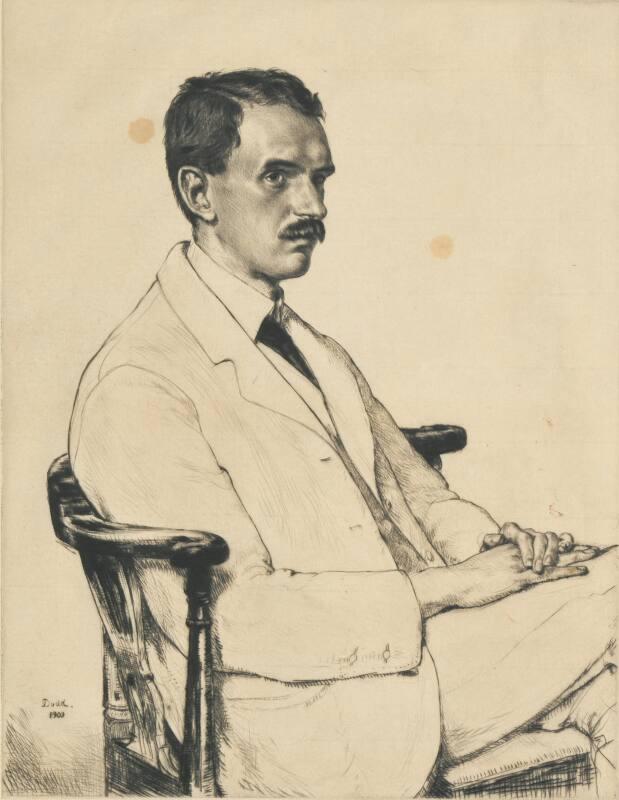
[[File:Portrait of Lionel Pearson – Francis Dodd – ABDAG005966.jpeg|thumb|”Portrait of Lionel Pearson” by [[Francis Dodd (artist)|Francis Dodd]]]] |
|||
|
{{Use dmy dates|date=February 2025}} |
{{Use dmy dates|date=February 2025}} |
||
|
{{Use British English|date=September 2016}} |
{{Use British English|date=September 2016}} |
||
|
[[File:Royal Artillery Monument corner view.jpg|thumb|[[Royal Artillery Memorial]]]] |
|||
|
|
(29 October 1879 – March )<ref name=”MVA”>{{cite web|title=Lionel Godfrey Pearson|work=A Biographical Dictionary of the Architects of Greater Manchester 1800-1940|publisher=The Victorian Society|url=https://manchestervictorianarchitects.org.uk/architects/lionel-godfrey-pearson|access-date=11 February 2021}}</ref> was a , best known for the Grade I listed [[Royal Artillery Memorial]], which he with the [[Charles Sargeant Jagger]]. |
||
|
== Biography == |
== Biography == |
||
Latest revision as of 02:07, 9 November 2025


Lionel Godfrey Pearson (29 October 1879 – 19 March 1953)[1] was a British architect, best known for the Grade I listed Royal Artillery Memorial, which he designed with the sculptor Charles Sargeant Jagger.
Pearson was educated at Manchester Grammar School.[1] He trained in Liverpool and then practiced in London, where from 1913, he worked in partnership with Henry Percy Adams and Charles Holden.[2] Earlier work in London from 1901 was with Edward Schroeder Prior.[1]
During the First World War, he served in the Royal Army Medical Corps.[1]
He was the architect of Stanley Spencer‘s Sandham Memorial Chapel.[3]
His architectural work included a number of hospitals. These included the new Westminster Hospital (1939), Royal Westminster Ophthalmic Hospital (1928), Southend Hospital (1932), and the Mineral Water Hospital in Bath.[1][4]
Pearson married Melinda Elizabeth Osborne in 1932.[1] His obituary was published in The Times on 27 March 1953.[1]

