
| education = [[Santa Clara College]]
| education = [[Santa Clara College]]
| occupation = Politician, businessman, rancher
| occupation = Politician, businessman, rancher
| image = Patrick W. Murphy.png
}}
}}
Canadian-born American politician (1837–1901)
|
Patrick Washington Murphy |
|
|---|---|
 |
|
| In office 1865–1866 |
|
| Preceded by | Juan Y. Cot |
| In office 1868–1869 |
|
| Succeeded by | Romualdo Pacheco |
| In office 1877–1881 |
|
| Preceded by | William J. Graves |
| Succeeded by | Warren Chase |
| In office 1881–1883 |
|
| Born | September 17, 1837 |
| Died | November 1, 1901 (aged 64) |
| Resting place | Santa Clara Mission Cemetery, Santa Clara, California, U.S. |
| Political party | Democratic |
| Spouse | Mary Catherine O’Brien (m. 1870–1875; her death) |
| Relations | Martin Murphy Jr. (father), Bernard D. Murphy (brother), Martin Murphy Sr. (grandfather) |
| Education | Santa Clara College |
| Occupation | Politician, businessman, rancher |
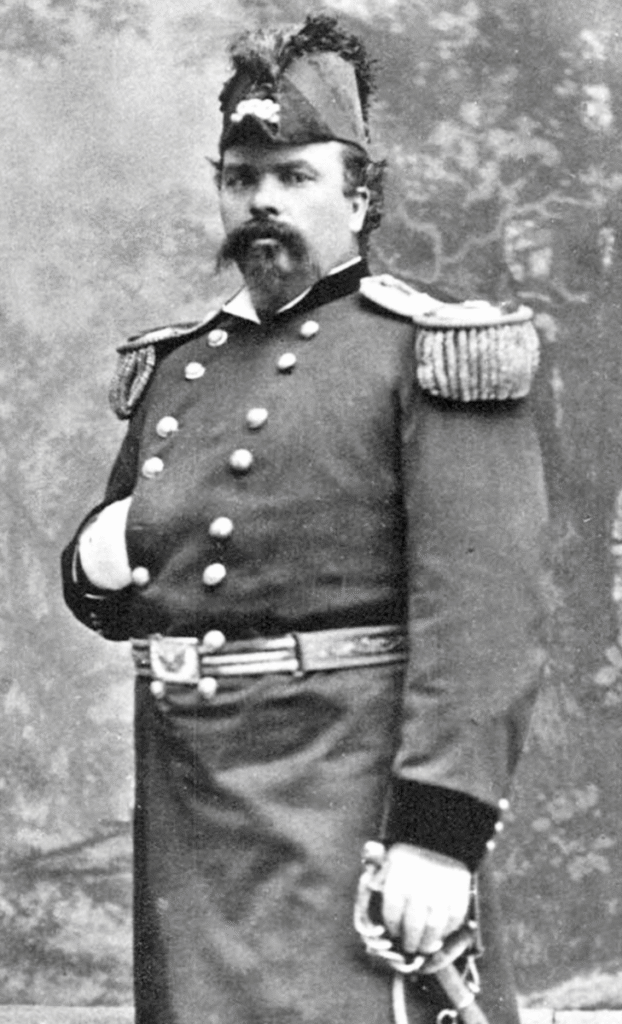
Patrick Washington Murphy (September 17, 1837 – November 1, 1901), also known as P. W. Murphy, was a Canadian-born American politician and rancher.[1][2][3] He was a Democrat representing Ventura, Santa Barbara, and San Luis Obispo Counties. Murphy served in the California State Senate; and was a member of the California State Assembly. He is from the Murphy family who were on the first wagon train to cross the Sierra Nevada, they were early settlers in California, and the founders of early Santa Clara Valley.[4][5] Murphy was nicknamed the “Black Prince” due to his complexion.[6]
Patrick Washington Murphy was born on September 17, 1837, in Quebec, Lower Canada (now Canada), to parents Mary Bulger and Martin Murphy Jr. His father was born in County Wexford, Ireland; their family migrated seeking religious freedom as Catholics.[7][8] He was one of eleven children, and his brother Bernard D. Murphy was also a politician who served in the same legislative house concurrently.[9]
In 1840, the Murphy family moved to Atchison County, Missouri to a settlement called Irish Grove.[10]
On May 6, 1844, the family started a wagon train from Missouri to California; it was made up of the Stephenson family, Townsend family and the Murphy family, called the Stephens–Townsend–Murphy Party. It was the first wagon train to cross the Sierra Nevada in 1844, and the journey took nine months to California.[7]
Murphy graduated from Santa Clara College (now Santa Clara University).
In the 1860s, his father bought land a 9,000 acres (3,600 ha) cattle ranch in Santa Margarita, California (part of Santa Margarita de Cortona Asistencia, Rancho Atascadero and Rancho Asuncion), which was run by his son Patrick.[5] At the time of Patrick’s death the ranch was 25,000 acres (10,000 ha) in size.[2]
Murphy gave the Southern Pacific Railroad the allowance to run their track through his Santa Margarita Ranch land.[11] This decision has defined the current route of the train.
Murphy was a Democrat representing Ventura County, Santa Barbara County, and San Luis Obispo County.[2] Murphy served in the California State Senate in 1865–1866, 1868–1869, and 1877–1881.[2] He was a member of the California State Assembly from 1881–1883.
Governor William Irwin appointed him brigadier general of the Second Brigade of the California National Guard. He was one of the founders and directors of the San Luis Obispo Water Company and Bank of San Luis Obispo.[12][13]
Murphy died of pneumonia on November 1, 1901, at the Lick House Hotel in San Francisco.[2][3]
His ranch sold in 1904 to the Fernando (Frank) Reis family.[11]
The family were the subject of Marjorie Pierce’s book, The Martin Murphy Family Saga (2000);[7] and the PBS documentary film, The Forgotten Journey (2021), produced by John Krizek.[14]
- ^ “Patrick W. Murphy”. JoinCalifornia. Retrieved November 9, 2025.
- ^ a b c d e ““Black Prince” Dies Suddenly”. San Francisco Chronicle (Obituary). November 2, 1901. p. 16. Retrieved November 9, 2025 – via Newspapers.com.
- ^ a b “Obituary for Patrick W. Murphy”. Los Angeles Evening Post-Record. November 2, 1901. p. 4. Retrieved November 9, 2025 – via Newspapers.com.
- ^ Sherman, Lola (May 20, 1960). “Family had roots in Ireland, were first settlers to cross Sierra to California”. Peninsula Times Tribune. p. 6. Retrieved November 8, 2025 – via Newspapers.com.
- ^ a b Woodman, Katharina. “The Murphy Story”. Sunnyvale Heritage Park Museum. Retrieved November 9, 2025.
- ^ “Obituary for Patrick W. Murphy”. Boston Evening Transcript (Obituary). November 2, 1901. p. 8. Retrieved November 9, 2025 – via Newspapers.com.
- ^ a b c Cheek, Martin (November 10, 2006). “MH Founding Father Became Leading Citizen”. Morgan Hill Times. Retrieved November 7, 2025.
- ^ “Martin Murphy”. The Pacific Bee (Obituary). October 24, 1884. p. 3. Retrieved November 9, 2025 – via Newspapers.com.
- ^ “Bernard D. Murphy”. JoinCalifornia. Retrieved November 3, 2025.
- ^ “Death of Notable California Pioneer”. Appeal-Democrat. March 29, 1865. p. 1. Retrieved November 7, 2025 – via Newspapers.com.
- ^ a b Roe, Cheri. “Rancho Days”. Santa Margarita Historical Society. Retrieved November 9, 2025.
- ^ “Coast News Itemized”. San Francisco Banner. July 20, 1895. p. 2. Retrieved November 9, 2025 – via Newspapers.com.
- ^ “Notice of Sale of Real Estate and Personal Estate”. The Independent. April 8, 1903. p. 7. Retrieved November 9, 2025 – via Newspapers.com.
- ^ “The Murphy Family Story”. Sunnyvale Heritage Park Museum. Retrieved November 9, 2025.

