
Battle of Tilpatra in Uri: When Quaid-e-Azam Muhammad Ali Jinnah declared Jihad in Kashmir and ordered Pakistan Army to participate in it. Captain Sarwar were participating in a course in GHQ’s School of Signals. His unit 2 Punjab Regiment entered Kashmir to face the enemy. As soon as the course ended he persisted to take permission to participate in Jihad of Kashmir, with his unit which was granted. He was appointed as the signals officer. He offered to fight the enemy at Tilpatra hill. On 27 July 1948, he took his men with him and attacked the enemy. The enemy opened fire with machine guns, artillery and mortars. He kept on advancing. His machine gunner got killed. He took hold of his gun and attacked. When a second gunner arrived he handed over the machine gun to him. He, along with some soldiers, advanced from another side and destroyed a machine gun of the enemy and advanced There was barbed wire, which he cut himself and let the soldiers pass through it and led the assault on the enemy. During this time, a burst from the automatic machine gun of the enemy injured him. His actions in the battle of Tipatra led him to be posthumously presented with the Nishan-e-Haider.<ref>{{cite web |last1=Amir |first1=Tariq |title=Pakistan Geotagging: Monument of Captain Raja Muhammad Sarwar Shaheed: Nishan e Haider |url=http://pakgeotagging.blogspot.com/2017/01/monument-of-captain-raja-muhammad.html |website=Pakistan Geotagging |access-date=9 March 2019 |date=12 January 2017}}</ref>}}<!–Rough translation from Urdu to American English.——–>
Battle of Tilpatra in Uri: When Quaid-e-Azam Muhammad Ali Jinnah declared Jihad in Kashmir and ordered Pakistan Army to participate in it. Captain Sarwar were participating in a course in GHQ’s School of Signals. His unit 2 Punjab Regiment entered Kashmir to face the enemy. As soon as the course ended he persisted to take permission to participate in Jihad of Kashmir, with his unit which was granted. He was appointed as the signals officer. He offered to fight the enemy at Tilpatra hill. On 27 July 1948, he took his men with him and attacked the enemy. The enemy opened fire with machine guns, artillery and mortars. He kept on advancing. His machine gunner got killed. He took hold of his gun and attacked. When a second gunner arrived he handed over the machine gun to him. He, along with some soldiers, advanced from another side and destroyed a machine gun of the enemy and advanced There was barbed wire, which he cut himself and let the soldiers pass through it and led the assault on the enemy. During this time, a burst from the automatic machine gun of the enemy injured him. His actions in the battle of Tipatra led him to be posthumously presented with the Nishan-e-Haider.<ref>{{cite web |last1=Amir |first1=Tariq |title=Pakistan Geotagging: Monument of Captain Raja Muhammad Sarwar Shaheed: Nishan e Haider |url=http://pakgeotagging.blogspot.com/2017/01/monument-of-captain-raja-muhammad.html |website=Pakistan Geotagging |access-date=9 March 2019 |date=12 January 2017}}</ref>}}<!–Rough translation from Urdu to American English.——–>
In 1967, the [[Government of Pakistan]] established a marble tomb in his memory to offer remembrance of his military career highlights and martyrdom to [[Pakistani society]]. Additional funding was secured in 1990 by Imtiaz Warraich, the [[Member of Parliament|MP]] to expand the facility in Sarwars’ memory.<ref name=”The Nation, 2016″>{{cite news |title=Capt Sarwar Shaheed, Pakistan’s first ever Nishan-e-Haider recipient remembered |url=https://nation.com.pk/27-Jul-2016/capt-sarwar-shaheed-pakistan-s-first-ever-nishan-e-haider-recipient-remembered |access-date=9 March 2019 |work=The Nation |agency=The Nation |publisher=The Nation |date=27 July 2016 |language=en}}</ref><ref name=”urdubiography”>{{cite web |title=Captain Sarwar Shaheed In Urdu |url=https://www.urdubiography.com/national-heroes/captain-sarwar-shaheed.html |website=www.urdubiography.com |access-date=9 March 2019}}</ref>
In 1967, the [[Government of Pakistan]] established a marble tomb in his memory to offer remembrance of his military career highlights and martyrdom to [[Pakistani society]]. Additional funding was secured in 1990 by Imtiaz Warraich, the [[Member of Parliament|MP]] to expand the facility in Sarwars’ memory.<ref name=”The Nation, 2016″>{{cite news |title=Capt Sarwar Shaheed, Pakistan’s first ever Nishan-e-Haider recipient remembered|url=https://nation.com.pk/27-Jul-2016/capt-sarwar-shaheed-pakistan-s-first-ever-nishan-e-haider-recipient-remembered |access-date=9 |=The Nation |date=27 July 2016|language=en}}</ref><ref name=”urdubiography”>{{cite web |title=Captain Sarwar Shaheed In Urdu |url=https://www.urdubiography.com/national-heroes/captain-sarwar-shaheed.html |website=www.urdubiography.com |access-date=9 March 2019}}</ref>
==In memory==
==In memory==
On 22 April 1968, a paintings exhibition was inaugurated in [[Lahore]], Pakistan depicting Pakistani war heroes including the first sketched portrait of Muhammad Sarwar.<ref>{{cite news|url=https://www.dawn.com/news/1403575|title=From the past pages of Dawn newspaper: Fifty years ago: War paintings show (Show was held on 22 April 1968)|newspaper= Dawn newspaper|date=24 April 2018|access-date= 9 November 2025|url-status=dead|archive-date=25 April 2018|archive-url=https://web.archive.org/web/20180425153450/https://www.dawn.com/news/1403575}}</ref>
On 22 April 1968, a paintings exhibition was inaugurated in [[Lahore]], Pakistan depicting Pakistani war heroes including the first sketched portrait of Muhammad Sarwar.<ref>{{cite news|url=https://www.dawn.com/news/1403575|title=From the past pages of Dawn newspaper: Fifty years ago: War paintings show (Show was held on 22 April 1968)|newspaper=Dawn newspaper|date=24 April 2018|access-date= 9 November 2025|url-status=dead|archive-date=25 April 2018|archive-url=https://web.archive.org/web/20180425153450/https://www.dawn.com/news/1403575}}</ref>
===Gallery===
===Gallery===
Pakistani army officer (1910–1948)
|
Raja Muhammad Sarwar |
|
|---|---|

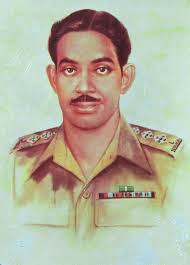
Sarwar, drawn posthumously in 1967 |
|
| Born | 10 November 1910 |
| Died | 27 July 1948 (aged 37) |
| Buried | |
| Allegiance |  British India (1929–1947) British India (1929–1947) Pakistan (1947–1948) Pakistan (1947–1948) |
| Branch/service |  British Indian Army British Indian Army Pakistan Army Pakistan Army |
| Years of service | 1929–1948 |
| Rank |  Captain Captain |
| Unit |  2/1st Punjab Regiment 2/1st Punjab Regiment2 Punjab Regiment |
| Battles / wars | |
| Awards |  Nishan-e-Haider Nishan-e-Haider Pakistan Medal Pakistan Medal 1939-1945 Star 1939-1945 Star Burma Star Burma Star War Medal 1939-1945 War Medal 1939-1945 |
| Memorials | G.T. Road near the Gujar Khan Tehsil, Tehile chowk sarwer shaheed Rawalpindi District, Punjab in Pakistan |
| Alma mater | Indian Military Academy Military College of Signals |
Captain Raja Muhammad Sarwar (Urdu: راجہ محمد سرور; 10 November 1910 – 27 July 1948) NH, better known as Muhammad Sarwar Bhatti,[2] was a Pakistani military officer who was cited as the first recipient of Pakistan’s highest military award, Nishan-e-Haider, for his gallantry and actions of valor during the First Indo-Pakistani War of 1947–48.[3][2]
Raja Muhammad Sarwar was born on 10 November 1910 to a Punjabi Muslim Bhatti family in a small village, Singhori, that was located in the vicinity of the Gujar Khan Tehsil, Rawalpindi District, Punjab, British India in British Indian Empire.[3][2][4] He was a military brat whose father, Raja Muhammad Hayat Khan, was an enlist in the British Indian Army, retiring at the rank of Havildar.[3][4]
He was educated in government-run schools in Rawalpindi District and secured his matriculation from a local school in Faisalabad in 1928.[4] After graduation, he followed his father, Havildar Muhammad Hyatt, path and enlisted in the British Indian Army in 1929 as a Sepoy, where he was posted with the 2nd Battalion of the 10th Baloch Regiment (2/10th Baloch Regiment) of the Baloch Regiment (present 7th Battalion The Baloch Regiment (Steadfast Battalion)).[3][4] From 1929 until 1939, he worked hard towards reaching one of the highest enlisted ranks and was eventually promoted to Naib Subedar and posted in supply and ammunition with the Pakistan Army Service Corps in 1939.[4]
In 1939, Sarwar was invited to attend the Indian Military Academy in Dehradun and completed his military training before gaining a commission in the 2nd Battalion of the 1st Punjab Regiment (2/1st Punjab Regiment) of the British Indian Army in 1943.[4] In 1944, 2nd-Lt. Sarwar briefly served in Burma with distinction during military operations there that earned him the Burma Star from the British administrations in Delhi in India.[5]
In 1944, 2nd-Lt. Sarwar was posted to an administrative position in the Punjab Regiment[2] — he was promoted to Lieutenant in 1945–46.[4] In the British Indian Army personnel accounts, Sarwar was known to be “a serious man with no nonsense and deeply religious who would practice his religion, Islam, devotedly and offered five prayers everyday … “[4]
Indo-Pakistani war of 1947-1948
[edit]
In 1946–47, Lt. Sarwar was promoted to army captain and decided to attend the signal course before he was recommissioned in the Pakistan Army Corps of Signals in 1947, and directed towards attending the Military College of Signals.[4] After hearing the news of the First Kashmir War between India and Pakistan over Jammu and Kashmir, Sarwar immediately wanted to volunteer. He refrained due to his officers wanting him to complete his studies in military signals, which he completed after a year.[4] In 1948, Captain Sarwar took command of the 2nd Battalion of the Punjab Regiment of the Pakistan Army and was deployed on the frontline.[2]
A march towards Uri town of Jammu and Kashmir was commenced under Sarwar,[2] and he led an attack on the organized Indian Army’s troops, forcing them to retreat from Gilgit-Baltistan to Ladakh on 26 July 1948.[5] Sarwar’s company followed the Indian Army’s troops to the Uri region where his unit faced off the strongly fortified enemy position located in that sector.[5] His company was only 50 yards away from the fortified enemy position as the Indian Army’s soldiers begin mortar shelling his positions, and received instructions on leading the attack on the left side of the bunker where the shelling was taking place.: 88 [6] Moving towards the new position, his passage was blocked due to barbed wire and he decided to advance to cut the wire, taking six men with him.[2]: 88 [6] During the firefight, Sarwar used a bolt cutter to cut the wire, and took a bullet from machine gun fire.: 89 [6][2]
On 27 July 1948, Captain Sarwar was killed while clearing the passage. He was 37 years old at the time.[3]: 188 [7]
Family background and personal life
[edit]
Muhammad Sarwar’s father, Raja Muhammad Hayat Khan, had served in the British Indian Army and was decorated with the British war medal for his services in World War I. Muhammad Hayat retired as a Havildar Sergeant and died on 23 November 1932.[5] Muhammad Sarwar had three brothers and one sister.[8] . He is the 4th one among his brothers , his brothers name was Raja Muhammad Mirza Khan, Raja Muhammad Sardar Khan, Raja Muhammad Afsar Khan and his sister name was Mohtarma Gulzar Begum. His marriage was performed on Sunday 15 March, 1936 in Sanghori, with Ms. Karam Jan. Allah blessed him with a son and a daughter, whom he named Raja Muhammad Safdar and Gulzar Begum, respectively. Reference Link

The body of Sarwar is buried at the Hill of Tilpatra which is near the Uri in Indian Kashmir where he was buried on 27 July 1948.[4] It was on 23 March 1956 when the Government of Pakistan recognized his services as the Parliament of Pakistan authorized to posthumously award the Nishan-E-Haider (Eng. lit. Emblem of the Lion) for his meritorious services, which was awarded to him by the President of Pakistan.[3][9][8] The Presidential Nishan-e-Haider citation on his grave is written in Urdu; and it reads with translation as:
Battle of Pandu at Tripatra hill in Uri:
CITATIONCAPT RAJA MUHAMMAD SARWAR
2 PUNJAB REGIMENT
Battle of Tilpatra in Uri: When Quaid-e-Azam Muhammad Ali Jinnah declared Jihad in Kashmir and ordered Pakistan Army to participate in it. Captain Sarwar were participating in a course in GHQ’s School of Signals. His unit 2 Punjab Regiment entered Kashmir to face the enemy. As soon as the course ended he persisted to take permission to participate in Jihad of Kashmir, with his unit which was granted. He was appointed as the signals officer. He offered to fight the enemy at Tilpatra hill. On 27 July 1948, he took his men with him and attacked the enemy. The enemy opened fire with machine guns, artillery and mortars. He kept on advancing. His machine gunner got killed. He took hold of his gun and attacked. When a second gunner arrived he handed over the machine gun to him. He, along with some soldiers, advanced from another side and destroyed a machine gun of the enemy and advanced There was barbed wire, which he cut himself and let the soldiers pass through it and led the assault on the enemy. During this time, a burst from the automatic machine gun of the enemy injured him. His actions in the battle of Tipatra led him to be posthumously presented with the Nishan-e-Haider.[10]
In 1967, the Government of Pakistan established a marble tomb in his memory to offer remembrance of his military career highlights and martyrdom to Pakistani society. Additional funding was secured in 1990 by Imtiaz Warraich, the MP to expand the facility in Sarwars’ memory.[11][12]
On 22 April 1968, a paintings exhibition was inaugurated in Lahore, Pakistan depicting Pakistani war heroes including the first sketched portrait of Muhammad Sarwar.[13]
Tomb and memorial of Capt. Muhammad Sarwar
Awards and decorations
[edit]
Foreign decorations
[edit]
- ^ Singh, Brig Jasbir (2010). Combat Diary: An illustrated history of operations conducted by 4th Battalion, The Kumaon Regiment 1788 to 1974. Lancer Publishers. p. 188. ISBN 978-1-935501-18-3.
- ^ a b c d e f g h i “CAPTAIN MUHAMMAD SARWAR (SHAHEED) – Profile”. Pakistan Army Museum website. Archived from the original on 14 October 2018. Retrieved 9 November 2025.
- ^ a b c d e f “Captain Sarwar Shaheed, Pakistan’s first ever Nishan-e-Haider award recipient remembered”. Pakistan Today newspaper. 27 July 2016. Archived from the original on 10 July 2018. Retrieved 9 November 2025.
- ^ a b c d e f g h i j k “Tombstone of Muhammad Sarwar”. Retrieved 7 March 2019.
- ^ a b c d “Shahadat Anniversary Captain Raja Muhammad Sarwar Shaheed, Nishan-e-Haider”. Shaheed Foundation website. 27 July 2018. Archived from the original on 3 September 2018. Retrieved 9 November 2025.
- ^ a b c Mirza, Yaqub (1947). The golden jubilee celebrations of the Islamic Republic of Pakistan (snippet view). Karachi, Sin. Pakistan: National Book Foundation. p. 115. ISBN 9789693701784.
- ^ Singh, Brig Jasbir (2010). Combat Diary: An illustrated history of operations conducted by 4th Battalion, The Kumaon Regiment 1788 to 1974. Lancer Publishers. p. 291. ISBN 9781935501183.
- ^ a b Captain Sarwar Shaheed remembered The News International (newspaper), Published 11 December 2017, Retrieved 4 November 2018
- ^ “Profile of Raja Muhammad Sarwar”. shaheedfoundation.org website. Archived from the original on 12 August 2014. Retrieved 9 November 2025.
- ^ Amir, Tariq (12 January 2017). “Pakistan Geotagging: Monument of Captain Raja Muhammad Sarwar Shaheed: Nishan e Haider”. Pakistan Geotagging. Retrieved 9 March 2019.
- ^ “Capt Sarwar Shaheed, Pakistan’s first ever Nishan-e-Haider recipient remembered”. The Nation newspaper. 27 July 2016. Retrieved 9 November 2025.
- ^ “Captain Sarwar Shaheed In Urdu”. www.urdubiography.com. Retrieved 9 March 2019.
- ^ “From the past pages of Dawn newspaper: Fifty years ago: War paintings show (Show was held on 22 April 1968)”. Dawn newspaper. 24 April 2018. Archived from the original on 25 April 2018. Retrieved 9 November 2025.

