
expand
| ← Previous revision | Revision as of 21:37, 11 November 2025 | ||
| Line 38: | Line 38: | ||
|
[[File:Two Views of the Gas in the Southern Ring Nebula (NIRCam and MIRI Composite Images) (southernring1).jpeg|thumb|right|300px|Two images of NGC 3132 in near- and mid-infrared light.<ref>{{cite news |url=https://esawebb.org/images/southernring1/|title=Two Views of the Gas in the Southern Ring Nebula (NIRCam and MIRI Composite Images) |date=October 18, 2023}}</ref> ]]
|
[[File:Two Views of the Gas in the Southern Ring Nebula (NIRCam and MIRI Composite Images) (southernring1).jpeg|thumb|right|300px|Two images of NGC 3132 in near- and mid-infrared light.<ref>{{cite news |url=https://esawebb.org/images/southernring1/|title=Two Views of the Gas in the Southern Ring Nebula (NIRCam and MIRI Composite Images) |date=October 18, 2023}}</ref> ]]
|
||
|
From the Earth, NGC 3132 appears to have a strongly elliptical shape. Three-dimensional modeling of the nebula has found that NGC 3132 is a [[bipolar nebula]], with its major axis inclined about twenty degrees from the line of sight. The central low-density cavity is surrounded by multiple ring-like structures.<ref name=Monteiro>{{cite journal|last1=Monteiro |first1=H. |last2=Mendes De Oliveira |first2=C. |last3=Amram |first3=P. |last4=Stanghellini |first4=L. |last5=Wesson |first5=R. |last6=Bouvis |first6=K. |last7=Akras |first7=S. |last8=Matsuura |first8=M. |last9=Quint |first9=B. C. |title=The planetary nebula NGC 3132 revisited: High definition 3D photoionization model |journal=Monthly Notices of the Royal Astronomical Society |date=2025 |volume=539 |issue=2 |pages=1756–1774 |doi=10.1093/mnras/staf488 |doi-access=free }}</ref>
|
|||
|
==Planetary nebula nucleus (PNN)==
|
==Planetary nebula nucleus (PNN)==
|
||
|
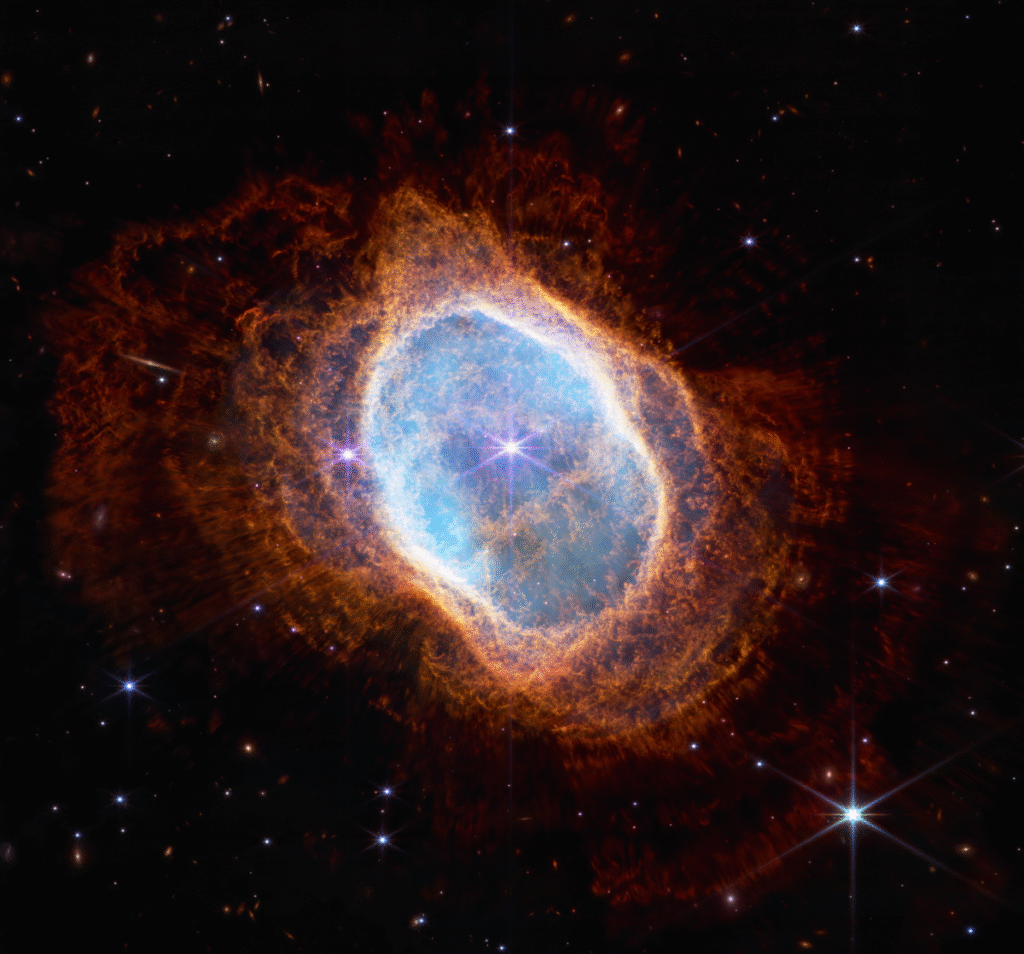
[[File:NASA’s Webb Captures Dying Star’s Final ‘Performance’ in Fine Detail – Flickr – James Webb Space Telescope.png |thumb |James Webb image revealing the two stars inside the nebula (orange-white and blueish-white, center)]]
|
[[File:NASA’s Webb Captures Dying Star’s Final ‘Performance’ in Fine Detail – Flickr – James Webb Space Telescope.png |thumb |James Webb image revealing the two stars inside the nebula (orange-white and blueish-white, center)]]
|
||
|
Images of NGC 3132 reveal two stars close together within the nebulosity, one of 10th [[Apparent magnitude|magnitude]], the other 16th, located about 1.7{{pprime}} away from the central star. The central star of the planetary nebula is a [[white dwarf]], and is the fainter of the two stars. This hot central star of about
|
Images of NGC 3132 reveal two stars close together within the nebulosity, one of 10th [[Apparent magnitude|magnitude]], the other 16th, located about 1.7{{pprime}} away from the central star. The central star of the planetary nebula is a [[white dwarf]], and is the fainter of the two stars. This hot central star of about ,000 [[kelvin|K]] has now blown off its outer layers and is making the nebula fluoresce brightly from the emission of its intense [[ultraviolet]] [[radiation]].<ref>{{cite journal |bibcode=2020A&A…634A..47M |title=The MUSE view of the planetary nebula NGC 3132 |last1=Monreal-Ibero |first1=Ana |last2=Walsh |first2=Jeremy R. |journal=Astronomy and Astrophysics |year=2020 |volume=634 |pages=A47 |doi=10.1051/0004-6361/201936845 |arxiv=1912.02847 |s2cid=208857629 }}</ref> The 10th magnitude star, HD 87892, is an [[A-type main-sequence star]] of type A2V, and is separated from the white dwarf by at least 1277 [[astronomical unit|au]].<ref name=Sahai>{{cite journal|doi=10.3847/1538-4357/aca7ba|title=The Binary and the Disk: The Beauty is Found within NGC3132 with JWST |year=2023 |last1=Sahai |first1=Raghvendra |last2=Bujarrabal |first2=Valentin |last3=Quintana-Lacaci |first3=Guillermo |last4=Reindl |first4=Nicole |last5=Van De Steene |first5=Griet |last6=Contreras |first6=Carmen Sánchez |last7=Ressler |first7=Michael E. |journal=The Astrophysical Journal |volume=943 |issue=2 |page=110 |arxiv=2211.16741 |bibcode=2023ApJ…943..110S |s2cid=254096318 |doi-access=free }}</ref> The A-type star orbits at roughly the same distance as the edge of a dust cloud surrounding the central white dwarf.<ref name=Sahai/> The system is likely a quadruple [[star system]].<ref name=DeMarco/>
|
||
|
The progenitor star of the planetary nebula had a mass of about 2.7 times that of the Sun.<ref name=Monteiro/>
|
|||
|
The progenitor star of the planetary nebula had a mass of about 2.86 times that of the Sun.<ref name=DeMarco>{{cite journal|doi=10.1038/s41550-022-01845-2 |title=The messy death of a multiple star system and the resulting planetary nebula as observed by JWST |date=2022 |last1=De Marco |first1=Orsola |last2=Akashi |first2=Muhammad |last3=Akras |first3=Stavros |last4=Alcolea |first4=Javier |last5=Aleman |first5=Isabel |last6=Amram |first6=Philippe |last7=Balick |first7=Bruce |last8=De Beck |first8=Elvire |last9=Blackman |first9=Eric G. |last10=Boffin |first10=Henri M. J. |last11=Boumis |first11=Panos |last12=Bublitz |first12=Jesse |last13=Bucciarelli |first13=Beatrice |last14=Bujarrabal |first14=Valentin |last15=Cami |first15=Jan |last16=Chornay |first16=Nicholas |last17=Chu |first17=You-Hua |last18=Corradi |first18=Romano L. M. |last19=Frank |first19=Adam |last20=García-Hernández |first20=D. A. |last21=García-Rojas |first21=Jorge |last22=García-Segura |first22=Guillermo |last23=Gómez-Llanos |first23=Veronica |last24=Gonçalves |first24=Denise R. |last25=Guerrero |first25=Martín A. |last26=Jones |first26=David |last27=Karakas |first27=Amanda I. |last28=Kastner |first28=Joel H. |last29=Kwok |first29=Sun |last30=Lykou |first30=Foteini |journal=Nature Astronomy |volume=6 |issue=12 |pages=1421–1432 |arxiv=2301.02775 |bibcode=2022NatAs…6.1421D |display-authors=1 }}</ref>
|
|||
|
==See also==
|
==See also==
|
||

