
==Description==
==Description==
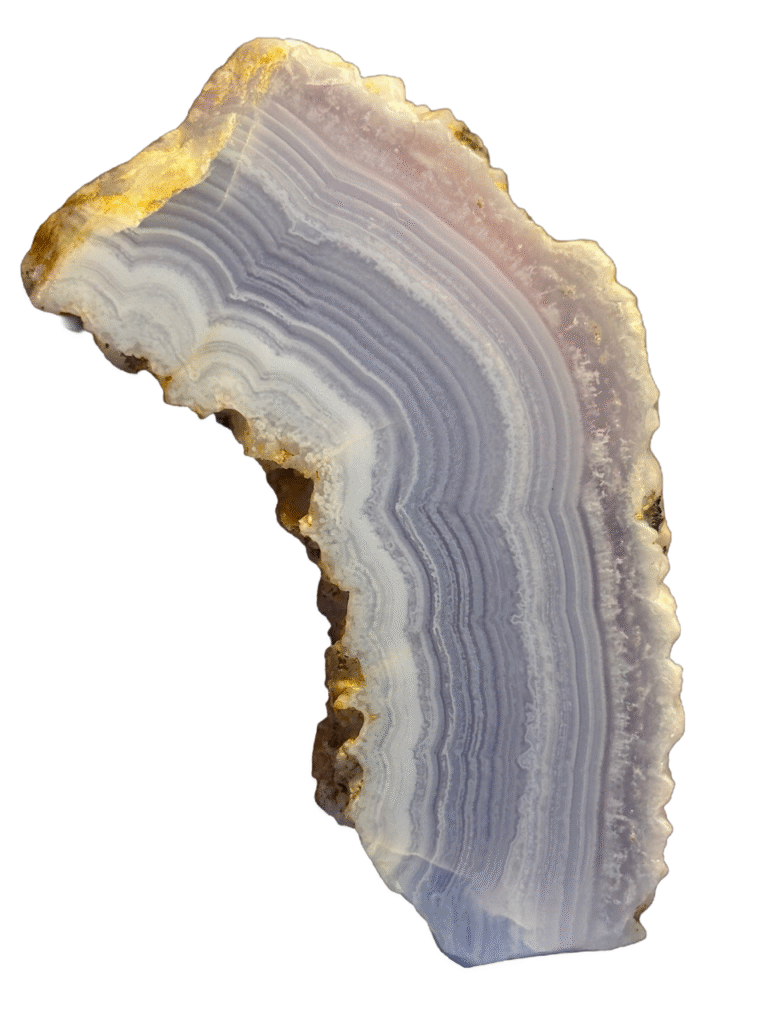
Blue lace agate is a variety of agate with pale blue banding.<ref name=”blue lace agate”>{{cite web |title=Blue Lace Agate |url=https://www.mindat.org/min-699.html |website=mindat.org |publisher=Hudson Institute of Mineralogy |access-date=12 November 2025}}</ref><ref name=”pabian”>{{Cite book |last1=Pabian |first1=Roger |title=Agates: Treasures of the Earth |last2=Jackson |first2=Brian |last3=Tandy |first3=Peter |last4=Cromartie |first4=John |date=2016 |publisher=Firefly Books |isbn=978-1-77085-644-8 |pages=134-135}}</ref><ref name=”stonemania” /> It has a distinctive lace-like pattern that consists primarily of blue, spherulitic [[chalcedony]] bands layered with bands of white, [[Granular material|granular]] [[quartz]].<ref name=”JAES” /> Unlike most agates,<ref name=”agate mindat” /> the majority of the chalcedony in blue lace agate is the length-slow variety, quartzine; this suggests that it formed in fluids with a high [[salinity]], likely from the underlying marine [[shale]]. Also present are bands and tiny clusters of angular, [[rhombohedral]] quartz crystals with thin chalcedony overgrowths, some of which are larger and have [[Euhedral and anhedral|well-formed faces]].<ref name=”JAES”>{{cite journal |last1=Welman-Purchase |first1=Megan |last2=Wicht |first2=Joanna |last3=Miller |first3=Duncan |last4=Roelofse |first4=Frederick |title=Blue lace agate and chalcedony pseudomorphs from Ysterputs in southern Namibia |journal=Journal of African Earth Sciences |date=19 January 2024 |volume=212 |doi=10.1016/j.jafrearsci.2024.105211 |url=https://www.sciencedirect.com/science/article/pii/S1464343X2400044X#fig6 |doi-access=free |access-date=12 November 2025}}</ref>
Blue lace agate is a variety of agate with pale blue banding.<ref name=”blue lace agate”>{{cite web |title=Blue Lace Agate |url=https://www.mindat.org/min-699.html |website=mindat.org |publisher=Hudson Institute of Mineralogy |access-date=12 November 2025}}</ref><ref name=”pabian”>{{Cite book |last1=Pabian |first1=Roger |title=Agates: Treasures of the Earth |last2=Jackson |first2=Brian |last3=Tandy |first3=Peter |last4=Cromartie |first4=John |date=2016 |publisher=Firefly Books |isbn=978-1-77085-644-8 |pages=134-135}}</ref><ref name=”stonemania” /> It has a distinctive lace-like pattern that consists primarily of blue, spherulitic [[chalcedony]] bands layered with bands of white, [[Granular material|granular]] [[quartz]].<ref name=”JAES” /> Unlike most agates,<ref name=”agate mindat” /> the majority of the chalcedony in blue lace agate is the length-slow variety, quartzine; this suggests that it formed in fluids with a high [[salinity]], likely from the underlying marine [[shale]]. Also present are bands and tiny clusters of angular, [[rhombohedral]] quartz crystals with thin chalcedony overgrowths, some of which are larger and have [[Euhedral and anhedral|well-formed faces]].<ref name=”JAES”>{{cite journal |last1=Welman-Purchase |first1=Megan |last2=Wicht |first2=Joanna |last3=Miller |first3=Duncan |last4=Roelofse |first4=Frederick |title=Blue lace agate and chalcedony pseudomorphs from Ysterputs in southern Namibia |journal=Journal of African Earth Sciences |date=19 January 2024 |volume=212 |doi=10.1016/j.jafrearsci.2024.105211 |url=https://www.sciencedirect.com/science/article/pii/S1464343X2400044X#fig6 |doi-access=free |access-date=12 November 2025}}</ref>
==Uses==
==Uses==
Blue lace agate has been widely marketed as a [[lapidary]] material for [[jewelry]] and other aesthetic purposes. Particularly interesting specimens, such as those with crystal coatings or cubic chalcedony, are also sought after by [[mineral collecting|mineral collectors]].<ref name=”Mineral Chatter” />
Blue lace agate has been widely marketed as a [[lapidary]] material for [[jewelry]] and other aesthetic purposes. Particularly interesting specimens, such as those with crystal coatings or cubic chalcedony, are also sought after by [[mineral collecting|mineral collectors]].<ref name=”Mineral Chatter” />
==References==
==References==
Variety of agate with blue and white banding
Blue lace agate is an agate variety with pale blue and white, lace-patterned banding. Until 2017, its primary source was a single, now-defunct mine in Namibia, although similar material has been found elsewhere. Blue lace agate is a vein agate that formed within dolerite of Jurassic age. It is used in lapidary as a semiprecious gemstone.
Origin
The primary source of blue lace agate for several decades was the privately-owned Ysterputs Mine (also spelled Ysterputz)[4] on Ysterputs Farm 254, Karasburg West, ǁKaras Region, Namibia.[3][5] The mine was owned by the late George Swanson[4] and was in operation from 1962 until January 2017; its future is currently uncertain.[6] Most of the mineralogical data on blue lace agate originates from recent analysis of material from Ysterputs.[6][4]
The geological formations at Ysterputs are not unique to this one location; it is possible that there are other occurrences of blue lace agate in Namibia or neighboring South Africa that remain unexploited.[4] Other localities have also produced a blue lace agate very similar to that found at Ysterputs, including the Lapurr Range in Turkana County, Kenya.[3] Blue lace agate or other blue-colored chalcedony has also been found in Georgia,[7] Malawi, Zambia, Turkey, and at other localities in Namibia.[8]
Description
Blue lace agate is a variety of agate with pale blue banding.[3][9][5] It has a distinctive lace-like pattern that consists primarily of blue, spherulitic chalcedony bands layered with bands of white, granular quartz.[6] Unlike most agates,[1] the majority of the chalcedony in blue lace agate is the length-slow variety, quartzine; this suggests that it formed in fluids with a high salinity, likely from the underlying marine shale. Also present are bands and tiny clusters of angular, rhombohedral quartz crystals with thin chalcedony overgrowths, some of which are larger and have well-formed faces.[6]
In specimens that span the whole width of the vein, the banding tends to be symmetrical on both sides, often surrounding a central area of massive (unbanded) chalcedony or a central vug.[4] The vugs are often lined with clear or blue druzy quartz crystals.[6] Crystals of calcite, gypsum, siderite, or ankerite may also occur in the vugs or on the outer surfaces of the agate.[6][4]
Rare cubic crystals of blue chalcedony up to 9 millimetres (0.35 in) in size have also been found in vugs and on plates at a single location in the Ysterputs Mine.[6][4] While previously thought to be pseudomorphs after fluorite, they are likely pseudomorphs after melanophlogite.[6]
The color of blue lace agate is believed to be due to Rayleigh scattering of light by tiny cavities, inclusions, or sub-microscopic particles of amorphous silica within the agate.[4] In some specimens from Ysterputs, a fraction of the chalcedony bands appear fluorescent green under short-wave ultraviolet light due to trace amounts of uranyl ions.[6]
Geology
At Ysterputs, blue lace agate formed in hydrothermal veins running through the Tandjiesberg sill, an igneous intrusion of dolerite dating to the Jurassic period (roughly 183 million years ago).[6] The sill intruded the Whitehill Formation shale of the Ecca Group,[6][4] part of the Karoo Series of marine sedimentary rocks dating to the Permian period. The dolerite sill caused low-grade regional metamorphism of the surrounding shale and partial melting at its base. This created a hydrothermal system that carried saline water and volatiles from the underlying Karoo rocks into fractures in the dolerite, forming the agate veins.[6][4] The veins are typically 20–30 millimetres (0.79–1.18 in) thick and rarely more than 60 millimetres (2.4 in) thick.[6]
Associated minerals include dolomite, which often occurs as a layer of yellow-green crystals surrounding the agate, in addition to crystals of calcite, quartz, ankerite, gypsum, and siderite.[6][4] Coating cavities in the veins is a smectite clay originating from weathered dolerite that has been described as nontronite, although this could not be confirmed analytically.[6]
Uses

Blue lace agate has been widely marketed as a lapidary material for jewelry and other aesthetic purposes. Particularly interesting specimens, such as those with crystal coatings or cubic chalcedony, are also sought after by mineral collectors.[4][6]
References
- ^ a b “Agate”. mindat.org. Hudson Institute of Mineralogy. Retrieved 11 October 2025.
- ^ “Agate”. gemdat.org. Retrieved 11 October 2025.
- ^ a b c d “Blue Lace Agate”. mindat.org. Hudson Institute of Mineralogy. Retrieved 12 November 2025.
- ^ a b c d e f g h i j k l Wicht, Jo; Miller, Duncan (June 2020). “Blue Lace Agate from Ysterputs, Southern Namibia”. Mineral Chatter. Cape Town Gem & Mineral Club. Retrieved 12 November 2025.
- ^ a b “What is Blue Lace Agate?”. stonemania.co.uk. Retrieved 13 November 2025.
- ^ a b c d e f g h i j k l m n o p Welman-Purchase, Megan; Wicht, Joanna; Miller, Duncan; Roelofse, Frederick (19 January 2024). “Blue lace agate and chalcedony pseudomorphs from Ysterputs in southern Namibia”. Journal of African Earth Sciences. 212. doi:10.1016/j.jafrearsci.2024.105211. Retrieved 12 November 2025.
- ^ “Agate (Var: Blue Lace Agate) (1308257)”. mindat.org. Hudson Institute of Mineralogy. Retrieved 12 November 2025.
- ^ “Agate (Var: Blue Lace Agate) (941578)”. mindat.org. Hudson Institute of Mineralogy. Retrieved 12 November 2025.
- ^ Pabian, Roger; Jackson, Brian; Tandy, Peter; Cromartie, John (2016). Agates: Treasures of the Earth. Firefly Books. pp. 134–135. ISBN 978-1-77085-644-8.

