
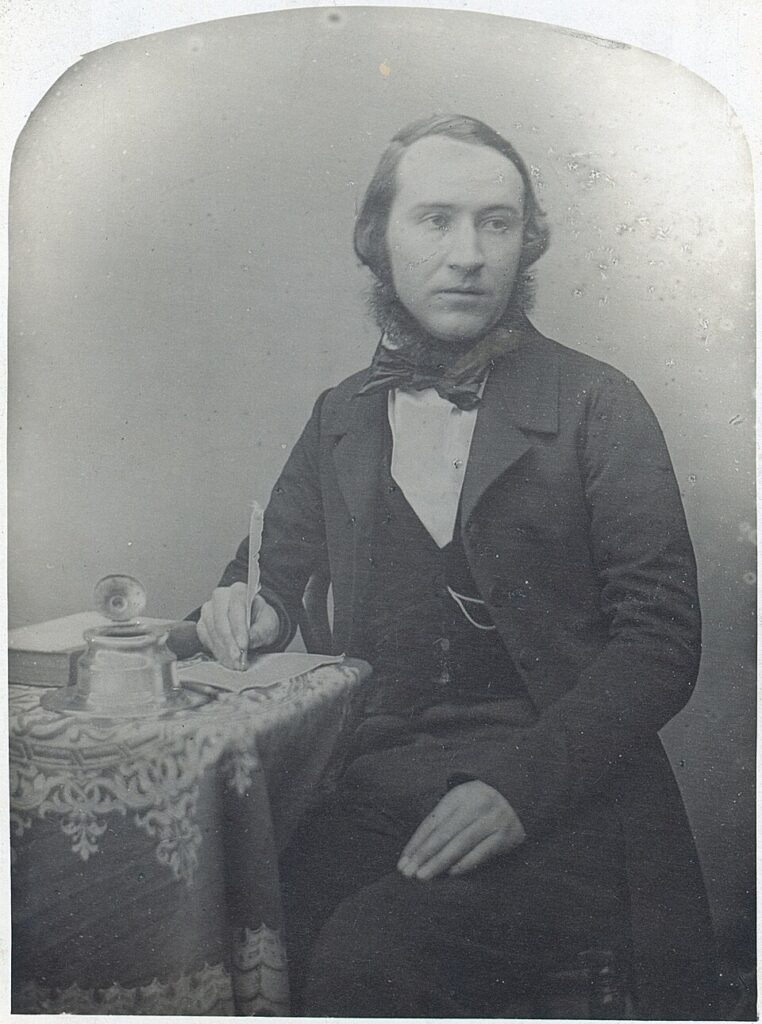
Welsh printer, writer, and Mormon missionary (1882–1882)
John Silvanus Davis (English: sɪlvɔnʌs) (Welsh: Davies), June 7, 1822 – June 11, 1882) was a Welsh printer, writer, and early defender of The Church of Jesus Christ of Latter-day Saints in South Wales during the mid-1800s.[1] He translated the Book of Mormon, Pearl of Great Price and Doctrine and Covenants into Welsh.[2]
Davis was born during a period of rapid industrialization in South Wales during the mid-1800s.[3] At the beginning of the 1800s, most people in Wales were involved in farming. But, the country expanded rapidly, especially during the Napoleonic Wars.[4] The wars required raw materials from mining towns like Merthyr Tydfil and Aberdare in Wales.
This prosperity halted when the war ended. Demand for Welsh products like coal and wool fell. This drove many workers to the industrial towns. Merthyr Tydfil’s population had increased from 7,705 in 1801 to 46,378 in 1851. Up to 10,000 of these people were migrant workers. There were more people employed in industry than farming in Wales making it the first industrial nation.[5] The result was a permanent state of uncertainty in these towns.[6]
Davis was baptized into the Congregational Church. His father later started his own congregation which was not uncommon in the non-conformist chapels of Wales. Davis followed his father’s faith as a young man.[7]
Davis received a fair education and developed a talent for literature.[8]
He began writing poetry when he was thirteen, under the direction of his mother.[9] His writing appeared in various Welsh magazines. Davis continued to write poems, songs and hymns for the rest of his life, a practice his daughter Julia Elizabeth Davis also enjoyed.
Life in Wales 1845–1854
[edit]
Davis first became interested in the Latter-day Saints in 1845 at Llanybyther (Llanybydder). He heard about them from the Reverend John Jones, who was Captain Dan Jones’s brother.[10] Reverend Jones was printing Mormon tracts at the time. This made him deeply unpopular among his fellow printers.[11] Davis was working with him as editor, typesetter, and pressman and read the tracts carefully.[12] The result was his baptism. Davis was baptized on April 19, 1846 by Thomas Harris.[13][14] He was ordained a teacher and priest within the next two years.[15] He strongly defended Mormonism in periodicals, tracts, and poems. He engaged directly with both local and visiting preachers. He traveled throughout Wales and Dublin as a missionary for his newfound religion.[16]

In 1848, Davis was called as first counselor to William S. Phillips, president of the Welsh mission.[17][18] The two managed the printing office in Llannerdy. Davis printed several periodicals influential among the Welsh Saints, most notably Zion’s Trumpet. He edited Zion’s Trumpet from 1849 until his emigration in 1854.[19]
In addition to translating, he wrote edifying tracts explaining and defending Latter-day Saint beliefs. He edited a hymnbook with over 500 songs. It included many of his own hymns.[20] His dealings with the Latter-day Saints in the Welsh mission brought him into circles with early Mormon leaders such as F. D. Richards, Orson Pratt, Erastus Snow, and future prophet John Taylor.[21]
Translation of the Book of Mormon, Doctrine and Covenants, and Pearl of Great Price into Welsh
[edit]

The first branch of the Latter-day Saints in Wales was established near Overton, in Flintshire.[22] The Latter-day Saint missionaries had been preaching there for more than a decade without a Welsh translation of the Book of Mormon because many of the farming communities around Overton did not speak Welsh.[23]
In 1842, Elder Lorenzo Snow sent William Henshaw to Merthyr Tydfil in South Wales.[24] While there, Henshaw saw the need for proselytizing materials in Welsh. The Reverend John Jones was printing Mormon tracts at his printing press in Rhydybont, near Llanybydder, Carmathenshire. He was assisted by a 23-year-old Davis.[25]
By late 1848, Dan Jones wanted to make the standard works of the Latter-day Saints available to his countrymen who had already been baptized.[26] However, he emigrated to the Great Salt Lake Valley in 1848 before the translation could be started. Davis was selected to oversee all printing activities for the Church in Wales in his place.[27]
Davis’s exposure to proper grammar, exposition, logic, and printing served him well as editor of all church publications in Wales. He was one of the most highly educated converts in mid-19th-century Wales.[28] Much of his education came from setting type and reading proofs in both Welsh and English.
In August 1850, Orson Pratt counseled Davis to translate and publish the Doctrine and Covenants into Welsh.[29] Instead of translating it all at once, he released 16 pages of the scripture every other week in Zion’s Trumpet. Between February 22, 1851 and August 23, 1851, He had released all 20 parts of the Doctrine and Covenants.[30]
This distribution method worked well and Davis decided to do the same for the Book of Mormon. He started gathering subscriptions for the translation in July 1851. He encouraged his distributors and church leaders to be very aggressive in getting subscriptions. But by September 1851, the Saints had gathered only 1,500 subscribers. Davis started the translation anyway. He released the final section of the Book of Mormon 31 weeks later. It was called Llyfr Mormon[31] Davis translated the Book of Mormon for free.[32]
_introduction_in_English_by_John_Silvanus_Davis.jpg)
In his introduction to the Welsh edition of the Book of Mormon, Davis said the translation was the “best that could be done under disadvantages which the majority of translators do not labor under,” and that he sought “perspicuity and plain language” more than “any kind of adornment.” The disadvantages he talked about could have been the lack of printing experience among the Saints or the cramped conditions of the printing press, which was in his house on John’s Street in Georgetown, Merthyr Tydfil.[33]
John sent a copy of the Llyfr Mormon to the editor of the Baptist periodical Seren Gomer for review. The editor said it was “so perfect a translation” but that Davis had wasted valuable time on something as “worthless a work as the Book of Mormon.”[34] The parts were then published and sold all in under one year. The first copy, bound in Moroccan leather, was taken to Brigham Young in Utah by emigrating Welsh elders.[35]
Davis’s translation was the only Welsh version of the Book of Mormon until the year 2000. It is also the only translation in a Celtic language.
Marriage and children
[edit]
Davis married Elizabeth Phillips (1823 – 1906) on December 30, 1850, in Merthyr Tydfil, South Wales.[36] They met each other through their association with the Latter-day Saints in the Cwmbach branch of the Welsh Mission.[37] They had one daughter, Julia Elizabeth Davis (1851 – 1946).[38] She married Utah’s first democratic senator, Joseph Lafayette Rawlins.[39]


Emigration to the United States in 1854
[edit]
Davis and his family started preparations for their emigration to the Great Salt Lake Valley in Utah as early as November 1853. He closed his accounts and transferred management of the Welsh mission and printing presses to Captain Dan Jones.[40] Davis received first word that the emigrants were to sail for the United States on February 1.[41][42] With only two weeks’ notice, the Latter-day Saints hastily gathered in from the countryside with what they could. John and Elizabeth visited their parents one last time before joining the others at Liverpool.
The Davises boarded the ship Golconda[43][44] in the late evening of January 31, 1854. Four days later, the ship set sail with 477 people. The weather was rough for much of their journey across the Atlantic Ocean. However, it warmed when they reached the Bermuda Islands. The passengers entertained themselves with mock trials, dancing, band music, weddings, and daily religious meetings.[45] The Golconda reached the Port of New Orleans in the United States six weeks later. The company made their way by steamboat and wagon to St. Louis, Missouri. They remained there for three weeks gathering provisions for the trek westward across the Great Plains.
After leaving St. Louis, they passed by several Native Americans who were receiving gifts from the United States government.[46] The Native Americans were also trading with pioneers, emigrants, gold diggers, and other people heading West. Crossing the Great Plains in the 1850s was a dangerous undertaking. It often resulted in hunger, privation, and death. Both Davis and his wife Elizabeth fell ill to cholera along the way. The emigration company arrived in the Great Salt Lake Valley in July 1854.[47] The journey took seven months and three weeks.
Life in Salt Lake City 1854–1861
[edit]
When Davis reached Salt Lake City, he started teaching English to the Welsh Saints. He taught various subjects throughout his life on topics ranging from writing to astronomy, both of which he knew well.[48]
Davis first met Brigham Young in December 1854. Young advised Davis to go into farming until he found out he was a printer. He instead directed him to pursue his trade at the Deseret News.[49]
On July 23, 1856, Brigham Young invited several prominent Latter-day Saints to join him at the mouth of Big Cottonwood Canyon for a Pioneer Day celebration. Davis and Elizabeth were among them. The next day, they received word of General Albert S. Johnston’s army approaching the Great Salt Lake Valley during the Utah War.[50] The Latter-day Saints had been driven from the eastern United States and were determined to stand their ground in Utah. Brigham Young ordered the Saints to bury the foundation of the Salt Lake Temple to protect it from destruction. Then, the Davises, along with the Deseret News staff and the presses, moved to Fillmore, Utah until the end of the Utah War.[51][52] They returned to Salt Lake City in September 1858.
Career as a printer
[edit]
In the late eighteenth and nineteenth centuries, political and social changes led to a renewed interest in religion. Different Christian sects started printing tracts, books, and hymnals teaching their beliefs. The Church of Jesus Christ of Latter Day Saints (the Mormons) were no exception. Although the different religions were cooperative in the beginning of the nineteenth century, by mid-century the printers started showing more interest in printing for their own denominations.[53] Many printers at the time “placed messianic faith in the power of the press.” It wasn’t just a tool to print text. It was a divine gift, provided to “turn the unfaithful multitudes toward Christ.” Joseph Smith also understood the importance of the press as a tool to preach the Gospel. The night before he was killed, Smith told Dan Jones, “you shall have $1100, and the start for Wales, not with your fingers in your mouth but prepared to buy a press and do business aright.”[54]

Davis played a large role in the production of these religious texts. Nineteenth-century printers were also authors and editors and had considerable control over the quality of the content coming off the presses. A printer’s apprentice was required “to be well versed in all the peculiarities of the English language.”[55] For Davis, this meant he was the silent editor and occasional author of Reverend Jones’s work. In 1848, Davis left John Jones’s print shop and established his own in Merthyr Tydfil. As official printer for the Mormons, he eventually printed thousands of pages of religious material in both English and Welsh. When he emigrated to the Great Salt Lake Valley in 1854, he took his printing expertise with him and established presses, periodicals, and newspapers throughout the Western United States.[56]

In addition to his religious and personal writings, he also worked professionally with secular and religious printing establishments such as the Deseret News, Valley Tan, and The Mountaineer (later called the Daily Herald).[57] Davis became the foreman of the Daily Herald in August 1859.[58]
In December 1858, Davis was elected as public printer for the legislative assembly.[59]
In 1861, Davis was forced to give up printing due to ill health. He was unemployed for one year until he and his wife, Elizabeth, opened a small store in their two-story house with one hundred dollars she had saved without his knowledge.[60] The business flourished until 1870, when Brigham Young and other businessmen formed Zion’s Co-operative Mercantile Institution (ZCMI)[61][62]
Final years and death
[edit]
In his final years, Davis manufactured and sold a root beer called “Cronk Beer” popular among Mormons.[63][64][65]
Davis died on June 11, 1882 in Salt Lake City, Utah after a lingering illness.[66] He “was of a retiring disposition, gentle but impressive in manner, a deliberate thinker, and a vigorous writer.”[67]
- Book of Mormon (Welsh: Llyfr Mormon) (Welsh translation) on April 6, 1852
- Doctrine and Covenants (Welsh translation) in 1850
- The Pearl of Great Price (Welsh translation) on October 16, 1852
- Zion’s Trumpet (Welsh: Udgorn Seion), also called Star of the Saints
- “Treatises on Miracles”
- The Bee Hive Songster in 1868. A collection of popular Mormon folk songs.[68]
- A collection of hymns, songs and spiritual rhymes, for the service of Latter Day Saints, in Wales. (Welsh: Casgliad o hymnau, caniadau, ac odlau ysbrydol, at wasanaeth Saint Y Dyddiau Diweddaf, yn Nghymru). A Welsh hymnbook edited by Davis. It contained many of his own songs.[69]
- ^
“Vital Information”. The Welsh Saints Project. Brigham Young University. 2012. Retrieved November 5, 2024. - ^ Dennis, Ronald D. (2002). “Llyfr Mormon: The Translation of the Book of Mormon into Welsh”. Journal of Book of Mormon Studies. 11 (1): 45–49. Retrieved December 21, 2024.
- ^ Rawlins, Bert J. (August 12, 1980). “Economic, Religious, and Social Change in Industrial Wales”. FamilySearch. The Church of Jesus Christ of Latter-day Saints. p. 1. Retrieved November 8, 2024.
In nineteenth-century Wales, society was profoundly affected by a series of drastic changes.
- ^ Rawlins, Bert J. (1980). Change in industrial Wales. p. 3. “The growth of some industrial towns was phenomenal.”
- ^ “Wales – the first industrial nation of the World”. Casgliad y Werin Cymru (People’s Collection Wales). Retrieved January 7, 2025.
By 1850, there were more people employed in industry in Wales than in agriculture. This makes Wales the world’s first industrial nation. As a result the nation’s economy and society were transformed.
- ^ Rawlins, Bert J. (1980). Change in industrial Wales. p. 4. “The words permanent uncertainty should be underscored, since they describe in essence the nature of the ironworks communities.”
- ^ Whitney, Orson F. (1904). History of Utah: in Four Volumes. Vol. 4. George Q. Cannon & Sons Co. p. 352.
His father was a minister in the Congregational church
- ^ Whitney, Orson F. (1904). “He received a fair education”
- ^ Biography. “Davis, John Silvanus – Biography”. The Welsh Saints Project. Brigham Young University. p. 1. Retrieved November 5, 2024.
At about the same time he began writing poetry.
- ^ Dennis, Ronald D. (2017). A Steamboat for an Eldership – Dan Jones and the Beginnings of Mormonism in Wales (PDF). Provo, Utah: Rhydybont Press. p. 65.
The owner of the press was the Reverend John Jones, Dan’s oldest brother.
- ^ Rawlins, Jacob D. (2022). Publishing in Wales – Renaissance and Resistance. Cambridge University Press. p. 72. ISBN 978-1-108-94817-3.
Within months, the press had acquired the nickname “the Prostitute Press” for its tireless work in service of two very different religious masters.
- ^ Dennis, Ronald D. (2017). p. 82. “a young man by the name of John Davis, took a great interest in the content of Jones’s pamphlet”
- ^ Whitney, Orson F. (1904). p. 352. “He joined the Latter-day Saints on 19th of April, 1846”
- ^ Dennis, Ronald D. (2017). p. 118. “The elder is probably Elder Thomas Harris, the missionary who baptized John Davis”
- ^ Whitney, Orson F. (1904). p. 353. “In the Church Mr. Davis held the office of High Priest.”
- ^ Biography. p. 2. “he began to journey from Merthyr to North Wales and Dublin”
- ^ Dennis, Ronald D. (2017). p. 82. “John Davis was called to be a counselor in the mission presidency”
- ^ “William Samuel Phillips”. Church History Biographical Database. The Church of Jesus Christ of Latter-day Saints. Retrieved November 9, 2024.
- ^ Biography. p. 1. “he published the Udgorn Seion”
- ^ Dennis, Ronald D. (2017). p. 113. “In 1849 John Davis printed a second hymnal”
- ^ Biography p. 2. “John attended an LDS conference in London”
- ^ Dennis, Ronald D. (2017). p. 74. “to go to [Cloy], near Overton, in Flintshire”
- ^ Dennis, Ronald D. (2017). p. 74. “its inhabitants were not Welsh speaking”
- ^ Dennis, Ronald D. (2017). p. 61. “Lorenzo Snow issued a call to [William Henshaw] to take his young family to Merthyr Tydfil”
- ^ Dennis, Ronald D. (2002). p. 46. “Working at the press during the latter part of 1845 and the first part of 1846 was a 23-year-old employee by the name of John S. Davis”
- ^ Dennis, Ronald D. (2002). p. 46. “Jones undoubtedly wanted to make this standard work of his faith available to his fellow countrymen”
- ^ Dennis, Ronald D. (2017). p. 82. “with responsibilities for all the printing activities of the mission”
- ^ Dennis, Ronald D. (2002). p. 49. “John Davis was one of the most highly educated converts to the church”
- ^ Biography. p. 2. “he was directed by Orson Pratt … to translate the Book of Mormon and Doctrine and Covenants”
- ^ Dennis, Ronald D. (2002). p. 47. “The response to Davis’s idea was positive, for in 27 weeks the final signature was sent out.”
- ^ Dennis, Ronald D. (2002). p. 48. “31 weeks after the distribution of the initial signature, Davis sent out the final signature with his periodical”
- ^ Whitney, Orson F. (1904). p. 352. “The translation itself was free”
- ^ Dennis, Ronald D. (2002). p. 48. “Davis stated that the translation was ‘the best that could be done under disadvantages'”
- ^ Whitney, Orson F. (1904). p. 352. “with the remark that it was a pity”
- ^ Whitney, Orson F. (1904). p. 352. “The first published copy … dedicated to Brigham Young … was sent to Utah”
- ^ Whitney, Orson F. (1904). p. 352. “He married on December 30, 1850, Elizabeth Phillips.”
- ^ Rawlins, Bert J. (August 12, 1980). Genealogical Records as Family History Sources in Wales: A Case Study. The Church of Jesus Christ of Latter-day Saints. p. 3. Retrieved November 9, 2024.
through a visit to her branch at Cwmbach
- ^ Whitney, Orson F. (1904). p. 352. “the issue of this union was a daughter, their only child.”
- ^ Whitney, Orson F. (1904). p. 681. “[Rawlins] had been a married man since December 8, 1876, when he wedded Miss Julia E. Davis”
- ^ Biography. p. 2. “he transferred his printing office over to Daniel Jones”
- ^ Biography. p. 2. “the Saints would have to emigrate on the 31st day of January.”
- ^ Rawlins, Bert J. (1980). p. 4. “informed him that the ship would sail on 1 February”
- ^ Whitney, Orson F. (1904). p. 352. “they embarked at Liverpool on the ship ‘Golconda'”
- ^ Biography p. 3. “they went on board the ship ‘Golconda.'”
- ^ “Davis, Elizabeth (Phillips) – Biography”. The Welsh Saints Project. Brigham Young University. 1923. Retrieved November 10, 2024.
Many meetings were held on shipboard interspersed with mock trials by way of relaxation.
- ^ Biography. p. 4. “they passed a large camp of Indians, gathered there to receive gifts from the Government”
- ^ Biography p. 4., “The company arrived in Salt Lake City”
- ^ Biography. p. 4. “John delivered a lecture on astronomy”
- ^ Biography. p. 4. “[Brigham Young] counselled [Davis] to follow his trade of printing at the Deseret News”
- ^ Biography. p. 4. “when couriers brought news of the approach of [Johnston’s] Army”
- ^ Biography. p. 5. “The Deseret News printing press had been removed to Fillmore”
- ^ Whitney, Orson F. (1904). p. 352. “was for six months with the press at Fillmore”
- ^ Rawlins, Jacob D. (2022). Renaissance and Resistance. p. 69. “The waves of religious revival that rolled through … the United Kingdom … in the early 1800s were accompanied by mountains of printed materials … designed to attract potential converts.”
- ^ Dennis, Ronald D. (2002). p. 45 “he told Jones, ‘but prepared to buy a press, and do business aright.'”
- ^ Rawlins, Jacob D. (2022). p. 71. “Apprentices were required ‘to be well versed'”
- ^ Rawlins, Jacob D. (2022). p. 73. “He became part of a [group of] printers who established book presses, periodicals, and newspapers throughout the Western United States.”
- ^ Whitney, Orson F. (1904). p. 353. “He frequently contributed articles to the local press.”
- ^ Whitney, Orson F. (1904). p. 353. “He mastered [printing] so thoroughly that he became the foreman of a large establishment”
- ^ Biography p. 5. “he was elected Public Printer for the Legislative Assembly”
- ^ Elizabeth Phillips Biography. p. 8. “Unknown to her husband, Sister Davis, through her economy had saved one hundred dollars”
- ^ “Cooperative Movement”. The Church of Jesus Christ of Latter-day Saints. Retrieved November 9, 2024.
The School [of Prophets] devised a plan: the Saints could form exclusive cooperative agreements
- ^ Biography. p. 5. “The business flourished until 1870, when the Ward Co-Operative Stores were organized.”
- ^ Davis, John S. (1876). “Davis’ Cronk Beer”. Archive.org.
- ^ Elizabeth Phillips Biography. p. 2. “It was there that Brother Davis first made and sold in large quantities his “Cronk Beer,” a species of root beer.”
- ^ Whitney, Orson F. (1904). p. 353. “In the latter part of his life, he went out of the printing business, and engaged for a while in merchandising”
- ^ Biography. p. 5. “Six years later, 1882, Mr. Davis died, after a lingering illness”
- ^ Whitney, Orson F. (1904). p. 353. “was of a retiring disposition”
- ^ Davis, John S. (1868). “The bee-hive songster, being a selection of original songs”. Church History Catalog. The Church of Jesus Christ of Latter-day Saints. Retrieved May 31, 2025.
- ^ Davis, John S. (1852). “A collection of hymns, songs and spiritual rhymes, for the service of Latter Day Saints, in Wales”. Church History Catalog. The Church of Jesus Christ of Latter-day Saints. Retrieved May 31, 2025.

