
From Wikipedia, the free encyclopedia
Content deleted Content added
| Line 537: | Line 537: | ||
|
=== District 19 === |
=== District 19 === |
||
|
{{Election box begin no change|title=Connecticut’s 19th State Senate district election, 1982 |
|||
|
{{Empty section|date=July 2025}} |
|||
|
}} |
|||
|
{{Election box winning candidate with party link no change |
|||
|
|party = Democratic Party of Connecticut |
|||
|
|candidate = James J. Murphy Jr. (incumbent) |
|||
|
|votes = 17,150 |
|||
|
|percentage = 64.5% |
|||
|
}} |
|||
|
{{Election box candidate with party link no change |
|||
|
|party = Connecticut Republican Party |
|||
|
|candidate = Peter J. Reenstra |
|||
|
|votes = 9,461 |
|||
|
|percentage = 35.5% |
|||
|
}} |
|||
|
{{Election box total no change |
|||
|
|votes = 26,611 |
|||
|
|percentage = 100.0% |
|||
|
}} |
|||
|
{{Election box hold with party link no change |
|||
|
|winner = Democratic Party of Connecticut |
|||
|
|loser = |
|||
|
}} |
|||
|
{{Election box end}} |
|||
|
=== District 20 === |
=== District 20 === |
||
Revision as of 05:10, 14 November 2025
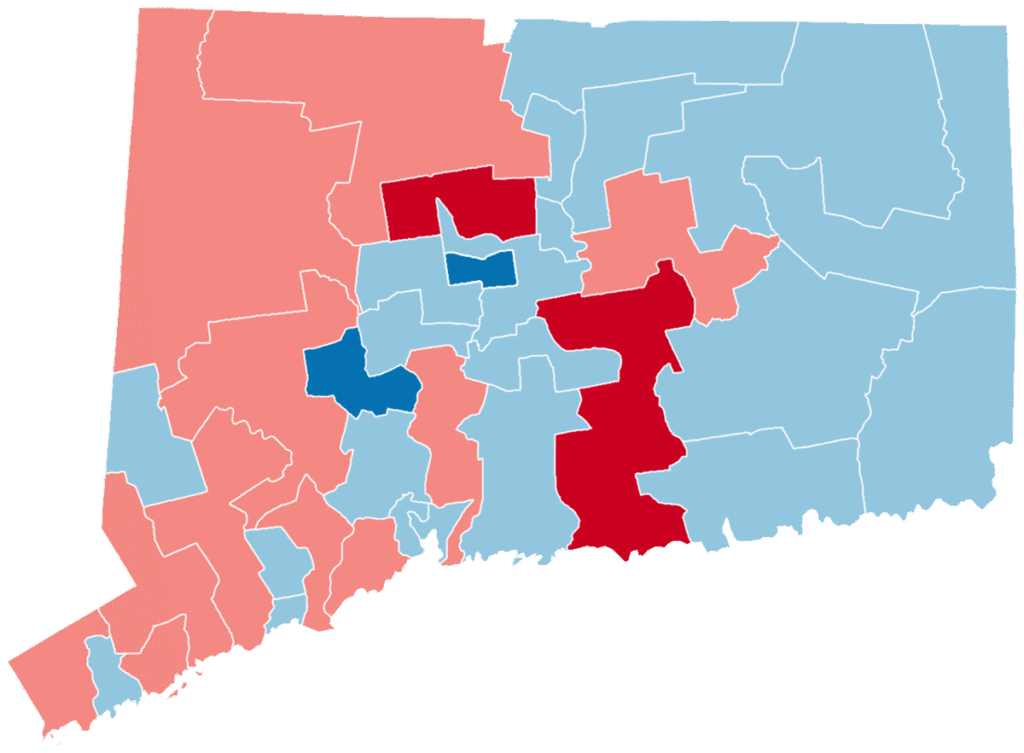
1982 Connecticut State Senate election
|
Results: |
|
|
|

The 1982 Connecticut State Senate elections took place as a part of the biennial 1982 United States elections. All 36 seats were up for re-election. Senators serve two year terms and are up for re-election every election cycle.
While both parties gained and lost seats, neither had a net-change, leading to the Democrats maintaining their 23-13 majority over the Republicans.[1]
Immediately following the elections, Republican Senate minority leader George Gunther was ousted and replaced with Philip S. Robertson.
Retirements
Eight incumbents did not seek re-election.
Democrats
- District 5: Clifton A. Leonhardt retired to run for Connecticut’s 6th congressional district. (Later withdrew).[2]
- District 9: Bill Curry retired to unsuccessfully run for Connecticut’s 6th congressional district against Nancy Johnson.
- District 11: Anthony M. Ciarlone retired.
Republican
- District 6: Nancy Johnson retired to successfully run for Connecticut’s 6th congressional district against Bill Curry.
- District 8: Russell L. Post Jr. retired to run for governor. (Later withdrew).[3]
- District 15: Gerald Labriola retired to unsuccessfully run for lieutenant governor of Connecticut.
- District 25: Alfred Santaniello Jr. retired.
- District 28: Myron R. Ballen retired.
Special elections
On December 31, 1980, Connecticut Governor Ella Grasso was forced to resign due to health issues after she was diagnosed with cancer. Her lieutenant, William A. O’Neill succeeded her as governor. According to Connecticut law, the President pro tempore of the Senate, at the time of which was Joseph J. Fauliso, would automatically assume the office of lieutenant governor once vacant. This left his seat, the 1st district, vacant, creating a special election.
On February 17, 1981, freshman Democratic state-representative William A. DiBella beat Republican Donald B. LaCroix, 76.8% to 23.2%, holding the seat Democratic.[4]
Incumbents defeated
In primary election
Democrats
- District 3: Marcella Fahey lost re-election to John B. Larson.
In general election
Democrats
- District 33: Frederick R. Knous lost re-election to Kenneth T. Hampton.[5]
Results
District 1
District 2
District 3
District 4
District 5
District 6
District 7
District 8
District 9
District 10
District 11
District 12
District 13
District 14
District 15
District 16
District 17
District 18
District 19
District 20
![[icon]](https://en.wikipedia.org/wiki/File:Wiki_letter_w_cropped.svg) |
This section is empty. You can help by adding to it. (July 2025)
|
District 21
|
This section is empty. You can help by adding to it. (July 2025)
|
District 22
|
This section is empty. You can help by adding to it. (July 2025)
|
District 23
|
This section is empty. You can help by adding to it. (July 2025)
|
District 24
|
This section is empty. You can help by adding to it. (July 2025)
|
District 25
|
This section is empty. You can help by adding to it. (July 2025)
|
District 26
District 27
|
This section is empty. You can help by adding to it. (July 2025)
|
District 28
|
This section is empty. You can help by adding to it. (July 2025)
|
District 29
|
This section is empty. You can help by adding to it. (July 2025)
|
District 30
|
This section is empty. You can help by adding to it. (July 2025)
|
District 31
|
This section is empty. You can help by adding to it. (July 2025)
|
District 32
|
This section is empty. You can help by adding to it. (July 2025)
|
District 33
|
This section is empty. You can help by adding to it. (July 2025)
|
District 34
|
This section is empty. You can help by adding to it. (July 2025)
|
District 35
|
This section is empty. You can help by adding to it. (July 2025)
|
District 36
References

