
From Wikipedia, the free encyclopedia
Content deleted Content added
|
|
|||
| Line 17: | Line 17: | ||
|
| synonyms_ref =<ref name=RDB>{{EMBL species|genus=Abronia|species=matudai}}. The Reptile Database. www.reptile-database.org.</ref> |
| synonyms_ref =<ref name=RDB>{{EMBL species|genus=Abronia|species=matudai}}. The Reptile Database. www.reptile-database.org.</ref> |
||
|
}} |
}} |
||
|
””’Abronia matudai””’, also known [[Common name|commonly]] as ”’Matuda’s arboreal alligator lizard”’ and ””’escorpión arborícola de Matuda””’ in New World Spanish, is a [[species]] of [[endangered]] [[arboreal alligator lizard]] in the [[Family (biology)|family]] [[Anguidae]]. The species, which was originally described in 1946 by [[Norman Edouard Hartweg|Norman Hartweg]] and [[Joseph Anton Tihen|Joseph Tihen]], is native to [[Middle America]]. |
””’Abronia matudai””’, also known [[Common name|commonly]] as ”’Matuda’s arboreal alligator lizard”’ and ””’escorpión arborícola de Matuda””’ in New World Spanish, is a [[species]] of [[endangered]] [[arboreal alligator lizard]] in the [[Family (biology)|family]] [[Anguidae]]. The species, which was originally described in 1946 by [[Norman Edouard Hartweg|Norman Hartweg]] and [[Joseph Anton Tihen|Joseph Tihen]], is native to [[Middle America]]. |
||
|
==Etymology== |
==Etymology== |
||
Latest revision as of 10:42, 15 September 2025
Species of lizard
Abronia matudai, also known commonly as Matuda’s arboreal alligator lizard and escorpión arborícola de Matuda in New World Spanish, is a species of endangered arboreal alligator lizard in the family Anguidae. The species, which was originally described in 1946 by Norman Hartweg and Joseph Tihen, is native to Middle America.
The specific name, matudai, is in honor of Eizi Matuda, a Japanese-born Mexican botanist.[4]
Geographic distribution
[edit]
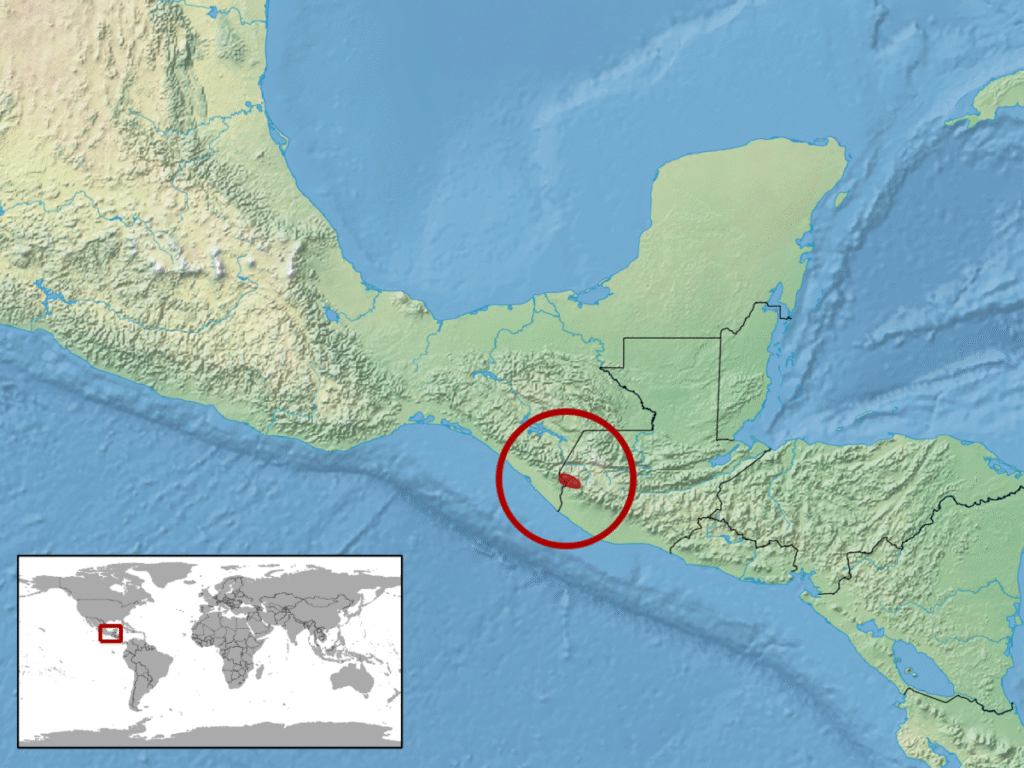
Abronia matudai is found in southwestern Guatemala and southeastern Chiapas, Mexico.[3]
Abronia matudai is found at elevations of 1,950 to 2,630 m (6,400 to 8,630 ft).[3]
Dorsally, Abronia matudai is green in life (fading to blue gray in alcohol), with about 11 dark crossbars on the head and body, and a corresponding number on the tail. The holotype has a snout-to-vent length (SVL) of 77 mm (3.0 in), and the tail is approximately the same length.[5]
Abronia matudai is viviparous.[3]
- Hartweg N, Tihen JA (1946). “Lizards of the Genus Gerrhonotus from Chiapas, Mexico”. Occasional Papers, University of Michigan Museum of Zoology (497): 1–16. (Gerrhonotus matudai, new species, pp. 3–5).
- Johnson, J.D.; Mata-Silva, V.; García-Padilla, E.; Wilson, L.D. (2015). “The Herpetofauna of Chiapas, Mexico: composition, distribution, and conservation”. Mesoamerican Herpetology. 2 (3): 272–329.
- Solano-Zavaleta, I.; Schmidt-Ballardo, Walter (2019). “Longitud máxima de la lagartija Abronia matudai”. Revista Latinoamericana de Herpetología. 2 (2): 98–99.
- Tihen JA (1949). “The Genera of Gerrhonotine Lizards”. American Midland Naturalist 41: 579–601. (Abronia matudai, new combination, p. 591).

