
- 14:07, 25 May 2025 (UTC)
I feel it’s time to trim this page down, so the older edits, many of which are still important to me, are here and here.
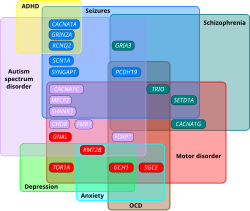
,_dystonia,_epilepsy_and_schizophrenia.svg)
Genes associated with epilepsy
Genes associated with schizophrenia
Genes associated with autism spectrum disorder
Genes associated with dystonia
- 21:15, 3 September 2025 (UTC)
- Does stimming merely feel good, or is it … at least for some …. an actual painkiller? If the latter, is this mostly true for low-functioning autistics, hence the stereotype of the helmet-wearing headbanger? I may have reached a state where my arms are in constant pain from my hand-flapping stim, and the only way to relieve the pain is to repeat the stim. if I’m not just fooling myself here, this could explain all self-injurious stims.
-
- it seems researches on animals in the 80s and 90s took this for granted, cf hypoalgesia, and that it might also happen after drinking milk for babies (not clear if breastfeeding motions or milk itself is responsible) . most of the articles about humans are paywalled.
- hand flapping for me will eliminate pain only if I continue doing it for 30 seconds or more. this is not the way most autistics flap their hands. I may be doing what martial artists do, or people who exercise, though thr runner’s high takes much longer to appear.
-
- it took me more than a year to reach this state. I think this explains why even with millions of other autistics each with their own stim habits, accounts like mine are rare: the only types of people with the ability to relieve pain by stimming are those who consciously strive to reach it and those who have no choice (i.e. nonverbal autistics who have no way to indicate that they’re in pain).
- Some autistics (and a few non-autistics; see below) may experience pain relief instantaneously, especially with head-banging. I have no expectation of reaching this state myself; it may be that hand-flapping simply cannot do this, and that I was never a headbanger so I’ll never become a headbanger, as my stim habits formed very early. But just as runner’s high might be three different hormones all at once, stimming might involve at least two, since I’m pretty sure I began stimming for its pleasurable sensations, which really do happen instantaneously, with pain relief only being subconscious or even absent until I specifically began to look for it.
- I’ll need to put this aside for now, as I now even have pain in my fingers, rather than just my forearm (elbow to wrist). This interferes with basic household tasks and can only get worse if I keep going. Fortunately I have other stims, and i can still do “normal” hand-flapping (as I did yesterday when I was stuck on the phone for hours) without the more vigorous movements that seem to give me the analgesic effect in addition to “just feeling good”. i will add though that it seems the pain-relieving form of the stim is the form that also causes more pain later on. it may be simply due to more vigorous hand mnotions, or its possible im even causing pain to myself during the stim that i can’t feel. this might be the same for runner’s high as well.
- i dont consider stimming, even when it leads to pain later on, to be self-injurious behavior (SIB). it seems that some people consider even nail-biting to be a SIB, which I also object to, so I want to make it clear that I’m not saying “i agree with it for everyone exvept me” etc
rocking and headbanging
[edit]
- Are head banging and rocking the same stim? Does head-banging provide short-term pain relief so strong that headbangers don’t even feel the pain when their heads hit the wall (or other object in front of them)?
- some autistics flap their hands because theyre happy, rather than to become happy. what explains this? it is common among young autistic children so it can’t be a learned behavior.
-
- my idea: consider the relationship between music and dancing: we are already happy when we hear music, and dancing heightens that pleasure, but if there is no music we cannot dance. these people are responding to a pleasurable sensation by flapping their hands, in much the same way an NT would respond to a pleasurable music track by dancing.
- Do some autistics find other autistics’ stims not just uninteresting, but in fact repulsive? I know I’m a sensory-seeking type, and what I do might be very off-putting for some others with autism since i enjoy the very things they flee from. I dont think I’ve ever experienced sensory overload, for example.
- Is there any connection between stims and tics? I get the impression some would disagree with me that stimming feels good, because they describe the moments leading up to the stim as unpleasant, so for them it’s just getting back to normal. I feel lucky that I don’t suffer from this. I saw anarticke saying there is a genetic link
- Why is headbanging associated only with low-functioning autistics? Is it because higher functioning autistics tend not to take the stim to such an extreme, and instead simply rock gently? Or are they completely different stims? is headbanging limited to autism?
- Do low-functioning nonverbal patients also flap their hands? Does anyone have both headbanging/rocking and hand-flapping habits so much that we might call them addictions?
- x
possible sensory avoidance https://www.sciencedirect.com/science/article/abs/pii/030437628390144X
pleasurable stimming with no diagnosed condition at all, though we may today consider him to have stereotypic movement disorder just by definition. also this suggests head banging and rocking may not be the same after all … one involves the head, the other involves the whole body
if thumbsucking is oral stimming, then breastfeeding almost certainly is too
this paper more or less says autistics are swimming in endogenous opioids, and also that ordinary children are. I’ve suspected the latter myself as it would explain why so many childhood pleasures are simple and why adults can’t seem to enjoy them. but the paper also links endogenous opioid production directly to autistic-like stimming, which i see as a weak link because small children don’t stim in autistic ways unless they are also autistic. this assumes swingsets are not a stim just like rocking chairs are not.
- The runner’s high article suggests that endorphins can’t be the main cause of runner’s high because they don’t cross the BBB, but this seems wrong to me, since endorphins are produced in the brain, where the pain perception takes place. If endorphins can’t be the cause of pain relief with the runner’s high, then how do they cause pain relief in other situations?
https://europepmc.org/article/MED/37788244 only 44% of autistics have stims, which sounds like what i heard around 2000. and 3-4% without autism (stereotypic movement disorder). these people are using the older, narrower definition of stims.
User:Emjo2000/Stimming
Stimming outside of autism (by condition)
[edit]
Photosensitive epilepsy#Television
Some people with PSE, especially children, may exhibit an uncontrollable fascination with television images that trigger seizures, to such an extent that it may be necessary to physically keep them away from television sets. Some people (particularly those with cognitive impairments, although most people with PSE have no such impairments) self-induce seizures by waving their fingers in front of their eyes in front of bright light or by other means.
- sure sounds like stimming to me. although autism and epilepsy have a slight positive correlation, I’d think we’d mention it if this were only common among epileptics who also have autism
Photosensitive epilepsy#Fluorescent lighting
When functioning correctly, mains-powered fluorescent lighting has a flicker rate sufficiently high (twice the mains frequency, typically 100 Hz or 120 Hz) to reduce the occurrence of problems. However, a faulty fluorescent lamp can flicker at a much lower rate and trigger seizures.[medical citation needed] Newer high-efficiency compact fluorescent lamps (CFL) with electronic ballast circuits operate at much higher frequencies (10–20 kHz) not normally perceivable by the human eye, though defective lights can still cause problems.
- though not really stimming, this is curiously reminiscent of autism as well
This site refers to OCD’s behaviors as stimming, but still carefully distinguishes them from the stims of autism. I would not approve this, as I think even under an expanded definition of stimming, OCD’s characteristic movements are better grouped with tics (though we distinguish them from both stims and tics currently).
- others
https://www.ncbi.nlm.nih.gov/books/NBK537721/ but probably only in patients who also have autism
[ https://pubmed.ncbi.nlm.nih.gov/27751663/ a possible uniting factor]
stimming outside of autism (by type)
[edit]
i may want to moge[1] the content to stereotypy when i get set up with the new PC and back on my Soap login. even though it seems that stereotypy also includes involuntary movements, the terminology for all disorders besides autism seems to prefer stereotypy over stimming.
fascination with water
[edit]
I am curious what is meant by the description of Angelman patients having attraction to/fascination with water. it is possible that this is no more than a warning to beware of unintentional drownings, which doesnt apply to adults and isnt really about water as water so much as the inability of the patient to perceive danger.[2] this study also claims an attraction to water appears in patients with, of all things, cri du chat, which is unrelated to all of the other conditions on this page.
https://autismakron.org/resources-for-caregivers/ says even autism leads to a risk of drowning, so i a ant to look more into tbis.
It is interesting that hand-flapping is a sign of many unrelated conditions, while head-banging seems to be exclusive to autism (and SMD, but this seems like a circular definition).
Angelman_syndrome#Signs_and_symptoms
A note that hand flapping currently redirects to stimming but there may be more to hand-flapping than that.
If hand-flapping can be caused by so many genes, maybe it’s actually a default human behavior that gets suppressed the way the snout reflex does, and re-appears when the suppression mechanism is stopped.
Children with Pitt-Hopkins syndrome typically have a happy, excitable demeanor with frequent smiling, laughter, and hand-flapping movements. However, they can also experience anxiety and behavioral problems.[3]
probably not stimming: Wilson’s disease. unlikje all the other conditions on this page, this is a progressive disorder caused by a chemical, rather than a disorder of brain structures present from before birth.
this may or may not be useful to maintain. I’m going to use a highly specific definition of hand-flapping here, excluding what I perceive to be involuntary movements and some others that I can’t easily explain.
My definitio nof “yes” is a step higher than “often”, because if i demnaded 100% there would be no “Yes” at all, especially since behaviors like dancing and music aren’y 100% in the general ppulation. but i may chanve that.
i use “Maybe” when a source says yes but i doubt them, or when the source itself is not sure. i’ve explained above why i think attraction to water may be something else entirely… unless they all love baths and showers, it seems more like these children simply had no time to learn how to swim or even about the risks of drowning.
| PROPRIOCEPTIVE | others | ||||||||
| hand flapping | headbanging | rocking | any others[4] | strobe lights | attraction to water | ||||
|---|---|---|---|---|---|---|---|---|---|
| idiopathic autism[5] | Yes | Sometimes | Usually | Yes | Sometimes | Rarely[6] | |||
| cri du chat | Sometimes[7] | No | Sometimes | ||||||
| Angelman | Often | No | Maybe | ||||||
| Pitt-Hopkins | Sometimes | ||||||||
| Rett’s | No[8] | ||||||||
| Photosensitive epilepsy | maybe to simulate light flashing | Maybe | |||||||
| Wilson’s disease | involuntary | ||||||||
im not sure what explains the surprisingly large overlap between dystonia and autism on the chart above. this seems to have nothing to do with stimming. i remember seeing someone who seemed to have some sort of spasm, but it seems odd that eight different genes would lead to both autism and dystonia if dystonia were so rare.
Childhood disintegrative disorder (CDD)
[edit]
I dont think that childhood disintegrative disorder should be considered a form of autism. it seems that it’s a cluster of symptoms, caused by at least five unrelated conditions, and that there is no medical reason to group these five conditions with each other, let alone with autism. the only common ground seems to be early childhood onset, and for four of the five causes of CDD, this early childhood onset is only because “the brain can only hold out so long”, when in fact the disorder was present from birth or even before birth.
grouping them with autism may make sense if autism is regression, but its increasingly likely that autism is always or almost always both present and expressed at birth.
i can understand grouping them together with each other from a treatment perspective even though they have different underlying causes, but it seems unhelpful to group them in turn with autism, even for the sake of treatment, since treatment really needs to address the symptoms even when the underlying causes are not treatable. I consider this the same sort of error we used to make when we classified Rett’s syndrome as part of the autism spectrum, as some people still do.
the paper linked early in the CDD article confirms that the genes of CDD have no connection to autism.
https://en.wikipedia.org/wiki/Childhood_dementia goes through the entire article without mentioning CDD.
- h
a coincidence: Yippee-Like 5
excuse me, do you have a comb i could borrow, please?
[edit]
https://en.wikipedia.org/wiki/Wikipedia:Articles_for_deletion/Five_point_scale check to see if this has achieved wider use over the last 20 yrs, maybe even outside autism
it is called the Dewey Story Test, after Margaret Dewey. it seems that the point scale had four judgments, not five, so maybe the five point scale was a derivative of it. Dewey story test is still empty; it may fit in an article about its creator, which is still also red. Dewey Social Stories Test is one other name; it has been translated into other languages and may have originated in Sweden despite its name (but i think it was maybe English > Swedish > English).
- ^ that is … merge and move. i thought it was clever when i wrote it, but it seems that would jsut be the same as a merge
- ^ https://pmc.ncbi.nlm.nih.gov/articles/PMC5289121/
- ^ “Pitt-Hopkins syndrome”, Definitions, Qeios, 2020-02-10, doi:10.32388/l1967e
- ^ e.g. spinning in circles
- ^ That is, autism that is not known to be caused by some other condition. This may be definitionally reduced to nothing at some point in the future as more causes of autism are found.
- ^ https://autismakron.org/resources-for-caregivers/
- ^ this site mentions hand flapping even with cri du chat, which is also real outlier among all these PDD’s, but it is the very last symptom listed, and thus may be among the least frequent.
- ^ this is based on my assumption that the hand-to-mouth movements in Rett’s are unlike the superficially similar hand-flapping seen in many other syndromes

