
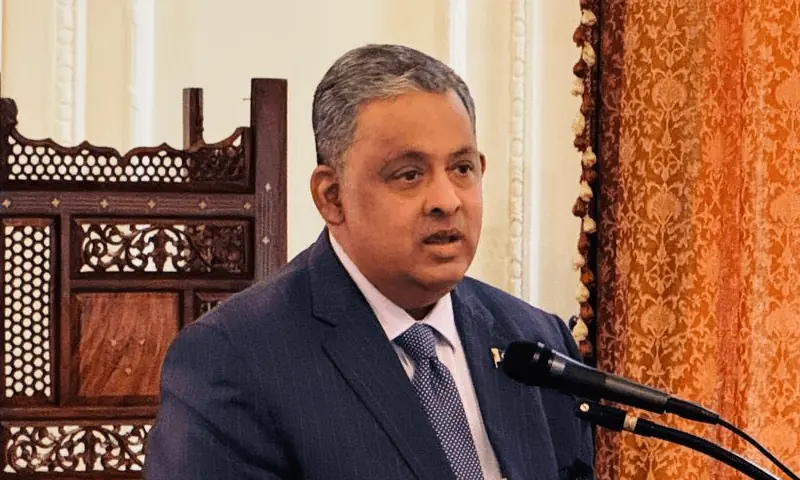
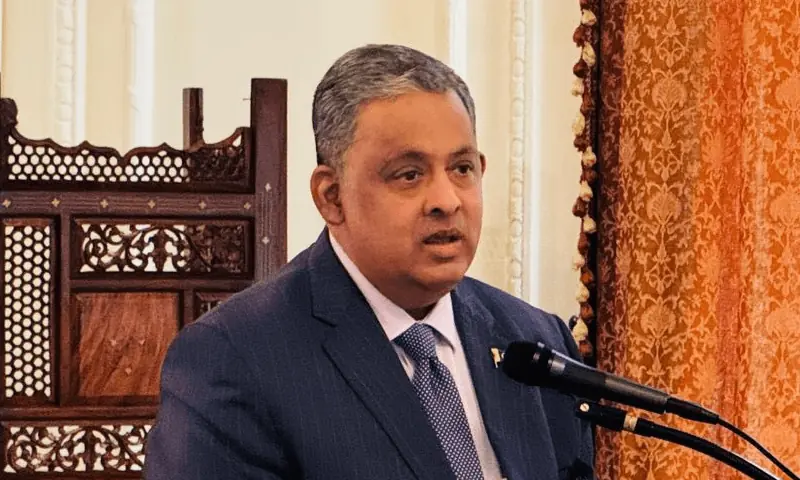
WASHINGTON: Relations between Pakistan and the United States have strengthened under the Trump administration but still hold potential for deeper engagement, according to Rizwan Shaikh, Pakistan’s ambassador to the US.
Borrowing from President Donald Trump’s vocabulary, he described the relationship as having “never been so good looking” in recent memory, while acknowledging that it still requires more substance.
The envoy was speaking at a symposium, organised by Pakistani students at Georgetown University, which covered a wide range of topics and featured several speakers from diverse backgrounds.
Most speakers attended the discussions in person, while some participated via video link.
Ambassador Robin Raphel, a former head of the State Department’s Bureau of South Asian Affairs, said President Trump had removed the “emotionalism” that previously hindered US efforts to rebuild ties with Pakistan.
Georgetown symposium brings together Pakistani intellectuals to discuss foreign policy, economic challenges and opportunities
“Now is the time to strengthen the relationship with a country that remains strategically important,” she added, pointing to Pakistan’s proximity to some of the world’s most sensitive regions.
Ambassador Shaikh also highlighted Pakistan’s potential as “a large country with the fifth-largest population and many things to offer”, adding that the Trump administration viewed Pakistan as a country with its own identity, rather than solely in reference to Afghanistan or India.
Former US ambassador Maleeha Lodhi outlined five key areas likely to dominate Pakistan’s foreign policy in the years ahead.
These areas include managing relations with China and the United States amid the US-China confrontation, addressing challenges in Afghanistan, maintaining an adversarial stance towards India, and balancing ties between strategic ally Saudi Arabia and neighbour Iran.
She described the situation in Kabul as a major security and foreign policy challenge, calling it “a severe policy dilemma” for Islamabad.
“There are obvious limits to a coercive approach and military response, as a total breakdown in relations with Afghanistan is not in Pakistan’s interest — especially given the already fraught ties with India,” she said.
Former senator Mushahid Hussain reflected on Pakistan’s evolving relationship with the US, urging Islamabad to leverage the current focus on economic and strategic engagement to rebuild its economy.
He emphasised Pakistan’s role as a regional security provider in the Middle East, asserting that only a strong and stable Palestinian state, with Jerusalem as its capital, can bring lasting peace to the region. His remarks were met with warm applause from the audience.
Prof Akbar S. Ahmed highlighted the challenges in the country’s tribal areas, praising the wisdom of local communities and warning about Balochistan, which makes up over 40 per cent of Pakistan’s total area. He urged that the mistakes of East Pakistan (now Bangladesh) should not be repeated.
He said no state can be sustained without justice, fairness and generosity. “We must consider the factors that truly support democracy,” he added, stressing that a functioning democracy is impossible without education.
Other speakers highlighted the critical role of Pakistan’s young population, with a median age of just 23, in shaping social and political movements.
Dr Mehlaqa Samdani, who leads a group lobbying for Mr Khan’s release from prison, sought permission to address Ambassador Shaikh, but the session ended before she could speak.
Published in Dawn, November 17th, 2025

