
From Wikipedia, the free encyclopedia
Content deleted Content added
|
|
|||
| Line 17: | Line 17: | ||
|
”M. pugnata” is a larger species of Megachile, with the typical female’s body length ranging from 12-18 mm and the male’s 11-13 mm.<ref>{{cite web |title=Megachile pugnata Say, 1837 |url=https://www.discoverlife.org/mp/20q?search=Megachile+pugnata#Hosts |website=Discover Life |publisher=The Polistes Foundation |access-date=18 November 2025}}</ref> The outer carapace of both the male and female is completely black in color. Females’ eyes are black as well, while the males have lighter colored grey/green eyes. The ventral aspect of females’ abdomens are characterized by rows of densely packed hairs, which facilitate the collection of pollen. Males have much less densely packed rings of hairs between each segment of the abdomen. Both males and females have large mandibles, an important attribute for the females who use them to slice through leaves to create their nests. The females have a pointed end to their abdomen while the male’s abdomen has a clublike, rounded terminus. The female’s limbs are all covered in hairs while the male’s fore-limbs are heavily modified with a dense brush of bright yellow hair.<ref>{{cite web |title=Megachile pugnata Say, 1837 |url=https://www.discoverlife.org/mp/20q?search=Megachile+pugnata#Hosts |website=Discover Life |publisher=The Polistes Foundation |access-date=18 November 2025}}</ref> |
”M. pugnata” is a larger species of Megachile, with the typical female’s body length ranging from 12-18 mm and the male’s 11-13 mm.<ref>{{cite web |title=Megachile pugnata Say, 1837 |url=https://www.discoverlife.org/mp/20q?search=Megachile+pugnata#Hosts |website=Discover Life |publisher=The Polistes Foundation |access-date=18 November 2025}}</ref> The outer carapace of both the male and female is completely black in color. Females’ eyes are black as well, while the males have lighter colored grey/green eyes. The ventral aspect of females’ abdomens are characterized by rows of densely packed hairs, which facilitate the collection of pollen. Males have much less densely packed rings of hairs between each segment of the abdomen. Both males and females have large mandibles, an important attribute for the females who use them to slice through leaves to create their nests. The females have a pointed end to their abdomen while the male’s abdomen has a clublike, rounded terminus. The female’s limbs are all covered in hairs while the male’s fore-limbs are heavily modified with a dense brush of bright yellow hair.<ref>{{cite web |title=Megachile pugnata Say, 1837 |url=https://www.discoverlife.org/mp/20q?search=Megachile+pugnata#Hosts |website=Discover Life |publisher=The Polistes Foundation |access-date=18 November 2025}}</ref> |
||
|
== |
==== |
||
|
=== Nest Building === |
|||
|
=== Foraging === |
|||
|
=== Formation of Larval Feed and Oviposition === |
|||
|
==Range== |
==Range== |
||
Latest revision as of 04:29, 18 November 2025
Species of leafcutter bee (Megachile)
Megachile pugnata is a species of North American bee in the family Megachilidae.[1] It was described by Thomas Say in 1837.[1]
Females are 12–18 mm in length while male are somewhat smaller: 11–13 mm. The adults are active from June to September.[2]
Females of this species are oligolectic on the pollen of plants in the sunflower family, Asteraceae, and commonly visit ironweeds (e.g. Vernonia fasciculata) for nectar.[3]
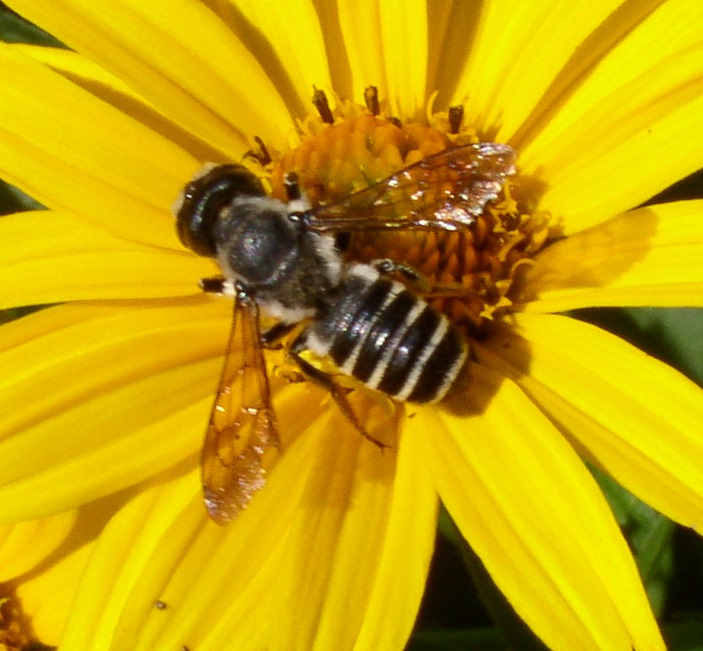
M. pugnata is a larger species of Megachile, with the typical female’s body length ranging from 12-18 mm and the male’s 11-13 mm.[4] The outer carapace of both the male and female is completely black in color. Females’ eyes are black as well, while the males have lighter colored grey/green eyes. The ventral aspect of females’ abdomens are characterized by rows of densely packed hairs, which facilitate the collection of pollen. Males have much less densely packed rings of hairs between each segment of the abdomen. Both males and females have large mandibles, an important attribute for the females who use them to slice through leaves to create their nests. The females have a pointed end to their abdomen while the male’s abdomen has a clublike, rounded terminus. The female’s limbs are all covered in hairs while the male’s fore-limbs are heavily modified with a dense brush of bright yellow hair.[5]
Formation of Larval Feed and Oviposition
[edit]
Taxonomy and Phylogony
[edit]

