
| watercap = 2,500 us gal
| watercap = 2,500 us gal
| valvegear = [[Stephenson valve gear]]
| valvegear = [[Stephenson valve gear]]
| tractiveeffort = approx. {{convert|19000|lbf|kN|2|abbr=on}}<ref>{{cite web |last name=Grant |first name=Robert |title=Colorado Railroad Museum |url=https://www.rgusrail.com/cocrm.html |website=rgusrail.com |access-date=2025-10-30}}</ref>
| tractiveeffort = approx. {{convert|19000|lbf|kN|2|abbr=on}}<ref>{{cite web |last=Grant |first=Robert |title=Colorado Railroad Museum |url=https://www.rgusrail.com/cocrm.html |website=rgusrail.com |access-date=2025-10-30}}</ref>
| factorofadhesion = 64,000 lbs
| factorofadhesion = 64,000 lbs
| operator = [[Denver and Rio Grande Western Railroad]] (historically), [[Rio Grande Southern]] (historically) [[Colorado Railroad Museum]] (current), and [[Knotts Berry Farm]] (current)
| operator = [[Denver and Rio Grande Western Railroad]] (historically), [[Rio Grande Southern]] (historically) [[Colorado Railroad Museum]] (current), and [[Knotts Berry Farm]] (current)
Narrow Gauge Steam locomotive class
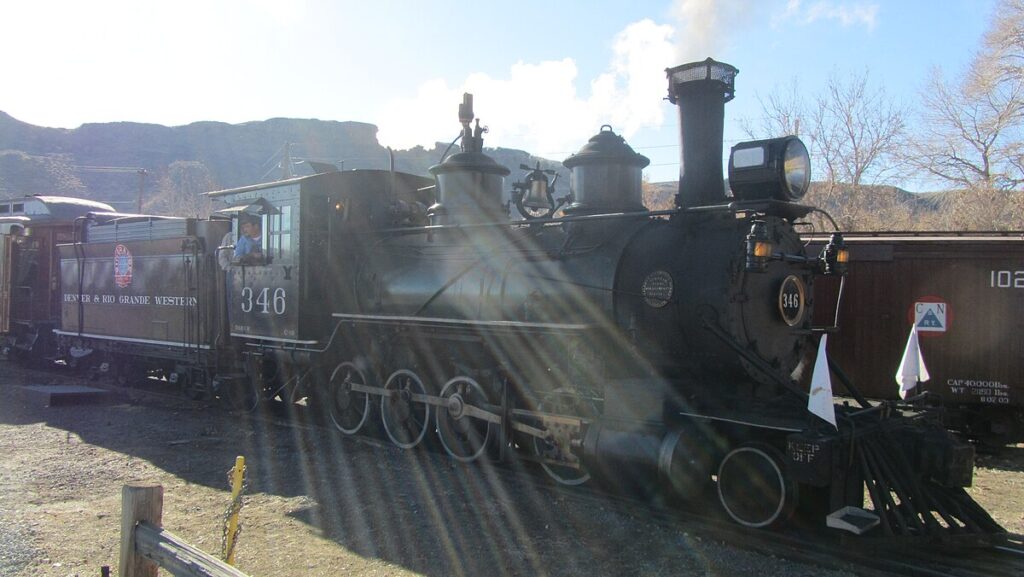
The Denver and Rio Grande Western C-19 (originally Denver and Rio Grande Class 70 or 74) is a class of 3 ft (914 mm) narrow-gauge 2-8-0 “Consolidation” type steam locomotives built for the Denver and Rio Grande Railroad (D&RG), later the Denver and Rio Grande Western Railroad (D&RGW) by the Baldwin Locomotive Works in 1881. These engines were built to supplement the smaller and weaker Class 60 2-8-0s (later designated C-16 after the reorganization).[4][5][6]
By the end of the 1880s, five of these bigger narrow-gauge engines were converted to standard gauge, but by 1900, they all were converted back to narrow gauge.[4] Two C-19s were purchased secondhand by the Rio Grande Southern Railroad as No. 40 and No. 41 respectively.[7] As of today, only 3 C-19’s exist in preservation, D&RGW No. 346 was the first C-19 to be preserved, as it was purchased by Robert W. Richardson, the founder of the Colorado Railroad Museum, while the other two (D&RGW No. 340 and RGS No. 41 respectively) were purchased for operation on Ghost Town & Calico Railroad on Knott’s Berry Farm, in Buena Park, California.[4][3][8]
History
By 1886, after a period of financial difficulty and reorganization, the Denver and Rio Grande Railway was divided into two independent systems: the Denver and Rio Grande Railroad, which operated the Colorado lines, and the Rio Grande Western Railway, which took control of the Utah lines.[5][6]
When the D&RG received its orders for the smaller Class 56 and Class 60 2-8-0 locomotives (later designated C-16s), the railroad began experimenting with larger and more powerful engines, such as the Class 70 (later C-19s), to handle the steep grades on the Marshall Pass route and to support construction of the San Juan Extension, which ran from Alamosa to Durango.[5][3]
Five of the original Class 70s would be converted for standard gauge use, and the first standard gauge locomotives to be ever used by the D&RG up until that point. Though they would all be reverted to narrow gauge at the turn of the century.[4]
After the Denver and Rio Grande merged with the Rio Grande Western, the combined company became the Denver and Rio Grande Western (D&RGW). After the reorganization, all the locomotives were redesignated based on their wheel arrangement and tractive effort. This gave the Class 70s a new designation of “C-19”, the “C” stands for “Consolidation” and the 19 indicates 19,000 lbs of tractive effort.[4][3][6][9]
In November 1916, the Rio Grande Southern purchased three secondhand 2-8-0 locomotives from the Denver and Rio Grande. Two of them were Class C-19 engines (Nos. 40 and 41), while the third was a Class C-17 (formerly classified as a Class 74 before the 1921 reorganization) and was numbered 42. Of the two C-19s, No. 40 was wrecked beyond repair in a wreck with RGS No. 20 near Hesperus and was scrapped in 1943. No. 20 was repaired and sent back to service and is now preserved at the Colorado Railroad Museum. The remaining two 2-8-0s, Nos. 41 and 42, were later sold to Knott’s Berry Farm and the Colorado Railroad Museum, respectively.[10]
As more powerful locomotives like the Rio Grande class K-27, K-36, and K-37 began to appear on the D&RGW mainlines. The older and diminutive 2-8-0s, including the C-19s, became increasingly obsolete and redundant; some remained as yard switchers but were largely withdrawn from service by the mid-1930s through the early-1940s, though some remained until the early 1950s.[6][8]
Locomotive Roster
| Number (D&RGW or RGS) | Original Number (D&RG) | Builder’s Number | Disposition | Notes |
|---|---|---|---|---|
| D&RGW No. 340 | D&RG No. #400 | 5571 | Preserved and operational at Knott’s Berry Farm on its Ghost Town & Calico Railroad since March 1952. | Originally named “Green River” |
| D&RGW No. 341 | D&RG No. 402 | 5603 | Scrapped in January 1939 | Originally named “Shoshone”
Conv. to Class 74 Std Gauge #800 on 12 Jul 1889 Conv. back to Class 74 NG D&RG 401 Jul 1898 |
| D&RGW No. 342 | D&RG No. 410 | 5755 | Scrapped in October 1938 | Originally named “Treasury Mountain”
Conv. to Class 74 Std Gauge #801 on 9 Jun 1888 Conv. back to Class 70 NG D&RG 411 in Jul 1898 |
| D&RGW No. 343 | D&RG No. 403 | 5604 | Scrapped on 21 April 1941 | Originally named “Roaring Forks”, later renamed “New Mexico”
Leased to the Colorado and Southern Railway (1935-1937). Appeared, disguised as an Egyptian loco pulling an armored train, in The Light That Failed (1939 film)[11] |
| D&RGW No. 344 | D&RG No. 404 | 5630 | Scrapped 1939 | Originally named “Sevier” |
| D&RGW No. 345 | D&RG No. 401 | 5572 | Destroyed in a stunt for the movie Denver and Rio Grande in 1952[Note 1] | Originally named “Grand River”
Conv. to Class 74 Std Gauge #803, 28 Mar 1889 Conv. back to Class 74 NG D&RG 405, Jun 1900 |
| D&RGW No. 346 | D&RG No. 406 | 5712 | Preserved at the Colorado Railroad Museum | Originally named “Cumbres”
Leased to the Colorado and Southern Railway (1935-1937) Rebuilt and returned to D&RGW Apr 1937[Note 2][13][12][14] Sold Montezuma Lumber 19-May-1947 |
| D&RGW No. 347 | D&RG No. 407 | 5713 | Scrapped October 1938 | Originally named “Old Rube” |
| D&RGW No. 348 | D&RG No. 408 | 5730 | Scrapped 1936 | Originally named “Marshall Pass” |
| D&RGW No. 349 | D&RG No.
405 |
5633 | Scrapped 1940 | Sold Dec-1926 As New Mexico Lumber Co #3 |
| RGS No. 40 | D&RG No. 411 | 5756 | Damaged in a wreck and subsequently scrapped in 1943 | Originally named “Quartz Creek”
Later renamed “Gold Nugget” Conv. to Class 74 Std Gauge #802 in Dec 1888 Conv. back to Class 74 NG D&RG 402 in Jul 1898 |
| RGS No. 41 | D&RG No. 409 | 5731 | Preserved and operational at Knott’s Berry Farm | Originally named “Red Cliff,” Later renamed “Red Buttes” |
Accidents
Accidents on the D&RG(W)
- Unknown date – D&RGW No. 340 overturns somewhere on the D&RGW or RGS right of way.[15]
- July 25, 1936 – D&RGW No. 346, which was leased to the Colorado and Southern Railway at the time, became a runaway due to human error and crashed on Kenosha Pass. The fireman escapes unscathed, while the engineer dies of his wounds the very next day; No. 346 is repaired within a few weeks.[12]
Accidents on the RGS
- August 31, 1943 – RGS No. 40 and 20 crash near Hesperus, No. 40 was damaged beyond repair and scrapped, while No. 20 was repaired and sent back to service.[16][17][10]
Preservation
Three C-19s are currently in preservation, whether they are in operation or storage. Two C-19s are operational on the Ghost Town & Calico Railroad, while the other is under a Federal Railroad Administration mandated overhaul at the Colorado Railroad Museum.[18]
C-19s in Preservation
Locations
See also
Other D&RGW steam locomotives
Other D&RGW steam locomotive classes
References
Notes
- ^ a b c D&RGW No. 345 was intentionally damaged for a climactic scene in the film Denver and Rio Grande (film), along with C-18 No. 319; both engines were damaged beyond repair and ultimately scrapped.
- ^
D&RGW No. 346 was wrecked over Kenosha Pass while leased to the C&S.
It was subsequently repaired and returned to the D&RGW.[12]
Citations
- ^ Grant, Robert. “Colorado Railroad Museum”. rgusrail.com. Retrieved 2025-10-30.
- ^ a b Official Roster No. 11 of the Denver and Rio Grande Western Railroad System. Denver, Colorado: The Denver and Rio Grande Western Railroad System. April 1, 1923. ISBN 9780918654564.
- ^ a b c d “Steam Locomotives of the Denver & Rio Grande Western (D&RGW)”. www.loco-info.com. Retrieved 2025-10-29.
- ^ a b c d e f “DRGW.Net | D&RG Class 70/74 / D&RGW C-19 Class Narrow Gauge Steam Locomotives”. www.drgw.net. Retrieved 2025-10-29.
- ^ a b c Johnson, Jeff. “C-19 Locomotive History”. blackstonemodels.com. Retrieved 2025-10-29.
- ^ a b c d Bachmann Trains (2012-09-25). C-19 Locomotive History. Retrieved 2025-10-31 – via YouTube.
- ^ a b Haworth, Steven. “RGS – Rolling Stock”. www.rgsrr.info. Retrieved 2025-10-29.
- ^ a b c “PWRS Pacific Western Rail Systems.” Pwrs.ca, Nov 5, 2008, https://www.pwrs.ca/announcements/view.php?ID=1034. Accessed 8 Nov. 2025.
- ^ Strong, Kevin (2018-04-29) [December 20, 2012]. “Bachmann C-19 Consolidation | Garden Railways Magazine”. Trains (magazine). Retrieved 2025-11-20.
- ^ a b Haworth, Steven. “RGS – Locomotive Timeline”. www.rgsrr.com. Retrieved 2025-10-30.
- ^ Chappell, Gordon. S (January 1, 1988). To Santa Fe by Narrow Gauge: The D & Rg Chili Line (4th ed.). Golden, Colorado.: 1969 Colorado Rail Annual, Colorado Railroad Museum. ISBN 978-0918654076.
- ^ a b c “C-19 Individual Locomotive History: D&RGW No. 346”. blackstonemodels.com. Retrieved 2025-10-30.
- ^ “HawkinsRails Colorado Railroad Museum Scrapbook”. hawkinsrails.net. Retrieved 2025-10-30.
- ^ “Locomotives – Colorado Railroad Museum”. 2015-09-01. Retrieved 2025-11-20.
- ^ “RD101-003.jpg | Friends of the Cumbres & Toltec Scenic Railroad”. ngtrainpics.photoshelter.com. Retrieved 2025-10-30.
- ^ Cook, W. George; McCoy, Dell. A; Collman, Russ (January 1, 2001). “RGS Story, The Vol. IX: Over the Bridges? Grady to Durango” (First ed.). Sundance Books. p. 66. ISBN 978-0913582718.
{{cite book}}: CS1 maint: url-status (link) - ^ “RD147-048.jpg | Friends of the Cumbres & Toltec Scenic Railroad”. ngtrainpics.photoshelter.com. Retrieved 2025-10-30.
- ^ Taylor, Jeff. “D&RGW 346 to head to Durango for 1472 work”. ngdiscussion.net. Retrieved 2025-10-30.
External links
- More information related to the D&RGW’s at D&RGW.net

