
The ”’Silicon Shield”’ is a [[Geopolitics|geopolitical]] and [[Free market|free enterprise]] strategy of prevention utilized by the country of [[Taiwan]] to deter a military invasion from from the [[Mainland China|Chinese mainland]], also known as [[Chinese unification|forced reunification]] <ref>{{Cite web |title=Silicon Shield 2.0: A Taiwan Perspective |url=https://thediplomat.com/2024/09/silicon-shield-2-0-a-taiwan-perspective/ |access-date=2025-11-22 |website=thediplomat.com |language=en-US}}</ref><ref>{{Cite web |date=2021-05-10 |title=Can Taiwan’s Silicon Shield Protect It against China’s Aggression? |url=https://www.voanews.com/a/east-asia-pacific_can-taiwans-silicon-shield-protect-it-against-chinas-aggression/6205660.html |access-date=2025-11-22 |website=Voice of America |language=en}}</ref>. The name ”Silicon Shield” is a reference to Taiwan’s world leading [[Semiconductor industry in Taiwan|semiconductor industry]] that leverages the [[United States|United States’]], its main ally, superior military power with the American economies insatiable desire for high end microchips.<ref>{{Cite web |date=2022-01-28 |title=Chip shortage cost U.S. economy billions in 2021 – CBS News |url=https://www.cbsnews.com/news/chip-shortage-cost-us-economy-billions-in-2021/ |access-date=2025-11-22 |website=www.cbsnews.com |language=en-US}}</ref> In plain English: Taiwan sells America cheap chips and in return the US will protect Taiwan from China.
The ”’Silicon Shield”’ is a [[Geopolitics|geopolitical]] and [[Free market|free enterprise]] strategy of prevention utilized by the country of [[Taiwan]] to deter a military invasion from the [[Mainland China|Chinese mainland]], also known as [[Chinese unification|forced reunification]] <ref>{{Cite web |title=Silicon Shield 2.0: A Taiwan Perspective |url=https://thediplomat.com/2024/09/silicon-shield-2-0-a-taiwan-perspective/ |access-date=2025-11-22 |website=thediplomat.com |language=en-US}}</ref><ref>{{Cite web |date=2021-05-10 |title=Can Taiwan’s Silicon Shield Protect It against China’s Aggression? |url=https://www.voanews.com/a/east-asia-pacific_can-taiwans-silicon-shield-protect-it-against-chinas-aggression/6205660.html |access-date=2025-11-22 |website=Voice of America |language=en}}</ref>. The name ”Silicon Shield” is a reference to Taiwan’s world leading [[Semiconductor industry in Taiwan|semiconductor industry]] that leverages the [[United States|United States’]], its main ally, superior military power with the American economies insatiable desire for high end microchips.<ref>{{Cite web |date=2022-01-28 |title=Chip shortage cost U.S. economy billions in 2021 – CBS News |url=https://www.cbsnews.com/news/chip-shortage-cost-us-economy-billions-in-2021/ |access-date=2025-11-22 |website=www.cbsnews.com |language=en-US}}</ref> In plain English: Taiwan sells America cheap chips and in return the US will protect Taiwan from China.
The other deterrent strategy used by Taiwan is known as the [[Porcupine strategy|Porcupine Strategy]], which is that of last resort, also known as [[asymmetric warfare]] such as [[Guerrilla warfare|guerilla warfare]]. This strategy is logically inferior to the Silicon Shield as it is primarily to be utilized after an invasion starts. However inferior, Taiwan has not abandoned the porcupine strategy and continues to invest in its own security, aiming to spend 5% of GDP on defense by 2030.<ref>{{Cite web |date=2025-10-08 |title=Koo reaffirms 5% defense spending goal amid U.S. call for major hike – Focus Taiwan |url=https://focustaiwan.tw/politics/202510080019 |access-date=2025-11-22 |website=Focus Taiwan – CNA English News |language=en-US}}</ref>
The other deterrent strategy used by Taiwan is known as the [[Porcupine strategy|Porcupine Strategy]], which is that of last resort, also known as [[asymmetric warfare]] such as [[Guerrilla warfare|guerilla warfare]]. This strategy is logically inferior to the Silicon Shield as it is primarily to be utilized after an invasion starts. However inferior, Taiwan has not abandoned the porcupine strategy and continues to invest in its own security, aiming to spend 5% of GDP on defense by 2030.<ref>{{Cite web |date=2025-10-08 |title=Koo reaffirms 5% defense spending goal amid U.S. call for major hike – Focus Taiwan |url=https://focustaiwan.tw/politics/202510080019 |access-date=2025-11-22 |website=Focus Taiwan – CNA English News |language=en-US}}</ref>
The Silicon Shield is a geopolitical and free enterprise strategy of prevention utilized by the country of Taiwan to deter a military invasion from the Chinese mainland, also known as forced reunification [1][2]. The name Silicon Shield is a reference to Taiwan’s world leading semiconductor industry that leverages the United States’, its main ally, superior military power with the American economies insatiable desire for high end microchips.[3] In plain English: Taiwan sells America cheap chips and in return the US will protect Taiwan from China.
The other deterrent strategy used by Taiwan is known as the Porcupine Strategy, which is that of last resort, also known as asymmetric warfare such as guerilla warfare. This strategy is logically inferior to the Silicon Shield as it is primarily to be utilized after an invasion starts. However inferior, Taiwan has not abandoned the porcupine strategy and continues to invest in its own security, aiming to spend 5% of GDP on defense by 2030.[4]
The island nation has made it abundantly clear that they do not want China’s One Country, Two Systems.[5] Taiwan has consistently cozied up with America as evidenced by repeated US arms sales to Taiwan for decades.[6]


CCP Territorial Claims over Taiwan
[edit]
The Chinese Communist Party has for decades claimed Taiwan is a rogue province and is part of China’s sovereign territory through their One-China Policy. Not long after the communists won the Chinese Civil War in 1949, did tensions flare between Beijing, Taipei and Washing DC. The First Taiwan Strait Crisis and the Second Taiwan Strait Crisis happened in 1954 and 1958 respectively. It wasn’t until 1995 that a Third Taiwan Strait Crisis happened. Then in January 2019, a potential fourth crisis began to brew when Chinese dictator Xi Jinping declared a desire to invade Taiwan using military force.[9] A month after the Taiwan threat, China proposed the 2019 Hong Kong Extradition Bill which was immediately followed by the infamous 2019-2020 Hong Kong Protests. The totality of threats against their sovereignty and the events in Hong Kong, followed closely by the COVID-19 lockdowns in China and China’s Zero-COVID Policy, was not lost on Taiwan regarding their own security.[10][11][12]
Microchip Foundry Model
[edit]
Starting in 1987, Taiwan fortuitously orchestrated international relations and began to pull the manufacturing of microchips lever using the Foundry Model. In which American companies still maintain control over chip design while Taiwan makes them. The idea, conceived of by TSMC founder Morris Chang, was implemented to great success. In 1990, the US manufactured 37% of the world’s microchips.[13] By 2020, TSMC alone accounted for more than 50% of the global wafer foundry market.[14] Furthermore, according to a briefing from the US International Trade Commission in 2024, Taiwan was “capturing nearly 70 percent of global foundry revenue in recent years.”[15]
American Desire to Defend
[edit]
It wasn’t until the 2020’s, after the COVID-19 Pandemic, that Americans became astutely aware of the strategic complications accompanying the gradual shift in chip manufacturing.[16] Up to that point, the US was seemingly running on autopilot. Due to supply chain issues that reared their ugly head during the international health crisis, the global economy soon experienced massive price increases known as the 2021–2023 inflation surge.
American consumers are well known to be particularly sensitive to price increases. Between 2020 and 2021, American car prices, ever dependent on microchips, increased 17.2%.[17] In 2022, President Joe Biden went as far as to virtually threaten China with war if they tired to invade Taiwan.[18] Also in 2022 was the infamous Nancy Pelosi visit to Taiwan, which saw the island nation’s airspace get bombarded with violations from Chinese military aircraft.[19] Proving Taiwan’s resolve on the Silicone Shield strategy, in 2024, two years after America passed the CHIPS and Science Act, Taiwan was still responsible for manufacturing 90% of the world’s most advanced microchips.[20] In 2025, there was widespread market speculation in the American economy of an AI and microchip bubble.[21]
Taiwanese Desire for Independence
[edit]
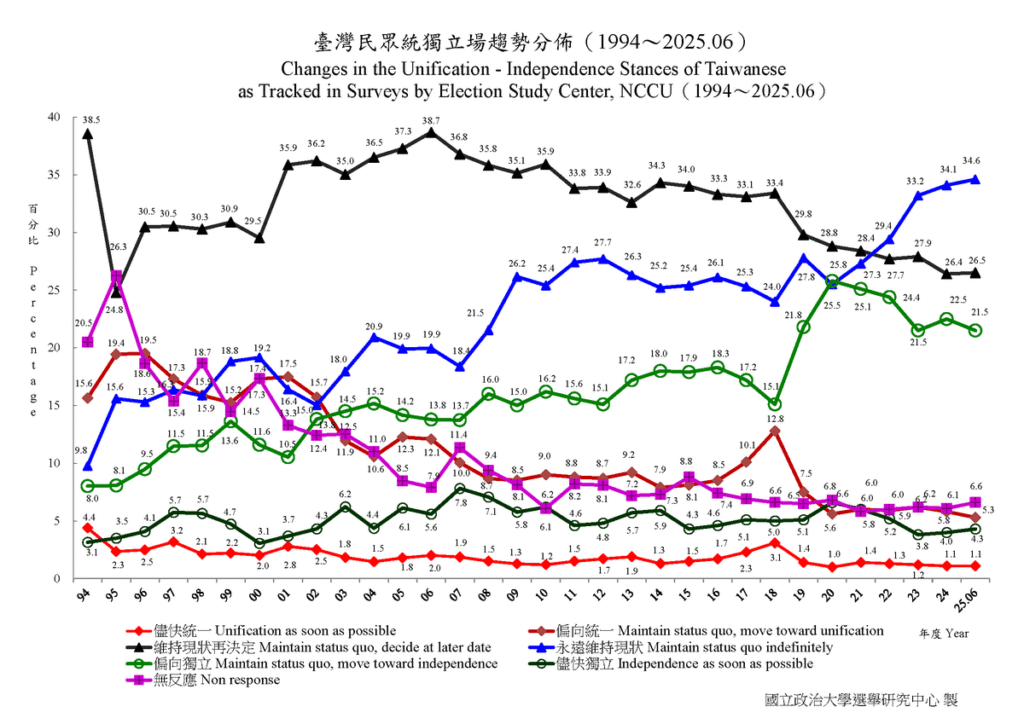
Polling from the Election Study Center, National Chengchi University consistently shows a complete lack of desire for Unification, which has never polled above 5%.[22] The poll measures Taiwanese Independence Stances from 1994-2025. Non Response (26.3% in ’95) beat Maintain Status Quo, Decide At Later Date (24.8% ’95) in the poll one time. In 2020, Maintain Status Quo, Move Toward Independence (25.8% in ’20) and Maintain Status Quo Indefinitely (26.5% in ’20) almost beat Maintain Status Quo, Decide At Later Date (28.8% in ’20). In the most recent years from the poll, Main Status Quo Indefinitely has been winning, (29.4% in ’22, 33.2% in ’23, 34.1% in ’24 and 34.6% in ’25) marking the end of Maintain Status Quo, Decide At Later Date’s dominance in the polls since 1996. When referencing Maintain Status Quo in the poll, what they are talking about is the One China Principle. In which Taiwan acknowledges it is part of sovereign Chinese territory, and claims that the Chinese mainland is the rogue province who needs to be under Taiwanese control.
One China Policy vs One China Principle
[edit]
The official name of Taiwan is the Republic of China or the ROC. The official name of China is the People’s Republic of China or the PRC. The ROC has the One China Principle, and the PRC has the One China Policy. Are you confused yet? It’s best to think of it in terms of two China’s. In the ROC’s Principle (Taiwan) and the PRC’s Policy (China), both China’s assert that they are the legitimate government of the other. The reason why goes back to before WWI. The ROC (modern day Taiwan) was established in 1912, after the defeat of Imperial China in the 1911 Revolution. The ROC (Taiwan), remained in charge of mainland China before losing the Chinese Civil War in 1949 to the PRC (Modern day China). In essence, both China’s assert that they are the one true China with fairly legitimate claims.
- ^ “Silicon Shield 2.0: A Taiwan Perspective”. thediplomat.com. Retrieved 2025-11-22.
- ^ “Can Taiwan’s Silicon Shield Protect It against China’s Aggression?”. Voice of America. 2021-05-10. Retrieved 2025-11-22.
- ^ “Chip shortage cost U.S. economy billions in 2021 – CBS News”. www.cbsnews.com. 2022-01-28. Retrieved 2025-11-22.
- ^ “Koo reaffirms 5% defense spending goal amid U.S. call for major hike – Focus Taiwan”. Focus Taiwan – CNA English News. 2025-10-08. Retrieved 2025-11-22.
- ^ “Taiwan does not want China’s ‘one country, two systems,’ president says”. NBC News. 2025-10-31. Retrieved 2025-11-22.
- ^ Agencies, News. “US sells $700m NASAMS missile system to Taiwan”. Al Jazeera. Retrieved 2025-11-22.
- ^ “Taiwan Independence vs. Unification with the Mainland(1994/12~2025/06)”. esc.nccu.edu.tw (in Chinese (Taiwan)). Retrieved 2025-11-22.
- ^ “Turning the Tide for Semiconductor Manufacturing in the U.S.” Semiconductor Industry Association. Retrieved 2025-11-22.
- ^ Kuo, Lily (2019-01-02). “‘All necessary means’: Xi Jinping reserves right to use force against Taiwan”. The Guardian. ISSN 0261-3077. Retrieved 2025-11-21.
- ^ Institute, Global Taiwan (2020-09-23). “A Political Analysis of Taiwanese Perceptions of Hong Kong Protests”. Global Taiwan Institute. Retrieved 2025-11-22.
- ^ “Taiwan’s people are not impressed with China’s “Zero COVID” status”. Brookings. Retrieved 2025-11-22.
- ^ “Taiwan does not want China’s ‘one country, two systems’, president says”. CNA. Retrieved 2025-11-22.
- ^ “Turning the Tide for Semiconductor Manufacturing in the U.S.” Semiconductor Industry Association. Retrieved 2025-11-22.
- ^ “Taiwan to remain largest semiconductor material market in 2020, 2021 – Focus Taiwan” (in Chinese). Archived from the original on 2020-09-23. Retrieved 2025-11-22.
- ^ “Wayback Machine” (PDF). www.usitc.gov. Archived from the original (PDF) on 2025-10-04. Retrieved 2025-11-22.
- ^ Lee, Yen Nee (2021-03-16). “2 charts show how much the world depends on Taiwan for semiconductors”. CNBC. Retrieved 2025-11-21.
- ^ “Average car price is at an all-time high of $47,000 going into 2022 | The Zebra”. www.thezebra.com. Retrieved 2025-11-21.
- ^ “Biden again says US would defend Taiwan if China attacks”. 2022-09-19. Retrieved 2025-11-21.
- ^ Tan, Huileng. “China has warned airlines to avoid the airspace near Taiwan as Beijing steps up military exercises over Pelosi’s visit”. Business Insider. Retrieved 2025-11-22.
- ^ Affairs, Technology in Global (2024-05-27). “Semiconductor Manufacturing Facilities Map”. Technology in Global Affairs. Retrieved 2025-11-21.
- ^ Inman, Phillip (2025-10-28). “‘A stomach of steel’: amateur investors ride out dips amid talk of an AI bubble”. The Guardian. ISSN 0261-3077. Retrieved 2025-11-21.
- ^ “Taiwan Independence vs. Unification with the Mainland(1994/12~2025/06)”. esc.nccu.edu.tw (in Chinese (Taiwan)). Retrieved 2025-11-22.

