
From Wikipedia, the free encyclopedia
Content deleted Content added
| Line 27: | Line 27: | ||
|
under the action of the [[Symmetry group|group]] generated by a rotation around the {{nowrap|1=<math> z </math>-}}axis by 90° and by a rotation by 180° around a straight line perpendicular to the {{nowrap|1=<math> z </math>-}}axis and making an angle of 22.5° with the {{nowrap|1=<math> x </math>-}}axis.{{r|timofeenko}} It has the [[Dihedral symmetry in three dimensions|three-dimensional symmetry]] of [[dihedral group]] <math> D_{4d} </math> of order 16.{{r|johnson}} |
under the action of the [[Symmetry group|group]] generated by a rotation around the {{nowrap|1=<math> z </math>-}}axis by 90° and by a rotation by 180° around a straight line perpendicular to the {{nowrap|1=<math> z </math>-}}axis and making an angle of 22.5° with the {{nowrap|1=<math> x </math>-}}axis.{{r|timofeenko}} It has the [[Dihedral symmetry in three dimensions|three-dimensional symmetry]] of [[dihedral group]] <math> D_{4d} </math> of order 16.{{r|johnson}} |
||
|
The snub square antiprism has forty edges. Compartmentalized into two types of polygonal faces, there are thirty-two triangle-to-triangle edges and eight triangle-to-square edges. These types form a [[dihedral angle]], a measured angle between two faces. For triangle-to-triangle, eight |
The snub square antiprism has forty edges. Compartmentalized into two types of polygonal faces, there are thirty-two triangle-to-triangle edges and eight triangle-to-square edges. These types form a [[dihedral angle]], a measured angle between two faces. For triangle-to-triangle, eight 164.257°, sixteen 144.144°, and eight 114.645°, all of which are in approximation; for triangle-to-square, angle approximately 145.441°.{{r|johnson}} |
||
|
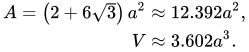
The surface area and volume of a snub square antiprism with edge length <math> a </math> can be calculated as:{{r|berman}} |
The surface area and volume of a snub square antiprism with edge length <math> a </math> can be calculated as:{{r|berman}} |
||
Revision as of 03:11, 25 November 2025
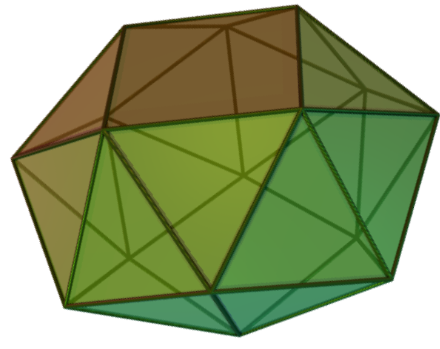
85th Johnson solid (26 faces)

In geometry, the snub square antiprism is the Johnson solid that can be constructed by snubbing the square antiprism. It can alternatively be imagined as two squares connected by two layers of triangles, like a regular icosahedron. It is one of the elementary Johnson solids that do not arise from “cut and paste” manipulations of the Platonic and Archimedean solids. However, it is a relative of the icosahedron that has fourfold symmetry instead of threefold. It has 26 faces: 2 squares and 24 triangles; and two types of edges: triangle-square, triangle-triangle.
Construction and properties
The snub is the process of constructing polyhedra by cutting loose the edge’s faces, twisting them, and then attaching equilateral triangles to their edges.[1] As the name suggests, the snub square antiprism is constructed by snubbing the square antiprism, resulting in twenty-four equilateral triangles and two squares as its faces.[2][3] The Johnson solids are the convex polyhedra whose faces are regular, and the snub square antiprism is one of them, enumerated as , the 85th Johnson solid.[4]

Let be the positive root of the cubic polynomial
Furthermore, let be defined by
Then, Cartesian coordinates of a snub square antiprism with edge length 2 are given by the union of the orbits of the points
under the action of the group generated by a rotation around the –axis by 90° and by a rotation by 180° around a straight line perpendicular to the –axis and making an angle of 22.5° with the –axis.[5] It has the three-dimensional symmetry of dihedral group of order 16.[2]







The snub square antiprism has forty edges. Compartmentalized into two types of polygonal faces, there are thirty-two triangle-to-triangle edges and eight triangle-to-square edges. These types form a dihedral angle, a measured angle between two faces. For triangle-to-triangle, there are three different angles: eight form 164.257°, sixteen form 144.144°, and eight form 114.645°, all of which are in approximation; for triangle-to-square, only one angle form approximately 145.441°.[2]
The surface area and volume of a snub square antiprism with edge length can be calculated as:[3]

References
External links

