
==Decommissioning plan==
==Decommissioning plan==
Taipower, as the operator of the power plant, was required by the [[Radiation Monitoring Center]] of the [[Atomic Energy Council]] to submit the 2018 decommissioning plans for the plant by December 2015 for the authority to review all of the plans before the decommissioning date. Once the reactors have been shut down, the plant should be dismantled within 25 years.<ref name=”pimagazine-asia1″/>
Taipower, as the operator of the power plant, was required by the [[Radiation Monitoring Center]] of the [[Atomic Energy Council]] to submit the 2018 decommissioning plans for the plant by December 2015 for the authority to review all of the plans before the decommissioning date. Once the reactors have been shut down, the plant should be dismantled within 25 years.<ref name=”pimagazine-asia1″/>
Taipower plans to allocate NT$18.2 billion for the disposal of nuclear waste from the decommissioned plant over the next 25 years. Currently, Taipower is doing a feasibility study of building a nuclear waste storage facility on an uninhabited island off the coast of Taiwan.<ref>{{cite web |url=https://focustaiwan.tw/society/201603010030 |title=Taipower mulling plan for nuclear waste treatment |date=1 March 2016 |work=Focus Taiwan |access-date=2025-09-15}}</ref>
Taipower plans to allocate NT$18.2 billion for the disposal of nuclear waste from the decommissioned plant over the next 25 years. Currently, Taipower is doing a feasibility study of building a nuclear waste storage facility on an uninhabited island off the coast of Taiwan.<ref>{{cite web |url=https://focustaiwan.tw/society/201603010030 |title=Taipower mulling plan for nuclear waste treatment |date=1 March 2016 |work=Focus Taiwan |access-date=2025-09-15}}</ref>
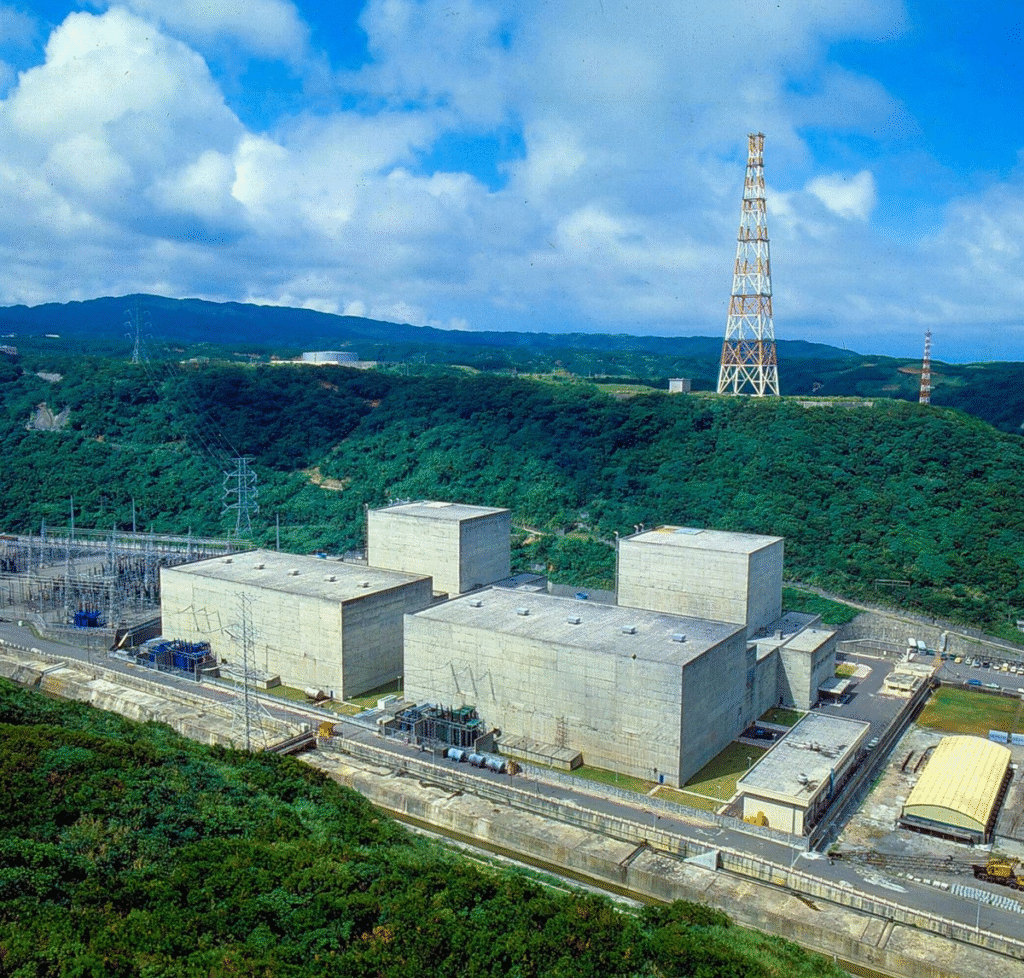
Nuclear power plant in Shimen, New Taipei, Taiwan
The Jinshan Nuclear Power Plant or Chin Shan Nuclear Power Plant[5] (金山核能發電廠), First Nuclear Power Plant (第一核能發電廠 or 核一), was a nuclear power plant in Shimen District, New Taipei, Taiwan. Commissioned in 1978, the plant was Taiwan’s first and smallest nuclear power plant.
The village of Qianhua, in Shimen District, Taipei, primarily populated by a family surnamed Lien, was demolished to construct the Jinshan Nuclear Power Plant in response to the 1970s energy crisis and incorporated into the Ten Major Construction Projects in 1973.[6]
Jinshan began generating power on 16 November 1977 and started commercial operations in December 1978.[6]
The power plant can generate 9 billion kWh of electricity per year.[7]
The two spent fuel pools at the plant have 3,074 and 3,076 spent nuclear fuel assemblies, respectively, with a maximum storage of 3,083 assemblies per pool.[8]
Decommissioning plan
[edit]
Taipower, as the operator of the power plant, was required by the Radiation Monitoring Center of the Atomic Energy Council to submit the 2018 decommissioning plans for the plant by December 2015 for the authority to review all of the plans before the decommissioning date. Once the reactors have been shut down, the plant should be dismantled within 25 years.[1]
Taipower plans to allocate NT$18.2 billion for the disposal of nuclear waste from the decommissioned plant over the next 25 years. Currently, Taipower is doing a feasibility study of building a nuclear waste storage facility on an uninhabited island off the coast of Taiwan.[9]
The July 2013 Typhoon Soulik caused a trip to the generator and turbine of the power plant Unit-2 because one suspension ground line failed and hit the transmission line when the typhoon hit the island on 13–14 July. The typhoon also caused the seawater inlet to be blocked by a large amount of debris and damaged three fine filters, the travelling filter rake, and the plant’s switchyard. The damage caused the plant to be offline for several days.[10][11]
In August 2013, it was reported that radioactive water may have been leaked from the storage pools of the nuclear power plant’s two reactors for three years. An official from Taipower said that the water might come from various sources, such as condensation water or water used for cleaning up the floors. The water, however, has been collected in a reservoir next to the storage pools used for spent nuclear rods and has been recycled back into the storage pools; thus, it is claimed to pose no threat to the environment.[12]
In December 2013, the circulating pump of the second reactor tripped due to the low lube oil pressure, which caused a built-in lube oil pump. The Atomic Energy Council was criticized for its very slow response to the public, providing answers only 10 hours after the trip.[13]
On 4 August 2016, smoke rose out from the power plant, resulting from unstable voltage frequency which caused external circuit breakers to trip and produced smoke.[14]

