
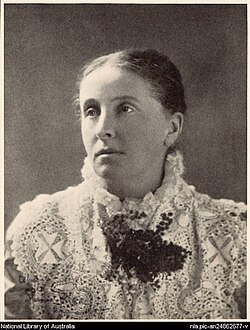
English-born Australian writer (1844–1926)
|
Ada Cambridge |
|
|---|---|
 |
|
| Born | 21 November 1844 |
| Died | 19 July 1926 (aged 81) |
| Burial place | Brighton General Cemetery |
| Other names | Ada Cross |
| Occupation | Writer |
| Spouse | George Frederick Cross |
| Children | 5 |
Ada Cambridge was born in Wiggenhall, Norfolk, on 21 November 1844. Her mother was the daughter of a doctor, while her father was a wealthy farmer. Her family moved to Thorpland around 1845 or 1846, where she would spend her early childhood. Her family was initially financially comfortable, but their financial fortunes began to suffer as a result of her father’s neglect of the farm in favour of hunting and horseriding. Sometime during the 1850s, the family moved into the town of Downham Market, where her father became a trader of corn and seeds. In 1856 Cambridge’s grandfather died, sparking a battle over inheritance that split the family and resulted in the loss of the estate. In the late 1850s, the family left for Great Yarmouth, where according to records her father worked as a “commercial traveller”. While living in Great Yarmouth, at least two of Ada’s siblings died within the span of a few months. The family then moved to Ely in Cambridgeshire.
While Ada was regarded as a gifted child by her parents, she received a very limited education. She was educated largely by a series of seven governesses, who were themselves typically poorly educated, and spent a few months at a boarding school before returning due to homesickness. Her youngest aunt was an intelligent and independent woman who worked as a governess for European royal families. She encouraged Ada’s interest in literature, and helped her to become a voracious reader.
After moving to Ely, Ada became more devoted to religion and considered becoming a nun. At around the age of 17 of 18, she began writing hymns for a church magazine. She published her first volume of hymns, Hymns on the Litany, in 1865, and followed this with her second, Hymns on the Holy Communion, in 1866. Her hymns featured a sombre and meditative tone, and a conservative theology. She began to appear in biographical dictionaries of hymnwriters, where she was described as a skilled and popular writer.
Ada wrote her first works of fiction for a church literary competition, where she won both first and second prize. The priest who judged the competition encouraged her to continue writing, and she soon began writing works of fiction for magazines and periodicals. Three of her early short stories have survived—”The Two Surplices”, “Little Jenny”, and “The Vicar’s Guest”. All three are moral tales that centre on religious themes and the experience of the poor. She also began writing poetry.
According to her biographers, by this point Ada’s life was almost “wholly church-centred”. She met a curate named George Frederick Cross, and they decided to marry and to move to Australia. After a seven-week engagement, they married on 25 April 1870 in the Holy Trinity Parish Church at Ely Cathedral. On 1 June they sailed for Australia, with plans to return to England soon.
Upon their arrival in Australia on 19 August, Ada and George spent some time touring Melbourne; Ada later wrote that she was impressed by the standard of life in the colony and by the new public infrastructure that had been established, including the University of Melbourne, the Botanical Gardens, and the new Public Library. But on 31 August they left Melbourne and travelled to the country parish in Wangaratta to which George had been appointed curate. During their journey they became lost in the bush amidst an enormous storm; Ada would later draw on this in her writing.
They settled in a cottage on the edge of Wangaratta. In March, Ada gave birth to the first of her five children, Arthur Stuart. She also became actively involved in the town’s social and community life, and was particularly involved in raising money for the church. She sometimes accompanied George on trips to the remote parts of his vast district, and learned to shoot to protect their home. In February 1871, Ada published her first work written in Australia in the Sydney Mail, a romantic poem titled “From the Battlefield. Good Night”. She earned an income from her writing that helped to supplement her husband’s meagre clergy stipend.
In January 1872, following George’s ordination to the priesthood, they left for his next posting at Yackandandah. Ada played an active role in the parish, playing the church organ, teaching classes at Sunday School, and conducting the church choir, although her poor health limited her degree of activity. She began to publish more poetry and fiction in newspapers, contributing substantially to the family’s income as George’s stipend declined. In November 1873, Ada gave birth to her second child, Edith Constance, who died of whooping cough at the age of just 10 months.
In December 1874, George and Ada moved to the town of Ballan. With clergy stipends in the Anglican church persistently low, Ada offered to write a serial for the Australasian in December 1874 to supplement the family’s income. The fourteen-episode serial, titled Up the Murray, was Ada’s first extended work of fiction and was published between March and July 1875. The story follows a young woman who suffers from seizures and hallucinations, who comes to Australia and marries a wealthy man after struggling with the question of whether she is motivated by money or by love. The story’s success enabled Ada and George to be adopted into the town’s literary and intellectual circles. She followed the serial with a volume of romantic and religious poetry, The Manor House and Other Poems, also published in 1875. The writer Raymond Beilby describes the volume as “a fairly mixed bag of religious, narrative, and descriptive verse of little consequence, showing in parts the influence of Tennyson and the Pre-Paphaelites”.
In April 1876, while Ada was nearing the birth of her third child, her four-year-old son died of scarlet fever. She gave birth to her third child, Vera Lyon, two weeks later on 26 April. That year, she published another serial, “My Guardian”, in Cassell’s Family Magazine – the serial would also be published as a book two years later. The story depicts a young woman who reluctantly marries a man and immediately falls into an illness; her husband dies, and she is free to marry the man that she truly loved. In 1877, Ada experienced a carriage accident while travelling between Ballan and Ballarat, leaving her with permanent disabilities.
In July 1877, Ada and George moved to Coleraine following the establishment of a new Diocese of Ballarat. She gave birth to her fourth child, Hugh Cambridge, on 14 August 1878. In 1879, the family attempted to raise cattle and farm the land to supplement George’s clergy stipend, but eventually abandoned the plan and instead rented out their land. That year she also wrote two new serial romance novels: “In Two Years’ Time” in the Australasian, and “The Captain’s Charge” in the Sydney Mail. She followed this with another romance serial, “Dinah”, published in the Australasian between December 1879 and February 1880.
On 3 January 1880, Ada gave birth to another son named Kenneth Stuart. She suffered a breakdown and became housebound, before also suffering a near-fatal miscarriage. She went away to recover. During her period of recovery, she produced a large volume of writing. She wrote another serial, “A Mere Chance”, initially published in the Australasian and then printed in three volumes in 1882. As her depression deepened in 1881, she began to write increasingly melancholy poetry, including one in which she expressed her support for euthanasia. She also published two more serials, “Missed in the Crowd” in the Australasian and “A Girl’s Ideal” in the Age, between late 1881 and early 1882, and a serial titled “Across the Grain” in December 1882.
In 1883 Ada published one of her most popular works, The Three Miss Kings. It was initially published as a serial in the Australasian, and then published as a book in 1892. The novel contains fairytale motifs and is staged against the backdrop of the Melbourne International Exhibition. It follows three newly orphaned young women who consider what to do with their newly found independence, before eventually settling down and finding husbands. George continued to take long trips to visit the remote parts of his parish, leaving Ada alone for long periods with her young children. She began to publish many poems expressing her sadness and her crisis of faith.
In January 1884, the family moved to Sandhurst (now Bendigo), a town of 50,000 people that was one of the colony’s major centres. That year, Ada wrote four short stories, and also began to rework some of her earlier writing to maintain her rate of publication and support the family financially. In March 1885 the family moved again to the goldfields town of Beechworth, where they would stay for the next nine years. Ada began to travel frequently to Melbourne, which was connected to Beechworth by train, and began to send her two surviving sons to Beechworth Grammar School.
While George’s stipend had finally been increased, Ada continued writing. She published her next serial, “A Little Minx”, in the Sydney Mail in 1885 – it would eventually be expanded and published in novel form in 1893. The novel centres on divorce, and criticises both feminists – who are shown to be more concerned with theoretical debates than women’s welfare – and the judgemental attitudes of society towards women.
In March 1886 Ada was admitted to hospital, with fears that she would not survive her hospitalisation, due to complications associated with her earlier miscarriage. She remained in hospital for three months before leaving against her doctor’s advice; the admission, which cost 200 pounds, had severely cut into the family’s finances. She published another volume of poetry, Unspoken Thoughts, anonymously in London in 1887. The volume features a number of poems centred on loss and grief, as well as Ada’s non-traditional views on religion and marriage. The volume was very positively received, but did not sell well, with only 150 of the 500 copies sold. Ada withdrew the volume from publication for reasons that remain uncertain; she would later refuse to allow the more controversial poems from the volume to be reprinted.
Ada’s next serial, “A Woman’s Friendship”, appeared in the Age between August and October 1889.. The novel depicts a group of women who form a society to discuss women’s rights, but end up torn apart by jealousy after pursuing a man. They eventually return to their husbands and repair their friendship. Ada’s fiction began to feature more depictions of the “New Woman”, who she suggested would only be made truly happy through marriage. Her stories also began to feature greater criticism of the hypocrisy and snobbery of the clergy.
By the early 1890s, Ada was a well-known and popular writer. She wrote two more romance novels: “Not All in Vain”, first serialised in the Australasian and then published as a book in 1892, and “A Little Minx”, a repurposing of some of her earlier serials published in 1893. Both novels were well reviewed. The family’s finances suffered as a result of Victoria’s 1890s depression, and were particularly strained by their son Hugh’s school fees at Geelong Grammar. Ada signed contracts with publishers in New York and London for her next novel, “A Marriage Ceremony”.
In October 1893 the family moved to Williamstown in Melbourne. “A Marriage Ceremony”, based on a serial that Ada had published a decade earlier in the Australasian, was published in 1894 and received positive reviews. She contracted again with publishers in New York and London for her next novel, “Fidelis”, which was based on her earlier work “A Marked Man” and was released in 1896 to positive reviews. Unlike Ada’s other fiction, Fidelis was written from a male perspective and explored the challenges of finding a suitable wife. She repeated this perspective in her next novel, A Humble Enterprise, which was also based on a previous serial she had written for the Australasian. Ada used the novel to present a moral lesson to young women, illustrating that men looked for domestic virtue when seeking a wife, and that “frivolous” matters like fashion would not help them to find a suitable husband.
Ada also began to write a number of short stories for English periodicals. In 1897 she published a collection of short stories titled At Midnight and Other Stories, which included both Gothic fiction and romance stories. Her reputation as a writer continued to grow; in 1896 she was the subject of a chapter in the book Australian Writers by the critic Desmond Byre, and in 1898 she was identified as one of Australia’s two leading “poetesses” in the book The Development of Australian Literature.
In 1898 Ada published the novel Materfamilias. The novel is narrated by a grandmother named Mary, who gives a biased recounting of her life while remaining unaware of how her manipulative behaviour and self-delusion have evidently affected those around her. According to Ada’s biographers, contemporary reviewers entirely misread the novel and failed to appreciate Ada’s use of irony. Bradstock and Wakeling regard Materfamilias as one of Ada’s best works, and write that it demonstrates “how the domestic novel can be elevated to an art form”.. She followed this with two more novels, Path and Goal and The Devestators, in 1900 and 1901.
In 1902, Ada became the first president of a newly formed society of women writers, the Melbourne Writers’ Club. She also contracted with a publisher to write her memoir, Thirty Years in Australia.. But she would also suffer personal tragedies; in 1902 her son Hugh died of typhoid fever at the age of 24, and in 1904 her son-in-law committed suicide as a result of his financial ruin, leaving Ada and George to support their daughter and infant grandson. She increased the pace of her writing, and by 1907 had published four new novels: Sisters, A Platonic Friendship, A Happy Marriage, and The Eternal Feminine.
In 1908, Ada and George returned to England for six months, where they visited George’s extended family and sites from Ada’s childhood. George had been forced to return to deal with the legal matters surrounding a family inheritance, and they had decided that in light of her poor health, Ada would accompany him. While in England, Ada began to write essays for the Atlantic Monthly and the North American Review. In these essays, she wrote about ageing, argued that wealth is a corrupting force, and described her religious journey. She also wrote about the women’s rights movement, characterising herself as a supporter of women’s rights while suggesting that modern women had undermined their own cause and allowed themselves to be treated as inferior by acting immaturely.
Later life and death
[edit]
Following George’s retirement in 1910, the couple moved to England in 1912 and settled in Cambridge. There, she published two books – The Retrospect, a reminiscence on her early life in England, in 1912, and a novel titled The Making of Rachel Rowe in 1914 – as well as a volume of poetry, The Hand in the Dark, in 1913. Ada became homesick and longed to return to Australia to be with her children. After George’s death in February 1917, Ada returned to Australia in August.
Ada had become too frail to write, but continued attempting to make money independently without being forced to rely on others. In 1919 she offered a volume of short stories to Angus & Robertson, but the publisher declined to proceed with the work. In 1921 Ada suffered a stroke, and as she became increasingly lonely and ill, she developed a correspondence with the publisher George Robertson. She published her last essay, “Nightfall”, in 1922, in which she described the “secret humiliations” of old age and wrote of her fear of becoming dependent on others’ charity. Her final published work was likely a poem that she published for Anzac Day in the magazine Woman’s World in April 1923.
While the serialised republication of her memoir Thirty Years in Australia had put her in a slightly more secure financial position, Ada remained concerned about her finances and pursued the republication of her other works. She moved into a nursing home in 1924, and then into a private hospital. She suffered another stroke in 1926, leaving her blind and paralysed. She died in Elsternwick on 19 July 1926 at the age of 82 and was buried at Brighton Cemetery.
Cambridge’s novels follow a similar formula. Most centre on the romance between a hero and a heroine, and end in marriage. Along the way, the narrative creates barriers to their marriage, such as misunderstandings, changes of heart, and moral dilemmas, which are then overcome. Cambridge’s heroines were generally attractive, morally upstanding, upper-middle class young women. Her novels often explore the challenges of finding a suitable spouse, and the expectations placed on men and women. Many of her heroines are forced to work or live independently, before ultimately finding happiness through marriage.
Bielby notes, however, that Cambridge’s writing frequently features ironic techniques that pose a challenge to interpreting her work. He suggests that she may have at times deliberately played with her traditional narrative structure to subvert readers expectations. He also observes that there is variation in Cambridge’s romances, from very simple narrative structures, to more complex plots featuring a greater cast of characters and less predictable endings. Cambridge’s use of irony and her subversion of traditional societal norms regarding marriage became more common in her later writing.
Cambridge’s fiction typically presented marriage as something that should be chosen freely. However, her romantic plots suggested that “true love” was not an essential component of a successful marriage, and that even those who do not truly love their husbands can become dutiful and happy wives. She also suggested that young women might only find the capacity for true love as they matured, after initially marrying for reasons of money or obligation. Some of her later works also criticised the desire of modern women to pursue their own passions at the cost of their duty, and suggested that true happiness would only be found through marriage.
Ada Cambridge was a popular and well-regarded writer during her lifetime and into the 1930s. She was described as the leading female novelist of her era, and was called the “doyen of women writers in Australia” upon her death. Her fiction was widely popular among Australian, English, and American readers. However, after her death, her fiction began to be regarded more critically. She was dismissed as an Anglophile interested only in trivial and womanly affairs. Her biographers Bradstock and Wakeling summarise her reputation as being that of a “frail clergyman’s wife writing romantic fiction of dubious value”. They attribute this shift in her reputation to the emergence of an Australian literary genre from the 1890s onwards, which centred around tales of the bush and male heroism. Cambridge was often discussed alongside the writers Tasma and Rosa Praed, with all three dismissed as the authors of trivial and low-quality romances.
In the 1970s a resurgence of interest in women’s writing saw a re-evaluation of Cambridge’s work. One of the catalysts for this re-evaluation of Cambridge’s writing was a 1972 article by Jill Roe, which sparked interest from other feminist scholars. Biographers and scholars have begun to regard Cambridge’s fiction as featuring more complexity, radicalism, and subversion than had previously been appreciated. Her biographer Audrey Tate notes her use of irony and experimentation, as well as the anti-establishment sentiment and liberal humanist politics that feature in much of her later work.
Notes from Bradstock & Wakeling
- Described as the leading female novelist of her era during her lifetime (1)
- Called the “doyen of women writers in Australia” upon her death (1)
- Eventually became regarded as “a frail clergyman’s wife writing romantic fiction of dubious value” (1-2)
- Examined marriage and the expectations placed on men and women by Victorian society (2)
- Exploring the difficulty of finding a suitable spouse (2)
- Had a modern view of marriage and something that should be chosen freely (2)
- Often discussed alongside Rosa Praed and Jessie Couvreur (3)
- Second child of a self-made “gentleman farmer”, Henry Cambridge, and his wife Thomasina Emmerson *the daughter of a doctor (5)
- Born 21 November 1844 at Wiggenhall in Norfolk (5)
- Spent early childhood in Thorpland (7)
- Family was upper middle class, but income eventually declined due to father’s poor management of the family’s finances and his tendency to spend his time hunting rather than managing the farm (9-10,16)
- Family moved from their farm into a house in the town of Downham Market in the 1850s (16)
- Grandfather died in 1856, sparking a battle over inheritance that split the family and resulted in the loss of the estate
- Received very limited education. Educated largely by governesses, as well as spending a few months at a boarding school before leaving due to homesickness (19-20)
- Suggested in some of her later writing that she was sexually abused or scarred in some way by a governess (21-22)
- Became a voracious reader (23-24)
- Influenced by a educated aunt who worked as a governess to take up writing (22, 26)
- Family left for Great Yarmouth in the late 1850s, when Henry Cambridge may have become a “commercial traveller” due to the family’s financial difficulties (27-28)
- Several of her siblings died within the space of a few months (28)
- Then moved to Ely in Cambridgeshire (28)
- Became more devoted to religion and considered becoming a nun (29-30)
- Wrote hymns for a church magazine at the age of 17 or 18 (30)
- Published her first volume of hymns “Hymns on the Litany” in 1865, and “Hymns on the Holy Communion” in 1866 (30)
- Her hymns had a sombre and meditative tone, and a conservative theology (31)
- Began to appear in biographical dictionaries of hymnwriters, including “Singers and Songs of the Church” and “Dictionary of Hymnology”, where she was described as a skilled and popular writer (32)
- Wrote her first works of fiction for a literary competition, where she won first and second prize (33)
- Started writing more works of fiction for magazines and periodicals (33)
- Three of her short works of fiction from her early career have survived: “The Two Surplices”, “Little Jenny”, and “The Vicar’s Guest”. All three are moralistic works centred on religion and the experiences of the poor (34)
- Life was “wholly church-centred” (35)
- Began writing poetry (36)
- Met George Frederick Cross, potentially while working as a District Visitor in the parish where he was serving as a curate (36-37)
- Decided to marry and go to Australia (37)
- Engaged for seven weeks then married on 25 April 1870 in the Holy Trinity Parish Church at Ely Cathedral (38)
- Left for Australia on 1 June (45)
- First child born in January 1871 (46)
- Met by a representative of the Bishop (48)
- Ada was very surprised and impressed by the state of the colony, and toured the University of Melbourne, the Fitzroy Gardens and Botanical Gardens, and the new Public Library (49)
- Then left Melbourne after a week to head to the parish where Cross would serve (50)
- Appointed as a curate in Wangaratta, a country town (51)
- Met the clergyman William Chalmers in Kyneton and formed a lifelong friendship (52)
- District of Wangaratta had a population of about 1400, ostly farmers (54)
- Found that Wangaratta was a lively town (55)
- Settled in a three-room cottage on the edge of the town (56)
- Found great joy in homemaking (56)
- Wrote her first work in Australia in February 1871 *a romantic poem titled “From the Battlefield. Good Night.” published in the Sydney Mail (57)
- Gave birth to the first of her five children in March (57)
- Had an active social and community life, particularly to raise money for the church (57)
- Expressed a fearful and pitying attitude towards Aboriginal Australians (60)
- Earned money from her writing that supplemented her husband’s stipend (62)
- In January 1872, left for Yackandandah (63)
- George Cross ordained as a priest on 17 December 1871 (64)
- Population of the town was 800. Mostly a mining district (65)
- George now in charge of his own parish (65)
- Played an active role in the church *teaching Sunday School, playing the organ, training the choir, and did other parish work (65)
- Suffered from poor health (68)
- Published her first extended work, “Up the Murray”, in the Australasian in 1875 (68)
- Clergy stipends in the Anglican church had remained extremely low (69)
- Published poetry and fiction in Australian newspapers (71)
- George travelled widely across the vast expanse of his district to visit parishioners (73)
- Gave birth to first daughter in November 1873; died of whooping cough after 10 months, causing Ada immense grief (73-74)
- Developed a more hostile relationship with institutional religion (74-75)
- Moved to Ballan in December 1874 *a town of 700 closer to Melbourne, where there was less need for George to undertake long journeys through the bush (76-77)
- Developed financial difficulties; Ada offered to write a serial novel for the Australasian in December 1874. Ended up writing fourteen episodes in the story, “Up the Murray”. (78)
- Story is about a young woman who suffers from seizures and hallucinations, who comes to Australia and marries a wealthy man after struggling with the question of whether she is motivated more by money or by love (79)
- Ada’s prose was always simple and direct (79)
- Heroines were always “ladylike” and “well-bred” (79-80)
- Story features more criticism of the colonial church (80-81)
- Dominant literary schools at the time were novels of about convicts and bushrangers, and stories about the Australian bush (81-82)
- Australian fiction largely focused on male heroes in the colonial setting; Ada one of the only writers describing relationships, emotions and marriage (82)
- Story allowed Ada and George to be adopted into a more exclusive social scene (82)
- Published a volume of poetry, “The Manor House and Other Poems”, in 1875 *contains a mix of romantic and religious poetry (84)
- Son died at the age of four in April 1876 of scarlet fever while Ada was expecting her third child (87)
- Gave birth to her third child, Vera Lyon, on 26 April 1876 (87)
- Published a serial, “My Guardian” in Cassell’s Family Magazine (later published as a book in 1878) (87)
- Experienced a carriage accident that led to permanent disability and frailty in 1877 (87)
- Moved to Coleraine in July 1877 after the establishment of the Diocese of Ballarat (88-90)
- Gave birth to fourth child, Hugh Cambridge, on 14 August 1878 (92)
- Published a novel titled “My Guardian” (previously serialised) in 1878 *first novel published in book form (92)
- Story is about a young woman who marries a man and immediately falls into an illness; her husband dies, and she marries the man that she truly loved (93)
- A fear of sex featured as a common theme in her fiction (93)
- Attempted to raise cattle in 1879 amid a depression and a stretch in their finances, but eventually rented out their land to supplement the family’s income (94)
- Wrote two new serials in 1879: “In Two Years’ Time” in the Australasian, and “The Captain’s Charge” in the Sydney Mail. Both are romances about young women finding marriage (94-95)
- Many of Ada’s works feature unhappy brides (95)
- Wrote “Dinah”, a serial in the Australasian from December 1879 *February 1880 (97)
- Dinah depicts an unwell young woman named Nan and her half-sister Dinah, who are both in love with a man named Noel Rutledge. Dinah decides he is not wealthy enough for her and marries another man, while Nan married Noel. After Nan and Dinah’s husband die, Dinah realises her mistake and marries Noel (97-98)
- Dinah is a more independent heroine (98)
- Noel Rutledge is a well-bred hero, and is contrasted with Dinah’s wealthy but common first husband (98)
- Ada gave birth to another son, Kenneth Stuart, on 3 January 1880 (99)
- She suffered a mental breakdown and went away to recover (99)
- She wrote another serial, “A Mere Chance”, in 1880 for the Australasian, which was published in 1882 in three volumes (99)
- “A Mere Chance” depicts an 18-year-old orphan who becomes engaged, and then falls in love with another man. She is convinced to break off the engagement, but eventually marries her fiance after all. As in “Dinah”, her husband eventually dies and encourages her to marry the man that she truly loved (99-100)
- Ada’s novels show that even those who do not love their spouses can still be dutiful and happy wives. She views romantic love as a positive, but not as essential for a happy life (100-101)
- Ada began to write increasingly melancholy poetry as her depression deepened in 1881 (102)
- She wrote another serial novel, “Missed in the Crowd”, for The Australasian between October 1881 and March 1882 (102)
- Ada, suffering from poor health, wrote a poem in which she expressed her support for euthanasia (104)
- Ada suffered a miscarriage around this time that almost killed her (106)
- She wrote another piece for the Age between December 1881 and January 1882 titled “A Girl’s Ideal” (106)
- She wrote another work titled “The Three Miss Kings” for the Australasian in 1883, later published as a book in 1892 (107,112)
- George continued long trips around the parish, leaving Ada alone for long periods (107)
- Her next serial, “Across the Grain”, was published in The Australasian in December 1882 (107)
- Ada gradually moved towards attacking women who marry for money (109)
- She published many poems expressing her sadness and her crisis of faith (111)
- “The Three Miss Kings” was one of her most popular works and was probably written in Mount Macedon while Ada was recovering from her breakdown (112)
- The novel contains fairytale motifs and is set on the backdrop of the Melbourne International Exhibition. It describes three young women raised in country Victoria. Newly orphaned, they consider what to do with their independence, but eventually find husbands and submit to them (113-114)
- One of the Kings also experiences a religious crisis similar to Ada’s own, eventually realising the flaws of religious institutions and deciding that faith in God is what is most important (115-116)
- They left for Sandhurst (now Bendigo), where George became priest in January 1884 (117-118)
- The town had a population of more than 50,000 people and was one of the colony’s major centres (122)
- Ada initially went to Melbourne to seek a treatment for her illness (117)
- Ada wrote four short stories in 1884 (118)
- Ada began to rework some of her earlier stories to maintain her rate of publication and make money for the family (119-120)
- In March 1885 the family moved from Sandhurst to Beechworth, where they would stay for nine years (122)
- Beechworth was a goldfields town, with a district population of over 7500 (123)
- Ada began to travel frequently to Melbourne, which was connected to Beechworth by train (124)
- She sent her two surviving sons to Beechworth Grammar School, while her daughter was educated by governesses (124)
- The family’s finances had finally improved; George’s stipend was now almost 400 pounds per year (124)
- She published a serial called “A Little Minx” in the Sydney Mail between October and December 1885 (125)
- The story was later expanded and published in 1893 (125)
- She published another serial, “Against the Rules: An Episode”, between November 1885 and 1886 in the Australasian (125)
- The story centres on divorce, which was the subject of a live debate at the time (126)
- The novel criticises both feminists, who are shown to be more concerned with theory than the welfare of women, and judgemental society (126)
- In March 1886 Ada was admitted to hospital, with fears that she would not survive, due to medical issues associated with her earlier miscarriage (128)
- She stayed for nearly three months, then left against her doctor’s advice. (129)
- The admission cost 200 pounds and severly cut into the family’s finances (130)
- Ada published another volume of poetry, Unspoken Thoughts, anonymously in London in 1887. Many of the poems centre on loss and grief. (130-131)
- The volume was very positively received, with positives reviews in both Australia and in Europe. However, it did not sell well, with only 150 of the 500 copies sold. Ada withdrew the volume from publication for unknown reasons; she would later refuse to allow the more controversial entries to be reprinted. (138-139)
- Ada visited Sydney in July 1887 (141-142,148)
- Ada’s health began to improve after her return, and the family’s finances were more secure. The smaller size of the parish also meant that George was no longer absent on long trips (149)
- Ada began to write more stories about the “New Woman” (150)
- Her stories also began to criticise the hypocrisy and snobbery of the clergy (152)
- Ada suggested in her novels that the “New Woman” would still only be made happy by marriage (153-154)
- Melbourne saw a major economic boom in the late 1880s (154)
- Ada wrote another serial, “A Woman’s Friendship”, in the Age between August and October 1889 (155)
- The novel features several women who form a society to discuss women’s rights. They are torn apart by jealousy after pursuing a man, but eventually return to their husbands and repair their relationship. (156)
- Ada’s writing was not wholly critical of the feminist movement, but did contain some scepticism towards the idealistic naivety of activists (156)
- Ada published a few short stories and poems in the Bulletin (158-159)
- She wrote another serial, “Not All in Vain”, for the Australasian between December 1890 and April 1891. It was published as a book in 1892. The novel features a young woman who becomes engaged to the son of a squatter during her journey to Australia. He accidentally kills a man and is imprisoned. While Katherine remains faithful for 20 years and founds her own hospital, she eventually happily marries the brother of his victim and returns to England (160-161)
- The novel was well-reviewed. (161)
- By the early 1890s, Ada was a well-known and popular writer (162-163)
- Ada is closely tied to Rosa Praed and Tasma in historical analysis (163)
- In 1893, Ada published “A Little Minx” *a repurposing of some of her earlier serials. It describes the life of Nancy Primrose, the wife of an English curate who comes to Australia. She marries a squatter after her husband’s death. Her second husband and her child die in a bushfire, and she becomes engaged for a third time. The novel ends with her death on her way to be married. (163)
- The novel was well-reviewed (163)
- Ada wrote several stories showing that young women married for reasons of money or obligation, and that they did not find the capacity for true love until they were older (164)
- By 1890, Victoria was on the brink of a financial crisis (165)
- The family’s finances suffered as a result of the 1890s depression (165)
- The family’s finances were particularly strained by the school fees of their son Hugh at Geelong Grammar (166)
- They had been searching for a parish in Melbourne for a while. They eventually reached an agreement with the priest at Williamstown to exchange their parishes (166)
- In October 1893 the family moved to Williamstown (168)
- Shortly before leaving for Williamstown, Ada signed contracts with publishers in New York and London for her next novel, “A Marriage Ceremony” (172)
- The novel was published in 1894, and was based on the story “Mrs Carnegie’s Husband”, published ten years earlier in the Australasian (172-173)
- Much of Ada’s time was taken up with managing her household, limiting the time that she was able to spend on her writing (173-174)
- The reviews of “A Marriage Ceremony” were positive (174)
- In January 1895 she contracted with publishers in New York and London for her next novel “Fidelis”, which was published in 1896 (174)
- The novel was based on “A Marked Man” (175)
- “Fidelis” also received generally positive reviews (175)
- Unlike Ada’s other novels, Fidelis explored the the challenges of finding a suitable wife from a male perspective (176)
- Her next novel, A Humble Enterprise, was also written from the perspective of a man seeking a wife. It was based on a serial that she had written for the Australasian in 1891 (178)
- Ada used the novel to present a moral lesson to young women, telling them that men looked for domestic virtue in a wife, and that “frivolous” matters like clothes were unimportant (180)
- She then wrote a number of short stories for English periodicals (180-181)
- In 1897, she published a collection of short stories called At Midnight and Other Stories, including both Gothic fiction and romance (181)
- In 1896 she was the subject of a chapter in a book titled Australian Writers by the critic Desmond Byre (182)
- In 1898 she was identified as one of two leading “poetesses” in the book The Development of Australian Literature (183)
- In 1898 “Materfamilias” was published (183)
- Materfamilias is narrated by a grandmother named Mary, who gives a biased recounting of her life, unaware of how her manipulative behaviour and self-delusion have evidently affected those around her. (184)
- According to Ada’s biographer, reviewers misread the novel and failed to understand the irony of the story. (185)
- Ada’s biographer writes that the novel demonstrates “how the domestic novel can be elevated to an art form” and is one of her best works, alongside “The Three Miss Kings” and “A Marked Man” (186)
- Ada’s next novel, Path and Goal, was published in London in 1900 (186)
- Her next novel, The Devestators, was published in 1901 (189)
- In 1902, Ada’s son Hugh died of typhoid fever at the age of 24 (192)
- In 1902 she became the first President of a newly formed society of women writers, the Melbourne Writers’ Club (192)
- She also contracted with a publisher to write her memoir, Thirty Years in Australia (192)
- Her memoir received favourable reviews, although some would later write that it revealed the lack of substance to her life (194)
- Ada’s son in law committed suicide after suffering financial ruin in January 1904 (195)
- In February 1904 she contracted with a publisher to write a new novel titled Sisters; the increased pace of her writing was likely driven by the family’s financial situation and the need to support her daughter and infant grandson (195-196)
- Ada notes that romantic love is not what ensures a happy and sustainable marriage (197)
- Her next novel, A Platonic Friendship, was published in 1906 (198)
- She contributed six poems to Bertram Steven’s “Anthology of Australian Verse” the same year (201)
- Her novel A Happy Marriage was also published (202)
- Ada demonstrates that “true love” will not necessarily lead to a happy marriage (203)
- In 1907, her novel The Eternal Feminine was published (204)
- By 1907, the family had moved to Healesville (204)
- The Eternal Feminine criticises the “new woman” and the desire of young women to pursue their own passions at the cost of their duty. (207)
- In 1908, Ada and George returned for six months to England. (208-209)
- They visited George’s family and several sites from her childhood (210-211)
- She published another novel, The Retrospect, in 1912 (215)
- Her final novel, The Making of Rachel Rowe, was published in 1914 (215)
- While she was in England, Ada wrote essays for the Atlantic Monthly and the North American Review (215)
- In these essays in the Atlantic, Ada wrote about her experiences of ageing, explored the value of money, arguing that wealth is corrupting and described her religious journey. (216-217)
- In a 1911 essay in the North American Review, Ada explained her view of the women’s rights movement. She characterised herself as a supporter of women’s rights, but said that modern women had allowed themselves to be treated as inferior by acting immaturely and allowing themselves to be occupied by trivial and frivolous matters like fashion. (217-218)
- In 1912, after George’s retirement, the couple moved to England (218-219)
- Ada published The Retrospect in 1912, then The Hand in the Dark in 1913, and finally the Making of Rachel Rowe in 1914 (220)
- They settled in Cambridge (220)
- Ada became homesick and longed to return to Australia to be with her children (221)
- The Hand in the Dark was a new volume of poems, some taken from Unspoken Thoughts (222)
- The volume did not sell well and was not well-reviewed; one reviewer dismissed it as old-fashioned and as having none of the normal features of Australian literature (223)
- The novel expressed a greater sense of anger at the treatment of the poor and vulnerable (226)
- The remaining copies of the book were ultimately destroyed after they failed to sell or to find a publisher interested in republishing them (229-230)
- Her final novel depicts the evolution of a young woman named Rachel Rowe from a spoiled and independent girl into a strong and courageous woman and single mother. It ends with her happy marriage (230)
- On 27 February 1917, George died (232)
- After his death, Ada decided to return to Australia. She departed in August (233)
- While she considered writing a final work about her time in England and her journey back to Australia amidst the First World War, she was by that point too frail to write (235)
- She sought to continue making money independently (236)
- In 1919 she offered a volume of short stories titled “The Good Old Times: Some Episodes” to Angus & Robertson, but the publisher declined to proceed with the work (236,238)
- In 1921 Ada suffered a stroke (238)
- As she became increasingly lonely and ill, she developed a correspondence with the publisher George Robertson (238)
- In a 1922 interview, Ada said that she had always preferred sewing to writing and that she had had to fit her writing among her domestic duties (239)
- Ada published her last essay, “Nightfall” in 1922. She describes the “secret humiliations” of old age and writes of her fear of becoming dependent on others’ charity. (239)
- Her likely final literary work was a poem published for Anzac Day in Woman’s World in April 1923 (241)
- While she was in a slightly more secure financial position after the serialised republication of Thirty Years in Australia, she remained concerned about money and pursued the republication of her other works (240-241)
- She moved into a nursing home in 1924 (241)
- She eventually moved into a private hospital (244)
- In 1926 Ada likely suffered another stroke, leaving her blind and paralysed. She died in Elsternwick on 19 July 1926 at the age of 82 (244)
- She was buried at the Brighton Cemetary (244)
- During Ada’s life and into the 1930s, she was a well-regarded novelist (246-247)
- Eventually Ada, alongside Tasma and Rosa Praed, became dismissed as a writer of low-quality romances (247)
- Ada’s biographer writes that the emergence of Australian literary genre from the 1890s onwards, centred around tales of the bush and male heroism, lead to the dismissal of Ada’s writing (247)
- A 1972 article by Jill Roe and other works by feminist scholars led to renewed interest in Ada’s writing (248)
- She has come to be regarded as a more complex and radical figure than her reputation suggested (248-249)
Notes from Tate
Notes from Belby

- Novels
- The Two Surplices (1865)
- My Guardian: A Story of the Fen Country (1874)
- Up the Murray (1875)
- In Two Years Time (1879)
- Dinah (1880)
- A Mere Chance (1880)
- Missed in the Crowd (1882)
- A Girl’s Ideal (1882)
- Across the Grain (1882)
- The Three Miss Kings (1883)
- A Marriage Ceremony (1884)
- A Little Minx (1885)
- Against the Rules (1886)
- A Black Sheep (1889)
- A Woman’s Friendship (1889) (Serialised in the Age, 1889; first published in book form in 1988)
- A Marked Man (1890)
- Not All in Vain (1891)
- Fidelis (1895)
- A Humble Enterprise (1896)
- Materfamilias (1898)
- Path and Goal (1900)
- The Devastators (1901)
- Sisters (1904)
- A Platonic Friendship (1905)
- A Happy Marriage (1906)
- The Eternal Feminine (1907)
- The Making of Rachel Rowe (1914)
- Poetry collections
- Hymns on the Litany (1865)
- Hymns on the Holy Communion (1866)
- Echoes (1869)
- The Manor House and Other Poems (1875)
- Unspoken Thoughts (1887)
- The Hand in the Dark and Other Poems (1913)
- Short story collections
- The Vicar’s Guest: A Tale (1869)
- At Midnight and Other Stories (1897)
- Children’s fiction
- Autobiography
- Thirty Years in Australia (1903)
- The Retrospect (1912)

