
From Wikipedia, the free encyclopedia
Content deleted Content added
|
Tags: Mobile edit Mobile web edit
|
|||
| Line 2: | Line 2: | ||
|
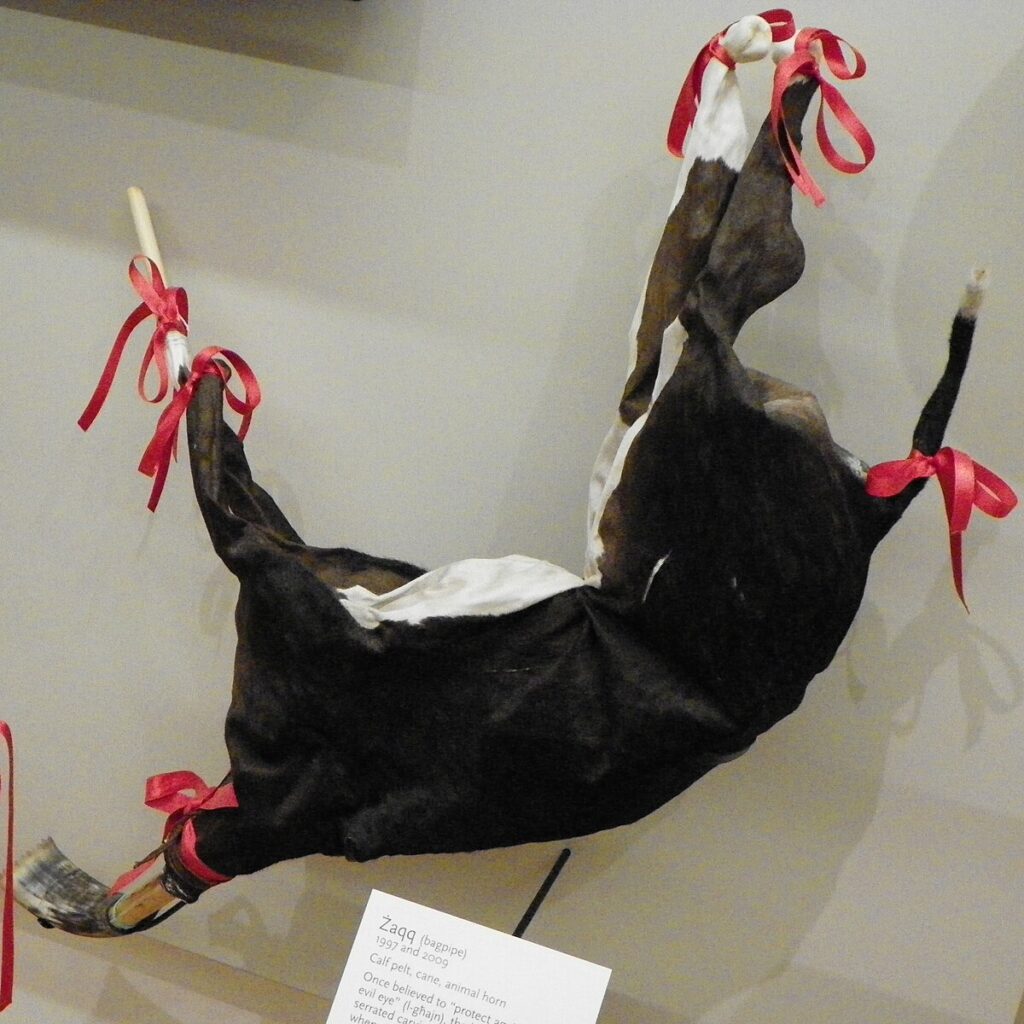
[[File:A żaqq (bagpipe), made from calf pelt, cane, and animal horn.jpg|thumb|Example of a żaqq, in the Phoenix [[Musical Instrument Museum (Phoenix)|Musical Instrument Museum]].]] |
[[File:A żaqq (bagpipe), made from calf pelt, cane, and animal horn.jpg|thumb|Example of a żaqq, in the Phoenix [[Musical Instrument Museum (Phoenix)|Musical Instrument Museum]].]] |
||
|
The ”’żaqq”’ ({{IPA|mt|zɐʔ}}) is the most common form of [[ |
The ”’żaqq”’ ({{IPA|mt|zɐʔ}}) is the most common form of [[]] [[]], and was once associated with Maltese folk festivals.<ref name=”BugejaBuhagiar1993″>{{cite book|author1=Lino Bugeja|author2=Mario Buhagiar|author3=Stanley Fiorini|title=Birgu: a Maltese maritime city|url=https://books.google.com/books?id=YI7iAAAAMAAJ|accessdate=24 April 2011|year=1993|publisher=Malta University Services|isbn=978-99909-44-01-3|pages=382 }}</ref> |
||
|
==History== |
==History== |
||
Latest revision as of 16:42, 28 November 2025
Maltese bagpipe
,_made_from_calf_pelt,_cane,_and_animal_horn.jpg)
The żaqq (Maltese pronunciation: [zɐʔ]) is the most common form of bagpipes from Malta, and was once associated with Maltese folk festivals.[1]
The use of the żaqq in daily life came to an end in the 1970s, the instrument having been perhaps replaced by the accordion earlier in the century.[2] In 1977 the Galpin Society noted only nine remaining traditional pipers in Malta; the last of these, Toni “l-Hammarun” Cachia, died in 2004.[3] Various folk music ensembles such as Etnika have attempted to revive the instrument.
Etymology and spelling
[edit]
It is sometimes erroneously referred to as the zapp due to a spelling error in a 1939 English-language publication. The Maltese word żaqq literally means “sack” or “belly” and derives from Arabic ziqq ( “skin” [as a receptacle]). is sometimes stated that żaqq derives from Italian zampogna but this is not the case.

