
[[Category:Buildings and structures in Knoxville, Tennessee]]
[[Category:Buildings and structures in Knoxville, Tennessee]]
[[Category:Office buildings in Tennessee]]
[[Category:Office buildings in Tennessee]]
[[Category:1940s architecture in the United States]]
Historic building in Knoxville, Tennessee
| Sears Roebuck Building | |
|---|---|

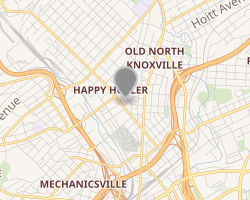
Interactive map of Sears Roebuck Building |
|
| Built | 1948 |
| Architectural style | Art Deco |
| Owner | Knox County |
Sears Roebuck Building, also known as the Old Sears Building[1] and the Knox County Central Building,[2] is an office building in Knoxville, Tennessee, United States.It was initiallly constructed in 1948 for Sears, Roebuck & Company as a retail store.
The building stands on a site that previously hosted a local baseball games and the old North Knoxville School, both of which were demolished before construction began.[2][3] Built between 1946 and 1948,[2] it became the first major department store located outside Downtown Knoxville and featured the largest free parking lot in the city at that time.[4]
The store represented Sears’ relocation from its former Gay Street location in downtown Knoxville.[5][6] The original design included marble floors, escalators, and a free shuttle to Gay Street.[7]
In April 1949, country singer Maybelle Carter, her teenage daughter June Carter, and guitarist Chet Atkins held a record-signing event at the store.[8]
The store closed in 1984 after the opening of Sears’ West Town Mall location, which became the company’s primary Knoxville store. In 1991, the building underwent renovation for use by the Knox County School System as office and warehouse space. Renovations included a long strip of glass blocks on two sides of the building.[9]
As of 2025, the building houses Knox County Records Management, Purchasing and Veterans Services.[7]
The building appears in Richard Marius’s last novel An Affair of Honor (2001), which is partly set in Knoxville and describes the Sears Roebuck Building as a place of “diabolical ugliness”.[4][10]

