
{{Short description|Australian convict and Bass Strait sealer}}
{{Short description|Australian convict and Bass Strait sealer}}
{{use dmy dates}}
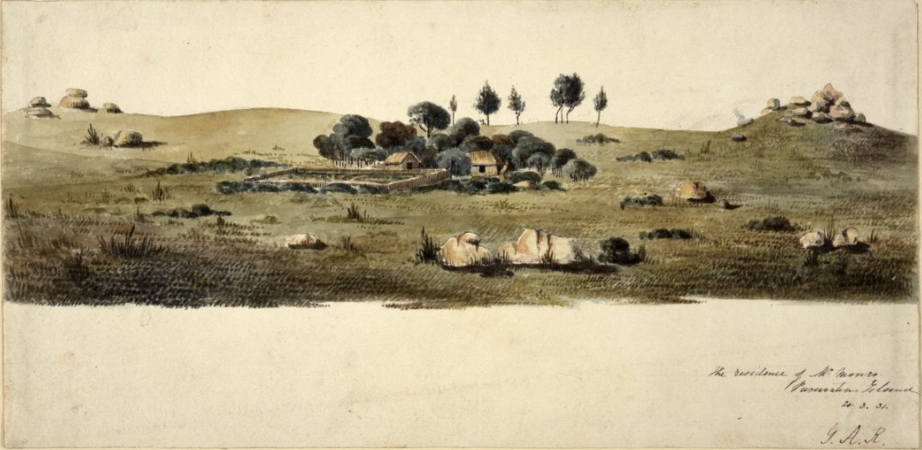
[[File:Henry Laing Establishment of James Munro.jpg|right|thumb|A view in Tasmania – Preservation Island, off SW corner of Cape Barren Island; view of the establishment of James Munro in centre, on broad plain, surrounded by cluster of trees. 1831 Pen and grey ink and watercolour ([[Henry Laing]], 1831)]]
[[File:Henry Laing Establishment of James Munro.jpg|right|thumb| establishment, surrounded by cluster of trees and grey ink and watercolour [[Henry Laing]], 1831)]]
”’James Munro”’ ({{circa|1779}}{{snd}}{{circa|1845}}<ref>
{{Australian Dictionary of Biography
|last= Valentine
|first= Barbara
|year= 2005
|volume= Supplementary Volume
|id2= munro-james-13122
|title= Munro, James (1779–1845)
|accessdate= 16 November 2014
}}
Munro established himself on the island, with him and various [[indigenous Australians|indigenous]] female partners being the only inhabitants. He built structures, farmed, raised livestock, and harvested the meat and eggs of [[short-tailed shearwater|mutton birds]].<ref name=”Backhouse1843″>{{cite book |first=James |last=Backhouse |title=A Narrative of a Visit to the Australian Colonies |url=https://archive.org/details/anarrativeavisi01backgoog |year=1843 |publisher=Hamilton, Adams and Co. |pages=[https://archive.org/details/anarrativeavisi01backgoog/page/n98 75]ff}}</ref>
Munro established himself on the island, with him and various [[ |]] female partners being the only inhabitants. He built structures, farmed, raised livestock, and harvested the meat and eggs of [[short-tailed shearwater|mutton birds]].<ref name=”Backhouse1843″>{{cite book |first=James |last=Backhouse |title=A Narrative of a Visit to the Australian Colonies |url=https://archive.org/details/anarrativeavisi01backgoog |year=1843 |publisher=Hamilton, Adams and Co. |pages=[https://archive.org/details/anarrativeavisi01backgoog/page/n98 75]ff}}</ref>
Munro was appointed a local constable in 1825, and opposed [[George Augustus Robinson]]’s attempts to prevent relationships between [[seal hunting|sealers]] and Aboriginal women.<ref name=”Rae-Ellis1996″>{{cite book |first=Vivienne |last=Rae-Ellis |title=Black Robinson: Protector of Aborigines |url=https://books.google.com/books?id=otEaZNfpbKwC&pg=PA72 |year=1996 |publisher=Melbourne University Publish |isbn=978-0-522-84744-4 |pages=72ff}}</ref> It is still disputed as to how consensual those relationships were. Some argue that they were often voluntary and mutually beneficial, but Munro was accused in 1830 of leading sealers in raiding parties to capture Aboriginal women.<ref name=”Haebich2000″>{{cite book |first=Anna |last=Haebich |title=Broken Circles: Fragmenting Indigenous Families 1800-2000 |url=https://books.google.com/books?id=vT6UpqhaEP4C&pg=PA80%7Cdate%3D1+November+2000%7Cpublisher%3DFremantle+Press%7Cisbn%3D978-1-921888-14-4%7Cpages%3D80%E2%80%93%7D%7D%3C%2Fref%3E |date=1 November 2000 |publisher=Fremantle Press |isbn=978-1-921888-14-4 |pages=80ff}}</ref>
Munro was appointed a local constable in 1825, and opposed [[George Augustus Robinson]]’s attempts to prevent relationships between sealers and Aboriginal women.<ref name=”Rae-Ellis1996″>{{cite book |first=Vivienne |last=Rae-Ellis |title=Black Robinson: Protector of Aborigines |url=https://books.google.com/books?id=otEaZNfpbKwC&pg=PA72 |year=1996 |publisher=Melbourne University Publish |isbn=978-0-522-84744-4 |pages=72ff}}</ref> It is still disputed as to how consensual those relationships were. Some argue that they were often voluntary and mutually beneficial, but Munro was accused in 1830 of leading sealers in raiding parties to capture Aboriginal women.<ref name=”Haebich2000″>{{cite book |first=Anna |last=Haebich |title=Broken Circles: Fragmenting Indigenous Families 1800-2000 |url=https://books.google.com/books?id=vT6UpqhaEP4C&pg=PA80%7Cdate%3D1+November+2000%7Cpublisher%3DFremantle+Press%7Cisbn%3D978-1-921888-14-4%7Cpages%3D80%E2%80%93%7D%7D%3C%2Fref%3E |date=1 November 2000 |publisher=Fremantle Press |isbn=978-1-921888-14-4 |pages=80ff}}</ref>
He died in December 1844 or January 1845 on the and was buried near his home. The ”[[Hobart Town Courier]]” published an obituary of him which praised his kindness. It reported that he left three children by an Aboriginal woman. [[Louisa Briggs]] was possibly his granddaughter.<ref name=adb/>
Mount Munro and Munro Bay on Cape Barren Island were named after him.<ref name=adb/>
* [[George Briggs (sealer)]]
* [[George Briggs (sealer)]]
Australian convict and Bass Strait sealer

James Munro (c. 1779 – c. 1845[1]) was a British convict who was transported to Australia, and later established himself as a farmer on Preservation Island, Tasmania, and community leader of the region’s community of European seal hunters, known as “King of the Eastern Straits”.[2]
Munro established himself on the island, with him and various Aboriginal female partners being the only inhabitants. He built structures, farmed, raised livestock, and harvested the meat and eggs of mutton birds.[3]
Munro was appointed a local constable in 1825, and opposed George Augustus Robinson‘s attempts to prevent relationships between sealers and Aboriginal women.[4] It is still disputed as to how consensual those relationships were. Some argue that they were often voluntary and mutually beneficial, but Munro was accused in 1830 of leading sealers in raiding parties to capture Aboriginal women.[5]
He died in December 1844 or January 1845 on the and was buried near his home. The Hobart Town Courier published an obituary of him which praised his kindness. It reported that he left three children by an Aboriginal woman. Louisa Briggs was possibly his granddaughter.[1]
Mount Munro and Munro Bay on Cape Barren Island were named after him.[1]
- ^ a b c Valentine, Barbara (2005). “Munro, James (1779–1845)”. Australian Dictionary of Biography. Vol. Supplementary Volume. National Centre of Biography, Australian National University. ISBN 978-0-522-84459-7. ISSN 1833-7538. OCLC 70677943. Retrieved 16 November 2014.
- ^ Religious Tract Society (Great Britain) (1799). Australia: Its Scenery, Natural History, and Resources, with a Glance at Its Gold Fields. pp. 9ff.
- ^ Backhouse, James (1843). A Narrative of a Visit to the Australian Colonies. Hamilton, Adams and Co. pp. 75ff.
- ^ Rae-Ellis, Vivienne (1996). Black Robinson: Protector of Aborigines. Melbourne University Publish. pp. 72ff. ISBN 978-0-522-84744-4.
- ^ Haebich, Anna (1 November 2000). Broken Circles: Fragmenting Indigenous Families 1800-2000. Fremantle Press. pp. 80ff. ISBN 978-1-921888-14-4.

