| ← Previous revision | Revision as of 20:14, 30 November 2025 | ||
| Line 25: | Line 25: | ||
|
Across clinical studies, the most commonly reported adverse events were gastrointestinal symptoms such as nausea, vomiting, and diarrhea.<ref>{{cite journal | vauthors = Jastreboff AM, Kaplan LM, Frías JP, Wu Q, Du Y, Gurbuz S, Coskun T, Haupt A, Milicevic Z, Hartman ML | title = Triple-Hormone-Receptor Agonist Retatrutide for Obesity – A Phase 2 Trial | journal = The New England Journal of Medicine | volume = 389 | issue = 6 | pages = 514–526 | date = August 2023 | pmid = 37366315 | doi = 10.1056/NEJMoa2301972 }}</ref>
|
Across clinical studies, the most commonly reported adverse events were gastrointestinal symptoms such as nausea, vomiting, and diarrhea.<ref>{{cite journal | vauthors = Jastreboff AM, Kaplan LM, Frías JP, Wu Q, Du Y, Gurbuz S, Coskun T, Haupt A, Milicevic Z, Hartman ML | title = Triple-Hormone-Receptor Agonist Retatrutide for Obesity – A Phase 2 Trial | journal = The New England Journal of Medicine | volume = 389 | issue = 6 | pages = 514–526 | date = August 2023 | pmid = 37366315 | doi = 10.1056/NEJMoa2301972 }}</ref>
|
||
|
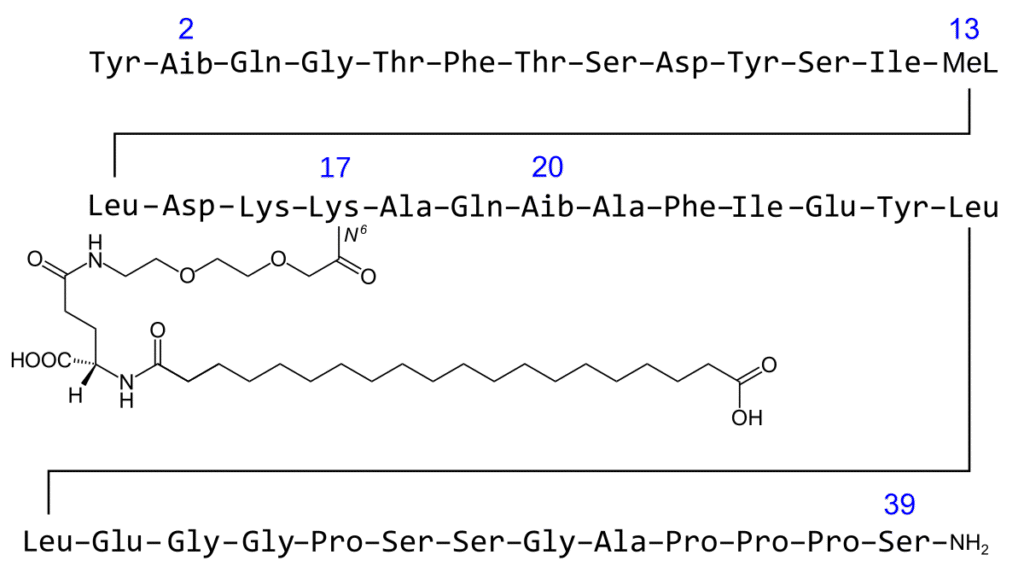
Preclinical and biochemical studies describe receptor activity at GLP-1, GIP, and glucagon receptors.<ref>{{Cite web | title = Compound: RETATRUTIDE (CHEMBL5095485) | url = https://www.ebi.ac.uk/explore/compound/CHEMBL5095485 | access-date = 2025-11-24 | website = www.ebi.ac.uk }}</ref> Reports on its development state that it was engineered for activity across these targets.<ref
|
Preclinical and biochemical studies describe receptor activity at GLP-1, GIP, and glucagon receptors.<ref>{{Cite web | title = Compound: RETATRUTIDE (CHEMBL5095485) | url = https://www.ebi.ac.uk/explore/compound/CHEMBL5095485 | access-date = 2025-11-24 | website = www.ebi.ac.uk }}</ref> Reports on its development state that it was engineered for activity across these targets.<ref =/>
|
||
|
Systematic reviews and meta-analyses of randomized controlled trials report that retatrutide produces substantial reductions in body weight in adults with obesity, with mean percentage weight loss typically between 15 and 24 percent over 48 to 72 weeks, depending on study protocols and populations.<ref name=”Tewari_2025″ /><ref name=”Abdrabou_Abouelmagd_2025″ /><ref name=”Katsi_2025″ /><ref name=”Olowo-Oribi_2025″ /><ref name=”Sinha_2025″ /> Adverse events are most commonly gastrointestinal symptoms such as [[nausea]] and [[diarrhea]], with relatively low rates of study discontinuation and infrequent serious adverse events reported during trials.<ref name=”Tewari_2025″ /><ref name=”Abdrabou_Abouelmagd_2025″ /><ref name=”Katsi_2025″ /> Safety assessments also indicate a low risk of [[hypoglycemia]] and no significant elevation in cardiovascular or hepatic adverse events in non-diabetic populations across published studies.<ref name=”Olowo-Oribi_2025″ /><ref name=”Sinha_2025″ />
|
Systematic reviews and meta-analyses of randomized controlled trials report that retatrutide produces substantial reductions in body weight in adults with obesity, with mean percentage weight loss typically between 15 and 24 percent over 48 to 72 weeks, depending on study protocols and populations.<ref name=”Tewari_2025″ /><ref name=”Abdrabou_Abouelmagd_2025″ /><ref name=”Katsi_2025″ /><ref name=”Olowo-Oribi_2025″ /><ref name=”Sinha_2025″ /> Adverse events are most commonly gastrointestinal symptoms such as [[nausea]] and [[diarrhea]], with relatively low rates of study discontinuation and infrequent serious adverse events reported during trials.<ref name=”Tewari_2025″ /><ref name=”Abdrabou_Abouelmagd_2025″ /><ref name=”Katsi_2025″ /> Safety assessments also indicate a low risk of [[hypoglycemia]] and no significant elevation in cardiovascular or hepatic adverse events in non-diabetic populations across published studies.<ref name=”Olowo-Oribi_2025″ /><ref name=”Sinha_2025″ />
|
||
Retatrutide