
The [[Battle of Shaiba]] took place during the [[World War I|First World War]] in 1915, between the [[British Empire]], and the [[Ottoman Empire]] at an area called Shaiba near Basrah. The Albu Salih tribesmen fought alongside the Ottomans, and the Muntafiq, under the leadership of Shaikh [[:ar:عجمي_السعدون|Ujaimi al-Sadun]] ([[Emir]] of the [[Al-Muntafiq|Muntafiq]]) trying to retake back the city of Basrah from the British.<ref name=”:3″ /><ref name=”:1″ /><ref name=”:4″ />
The [[Battle of Shaiba]] took place during the [[World War I|First World War]] in 1915, between the [[British Empire]], and the [[Ottoman Empire]] at an area called Shaiba near Basrah. The Albu Salih tribesmen fought alongside the Ottomans, and the Muntafiq, under the leadership of Shaikh [[:ar:عجمي_السعدون|Ujaimi al-Sadun]] ([[Emir]] of the [[Al-Muntafiq|Muntafiq]]) trying to retake back the city of Basrah from the British.<ref name=”:3″ /><ref name=”:1″ /><ref name=”:4″ />
The reason behind why the Albu Salih fought in this battle, was due to the Fatwa of Jihad against the foreign British forces, that was released by religious scholars. Although it was well known during that time, all the tribesman of Albu Salih, and their leaders had a long time rivalry, and hatred towards the Ottomans.<ref name=”:1″ /><ref name=”:4″ />
The reason behind why the Albu Salih fought in this battle, was due to the Fatwa of Jihad against the foreign British forces, that was released by religious scholars. Although it was well known during that time, all the tribesman of Albu Salih, and their leaders had a long time rivalry, hatred towards the Ottomans.<ref name=”:1″ /><ref name=”:4″ />
==Shaikh Bader Al Rumaiyadh==
==Shaikh Bader Al Rumaiyadh==
Arabic tribe
The Albu Salih tribe (Arabic: آلبو صالح) is an original Arab tribe from Bani Malik of the Al-Muntafiq.[1]
During the 19th century (mid 1800s), the Albu Salih transformed into a tribal confederation, a warfare alliance against foreign enemies. This alliance helped reduce the conflicts between neighboring clans that had different Arab tribal origins.
The Albu Salih grew in power, and under the leadership of Shaikh Badr Al Rumaiyadh, they had become the most influential tribe in the Bani Malik region of the Muntafiq Emirate. This resulted in Shaikh Bader’s rise to become the paramount Shaikh of the Bani Malik region.[2]
Indigenous Lands and Territory
[edit]
In the past, the tribe consisted of villagers, marshmen, and semi-nomads.
Settled Branches of Albu Salih
[edit]
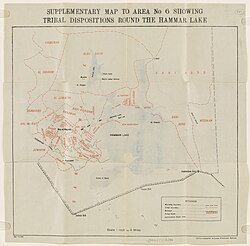
The villagers settled in villages, while the marsh men lived in the great marshes of the Albu Salih tribal territory (click to see map in 1941), known today as the district of Al’ Islah (in Dhi Qar). The district was established by Shaikh Sulaiman bin Mansur Al Nasrallah in 1918.[1][3]
The Albu Salih territory was rich in arable land, and marshes, which promoted agriculture for the settlers. The sophisticated geography of the Marshes, was in great advantage of Shaikh Bader’s resistance against the British occupation of Southern Iraq.[4]

Nomads of Albu Salih
[edit]
As for the bedouin semi-nomads in the past, they would migrate south on their annual migration during autumn, camping and herding their livestock in the North Eastern parts of Arabia[5] [6](Southern Iraq; Northern and Western Kuwaiti territories today).
The Albu Salih clans were well armed, they would migrate, and cross the Wadi Batin valley moving into Kuwait, reaching the Arabian Gulf coast. Alongside them usually were other tribes such as “Shraifat”, “Juwarin”, “Al Aunan”, as well as other clans of the Bani Malik.[5][7][6]
The Albu Salih semi-nomads during this migration would tend to trade with locals of nearby villages, and towns of Kuwait.[5][6]By the end of the spring season the Albu Salih, would head back north to their tribal territory.[5]
By the late 1940s and early 1950s a majority of the Albu Salih nomads had left the nomadic lifestyle and settled. They had settled in countries, cities, and towns that were either part of, or close to the indigenous lands of the Muntafiq.

Location of Albu Salih today
[edit]
Members of this tribe today are located in Iraq, Kuwait, Iran and Saudi Arabia.
In Iraq, the Albu Salih are concentrated in Al Islah (Arabic: الأصلاح), in the province of Dhi Qar; they can also be found in Amarah, Basra (Safwan , Zubayr), and Al Diwaniyah.
Shaikh Sabah bin Fares bin Mohsen bin Bader Al Rumaiyadh is the current leader of the Albu Salih
Sections of Albu Salih
[edit]
The Main Sections of the Albu Salih are:[3][5][8]
- Al Rumaiyadh (آل رميض) – Bani Malik (بني مالك)
- Al Nasrallah (آل نصرالله) – Shammar (of Abdah section, Alzagareet) (شمّر من عبده الزقاريط)
- Al Khlawi (آل خليوي) – Bani A’ridh (بني عارض)
- Al Omar (آل عمر) – Rabe’a (ربيعة)
- Al Araytham (العريثم)
- Al Shamla (الشملة)
- Al Safafaa (الصفافعة)
- Al Tarayma ( الترايمة)

The Battle of Shaiba took place during the First World War in 1915, between the British Empire, and the Ottoman Empire at an area called Shaiba near Basrah. The Albu Salih tribesmen fought alongside the Ottomans, and the Muntafiq, under the leadership of Shaikh Ujaimi al-Sadun (Emir of the Muntafiq) trying to retake back the city of Basrah from the British.[3][8][9]
The reason behind why the Albu Salih fought in this battle, was due to the Fatwa of Jihad against the foreign British forces, that was released by religious scholars. Although it was well known during that time, all the tribesman of Albu Salih, and their leaders had a long time rivalry, as well as hatred towards the Ottomans.[8][9]
Shaikh Bader Al Rumaiyadh
[edit]
Shaikh Bader Al Rumaiyadh (1845-1943)(Arabic: بدر بن عجيل بن سلمان بن ثنيان بن شدود بن رميض), was the Shaikh of the Rumaiyadh clan from Bani Malik, and Chief of the Albu Salih confederation (hence Albu Salih originates from the Rumaiyadh’s ancestor name Salih).[8][9]

Shaikh Bader Al Rumaiyadh was well known in the 20th century to revolt against the British Mandate of Mesopotamia. During his reign the Albu Salih were known to be “Anti-British”.[10]
He showed great courage and bravery during the British occupation of southern Iraq in the 1920s. He, along with other tribes, managed to lead his people in the resistance until they had pushed the British out of their tribal land. Sheikh Bader Al Rumaidh died in 1943, after when his son Sheikh Mohsin took over the leadership of Albu Salih tribe.[9]
Bader Al Rumaiyadh and Colonel H.R.P Dickson
[edit]
Colonel H.R.P Dickson reports in Kuwait and Her Neighbours (1956) “Of all Arabs I ever met, Badr ar Rumaiyadh was, I think, the strangest and most remarkable. I believe Captain Ditchburn and I were the first Englishmen ever to meet him, and I do not imagine that any of my countrymen ever saw him afterwards.”[4]

Shaikh Bader had a well known reputation for his hospitality among neighbouring tribes, tribes from other parts of Iraq, and the tribes of Arabia. Some use to compare his generosity to Hatim Al-Tai .

Shaikh Sulaiman Al Nasrallah
[edit]
Shaikh Sulaiman Al Nasrallah (1885-1939) (Arabic: سليمان بن منصور بن صقر بن عبدالله بن منيخر بن سلامة بن راشد بن حمد بن نصرالله), was the Shaikh of Al Nasrallah clan that originate from the Zagareet tribe from the Abdah Section of Shammar.[8][3]

His father Shaikh Mansur a wise, religious man stepped down as the chief, and gave the opportunity to his son to rise as the new chief during his lifetime. Shaikh Mansur then devoted the rest of his life to his religion, but was always consulted on serious matters concerning the clan.
Shaikh Sulaiman was well known for his admiration to seek knowledge, and had a major pivotal role in bringing the Albu Salih into the 20th century. He established the Islah district, and was hired by the British government to be the district’s Chief.[3][8]
Shaikh Sulaiman left his position soon after, and revolted against the British Government’s plans to depose Shaikh Bader and abolish him as the paramount Shaikh of Bani Malik due to his resistance against the British government.[8]
Shaikh Sulaiman established the first school in the Islah district in 1935, he motivated his tribesmen to learn, and seek knowledge.[8]
Al Nasrallah
The Al Nasrallah was once a small clan, that joined the Albu Salih as an alliance. In Iraq, today the Al Nasrallah have grown in size and view that they are now an independent tribe, with it’s own authority.
Their current chief is Shaikh Taher Jasem Mohammed bin Sulaiman Al Nasrallah.[3][8]
References and Citations
[edit]
- ^ a b عباس العزاوي. موسوعة عشائر العراق.
- ^ “‘Military Report on Iraq (Area 6 Lower Euphrates)’“. Qatar Digital Library. 2016-10-31. Archived from the original on 2022-07-14. Retrieved 2025-12-02.
- ^ a b c d e f “عشائرالنصرالله في محافظة ذي قار”. www.iraqcenter.net. Retrieved 2025-12-02.
- ^ a b Dickson, H.R.P (2007) [1956]. Kuwait and her neighbours (First ed.). London: London, Allen & Unwin (published 1956). pp. 221–228. ISBN 978-0049530027. Retrieved 1 December 2025.
- ^ a b c d e Dickson, H.R.P (1956) [1949]. The Arab of the Desert: A Glimpse Into The Badawin Life In Kuwait and Saudi Arabia (2nd ed.). London: George Allen and Unwin Ltd. pp. 545–560. Retrieved 1 December 2025.
- ^ a b c d ‘File 61/14 VIII (D 55) Relations Between Nejd And Iraq’, British Library: India Office Records and Private Papers,IOR/R/15/1/584, in Qatar Digital Library<https://www.qdl.qa/archive/81055/vdc_100000000193.0x00022d> [accessed 2 December 2025]
- ^ Coll 30/45 ‘Persian Gulf Diaries: Kuwait Intelligence Summaries, 1932-1936’ [256r] (522/1208), British Library: India Office Records and Private Papers, IOR/L/PS/12/3757, in Qatar Digital Library <https://www.qdl.qa/archive/81055/vdc_100057214325.0x00007b> [accessed 2 December 2025]
- ^ a b c d e f g h i “home”. alshabib.tripod.com. Retrieved 2025-12-02.
- ^ a b c d “لا بدر بعد غياب الرميض – كتابات” (in Arabic). Retrieved 2025-12-02.
- ^ File 3540/1916 ‘MESOPOTAMIA 1920 PORTION (1)’ [464v] (955/1006), British Library: India Office Records and Private Papers, IOR/L/PS/10/621, in Qatar Digital Library <https://www.qdl.qa/archive/81055/vdc_100151050024.0x00009c> [accessed 2 December 2025]
- The Arab of the Desert: A Glimpse of the Badawin life in Kuwait and Sa’udi Arabia (1949) by H.R.P Dickson
- Kuwait and Her Neighbours: (1956) by H.R.P Dickson
- ‘The Muntafik. Al Sa’dun, Bani Malik, Ajwad, Bani Sa’id, Bani Huchaim’ (1917) – British Library: India Office Records and Private Papers

