
== References ==
== References ==
{{reflist|refs=
{{reflist|refs=
<ref name=”Falk, Fritz. ”Jugendstil-Schmuck aus Pforzheim / Art Nouveau Jewellery from Pforzheim.” Schmuckmuseum Pforzheim, 2009.</ref>
<ref name=”Pforzheim Museum”>Schmuckmuseum Pforzheim collections and catalogues (various entries).</ref>
<ref name=”Pforzheim Museum”>Schmuckmuseum Pforzheim collections and catalogues (various entries).</ref>
<ref name=”Auction Examples”>Auction records and catalogues (Elmwood’s, Kingham & Orme, Oxford Antiques, etc.).</ref>
<ref name=”Auction Examples”>Auction records and catalogues (Elmwood’s, Kingham & Orme, Oxford Antiques, etc.).</ref>
<ref name=”Victor Mayer Family”>Mohr-Mayer, Herbert. ”Victor Mayer (1857–1946): Humorous, Diligent and Socially Conscientious.” Verlag Regionalkultur, 2007.</ref>
<ref name=”Victor Mayer Family”>Mohr-Mayer, Herbert. ”Victor Mayer (1857–1946): Humorous, Diligent and Socially Conscientious.” Verlag Regionalkultur, 2007.</ref>
}}
}}
<ref name=”Falk2009″>Falk, Fritz (2009). ”Art Nouveau Jewellery from Pforzheim”. Stuttgart: Arnoldsche Art Publishers. ISBN 978-3-89790-280-0.</ref>
* Nicholls, Dale. ”Antique Enameled Jewelry”. Atglen, PA: Schiffer Publishing, 2006. ISBN 978-0-7643-2382-5.
== External links ==
== External links ==
| Industry | Jewellery, silverware |
|---|---|
| Founded | 1887 |
| Founders | Gustav Meyle and Julius Mayer |
| Defunct | 1945 |
| Headquarters |
Pforzheim , Germany |
| Products | Art Nouveau (Jugendstil) jewellery, enamelwork, silverware |
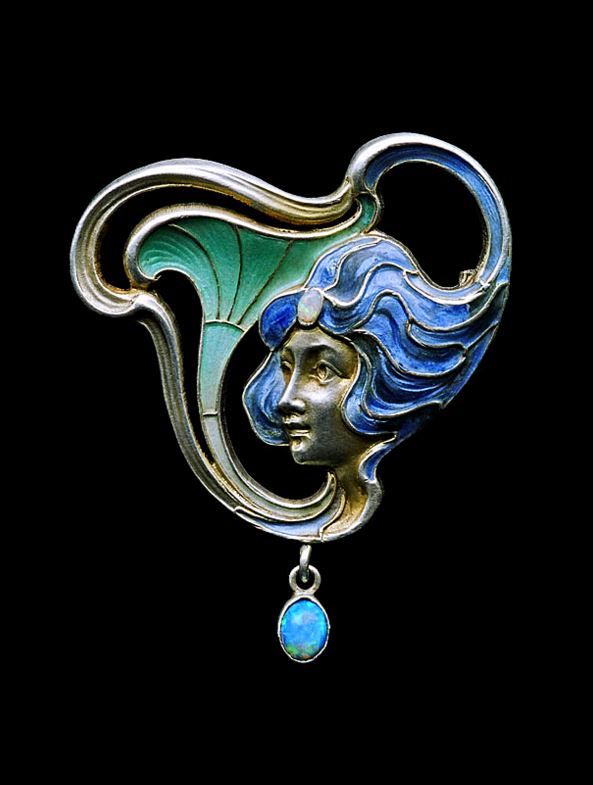
Meyle & Mayer was a German jewellery and silverware manufacturer founded in 1887 in Pforzheim by the jeweller Gustav Meyle (1846–1932) and the goldsmith Julius Mayer (1856–1940). The firm became one of the most notable workshops associated with the Jugendstil (Art Nouveau) movement in Germany, producing enamelled silver jewellery, plique-à-jour pieces and small decorative objects. The company remained active until its destruction during the Second World War in 1945.

Meyle & Mayer was founded at a time when Pforzheim was developing into the leading centre of German jewellery and watch production after the 1872 unification of the German Reich and subsequent Gründerzeit movement. The partnership combined the technical skill of Gustav Meyle with that of Julius Mayer, a member of the Pforzheim-based Mayer family, which would later also produce the jewellery firms Victor Mayer and the Swiss branch Leicht-Mayer.
The business partnership became a family alliance when Gustav Meyle married Friederike Mayer (1853–1902), sister of Julius and of the jeweller Victor Mayer (1857–1946). The close personal and artistic ties between the families helped form a distinctive Pforzheim workshop circle specialising in fine metalwork and enamel artistry.
The firm continued until 1945, when its premises were destroyed in wartime bombing. Meyle & Mayer was not re-established after the war, but its surviving works remain in collections and frequently appear in exhibitions and collectors’ markets.
Meyle & Mayer is primarily associated with German Jugendstil jewellery style, characterised by flowing asymmetrical lines, naturalistic motifs and extensive use of enamel. Typical designs include:
- translucent and plique-à-jour enamel[1]
- stylised insects such as dragonflies and butterflies[2]
- enamelled female portraits[3]
- floral and botanical motifs
- mythological themes inspired by late 19th-century German culture[4]
The workshop produced brooches, pendants, sliding mirror lockets, buckle plates, stickpins and small silver objects. Materials included gilded silver (often marked 800 or 900), 18-carat gold, opal cabochons, paste stones, seed pearls and guilloché enamel. Many pieces carry the maker’s marks DEPOSE, purity marks such as 900 or 800, a stylised dragonfly symbol or the initials MM.
Meyle & Mayer formed part of the wider Mayer jewellery dynasty in Pforzheim and Switzerland. Co-founder Julius Mayer was the brother of Victor Mayer, founder of the Pforzheim-based jewellery manufacture of the same name. Gustav Meyle’s marriage to Julius’s sister Friederike created a double family link between the firms.
Through other siblings—most notably Roman Mayer in Montreux and Rudolf Mayer and Anna Mayer in Luzern—the Mayer family also became connected to the Swiss jewellers Leicht-Mayer, creating an extended German–Swiss network of jewellery workshops and retailers.
Collectors and scholarship
[edit]
Meyle & Mayer’s work holds an established place in the study of German Art Nouveau jewellery. Pieces by the firm are cited extensively in Fritz Falk’s monograph Jugendstil-Schmuck aus Pforzheim / Art Nouveau Jewellery from Pforzheim (2009), which documents multiple representative designs and provides catalogue numbers for characteristic models such as plique-à-jour dragonfly pendants, enamelled portrait medallions and sliding mirror lockets. Several documented examples are associated with or reproduced in the collections of the Schmuckmuseum Pforzheim.
The firm’s jewellery appears regularly in the international art and collectors’ market. Silver and enamel brooches, pendants and mirror lockets are among the most frequently traded objects, with high-quality examples—especially those illustrated in specialist literature—commanding higher prices. Auction realisations typically range from mid–three-figure to mid–four-figure sums depending on quality, enamel condition and provenance.
Meyle & Mayer’s identifiable maker’s marks, including a stylised dragonfly, the initials MM, the registration stamp DEPOSE, and purity marks such as 900, 800 or .900 18ct, assist in the authentication and scholarly study of the firm’s oeuvre.
Within academic and collecting circles, Meyle & Mayer is regarded as one of the leading Pforzheim workshops of the Art Nouveau period, noted for its refined enamel work and connections to the designers of the Pforzheim School.
Although the company did not survive the Second World War, the surviving corpus of Meyle & Mayer jewellery continues to be featured in exhibitions, museum collections and scholarship devoted to Art Nouveau. The firm is recognised as a significant contributor to the artistic legacy of Pforzheim and the wider history of European decorative arts.
- Nicholls, Dale. Antique Enameled Jewelry. Atglen, PA: Schiffer Publishing, 2006. ISBN 978-0-7643-2382-5.
- ^ Falk, Fritz (2009). Art Nouveau Jewellery from Pforzheim. Stuttgart: Arnoldsche Art Publishers. ISBN 978-3-89790-280-0.

