
Content deleted Content added
|
|
|||
| Line 26: | Line 26: | ||
|
==Geography== |
==Geography== |
||
|
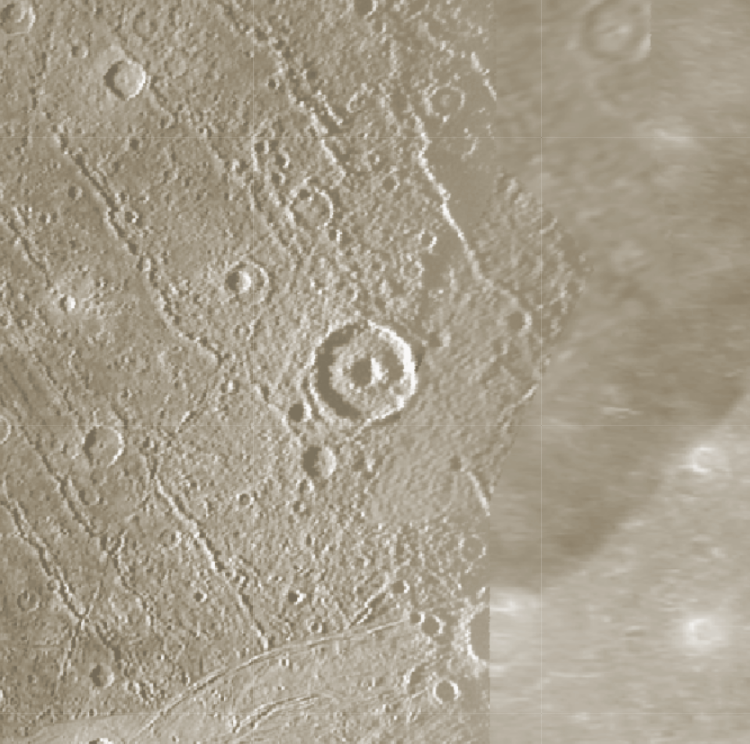
Ninlil is a dark, double-rimmed crater located in [[Galileo Regio]], a dark, oval-shaped ancient region occupying a huge portion of Ganymede’s northern hemisphere. It lies entirely within the Galileo Regio—near its eastern edge. However, the crater itself and its surrounding region are lighter and slightly less colorful than the darker, more saturated overall color of Galileo Regio. |
|||
|
Ninlil’s rims are well-defined but it lacks any bright [[ray system|ray formation]], unlike the nearby ray craters to the east. The reason why it is like this is not yet well understood—either because the crater is already very old and its bright rays have already disappeared due to [[space weathering]], or because the subsurface of the spot where the asteroid that formed the crater impacted is full of dark materials with very little clean ice. Further imaging and [[spectral analysis|spectral analyses]] are necessary to determine its history and nature. Other dark craters on Ganymede such as [[Khensu (crater)|Khensu]] might be related to Ninlil in nature but no explanation has been proven yet. |
|||
|
Ninlil is surrounded by dozens of unnamed craters that are just as dark and dull-looking as it is. There are two smaller craters to the northeast and southwest of Ninlil that nearly breach its outer rim, but neither actually overlaps the crater. |
|||
|
To the northeast lies the crater [[Nidaba (crater)|Nidaba]], and [[Memphis Facula]], which is probably large [[palimpsest (planetary astronomy)|palimpsest]], or “ghost crater”. To its northeast is the brighter crater [[Selket (crater)|Selket]], to its southwest is a smaller crater named [[Anat (crater)|Anat]], and to the south is another named crater [[Ninki (crater)|Ninki]]. To its east (outside the bounds of Galileo Regio) lie dozens of very bright ray craters that are unlike the Ninlil and its satellite craters. |
|||
|
Ninlil lies within the Memphis Facula quadrangle of Ganymede (designated Jg 7).<ref>[http://www6.uniovi.es/solar/eng/ganymap.htm Ganymede Map Images<!– Bot generated title –>] {{webarchive|url=https://web.archive.org/web/20071119101835/http://www6.uniovi.es/solar/eng/ganymap.htm |date=2007-11-19 }}</ref> It is located about three-fourths of the way between the side of Ganymede that always faces Jupiter, and the opposite side that never faces Jupiter—a consequence of the moon’s [[synchronous rotation]]. This means that an observe on Ninki will never see Jupiter. |
Ninlil lies within the Memphis Facula quadrangle of Ganymede (designated Jg 7).<ref>[http://www6.uniovi.es/solar/eng/ganymap.htm Ganymede Map Images<!– Bot generated title –>] {{webarchive|url=https://web.archive.org/web/20071119101835/http://www6.uniovi.es/solar/eng/ganymap.htm |date=2007-11-19 }}</ref> It is located about three-fourths of the way between the side of Ganymede that always faces Jupiter, and the opposite side that never faces Jupiter—a consequence of the moon’s [[synchronous rotation]]. This means that an observe on Ninki will never see Jupiter. |
||
Latest revision as of 04:24, 4 December 2025
Crater on Ganymede
Ninlil is a dark crater on Ganymede, the largest moon of Jupiter. It has two rims, and its outer rim is approximately 91 kilometres (57 mi) wide.
Ninlil is named after the Mesopotamian goddess Ninlil, the goddess of grain and fertility, consort of Enlil, the god of the wind and supreme deity of the Sumerian pantheon, and the mother of important deities such as Nanna,[2] and sometimes also Nergal and Ninazu.
The International Astronomical Union (IAU), which governs the official naming of celestial bodies and their surface features, rules that craters and features on Ganymede be named after deities, heroes and place from Ancient Middle Eastern mythologies. This includes Mesopotamian mythology of which Ninlil is a part of. The crater’s name was approved by the IAU in 1985.[3]
Officially, the IAU considers Ninlil as the consort of Ashur, the supreme god in Assyrian mythology. However, Ninlil is Sumerian; and the wife of Ashur in Assyrian mythology is Mullissu instead. As queen of the gods, Ninlil is sometimes considered as the Sumerian counterpart of the Assyrian Mullissu as both are married to their pantheon’s supreme deity[4].
Ninlil lies within the Memphis Facula quadrangle of Ganymede (designated Jg 7).[5] It is located about three-fourths of the way between the side of Ganymede that always faces Jupiter, and the opposite side that never faces Jupiter—a consequence of the moon’s synchronous rotation. This means that an observe on Ninki will never see Jupiter.

