
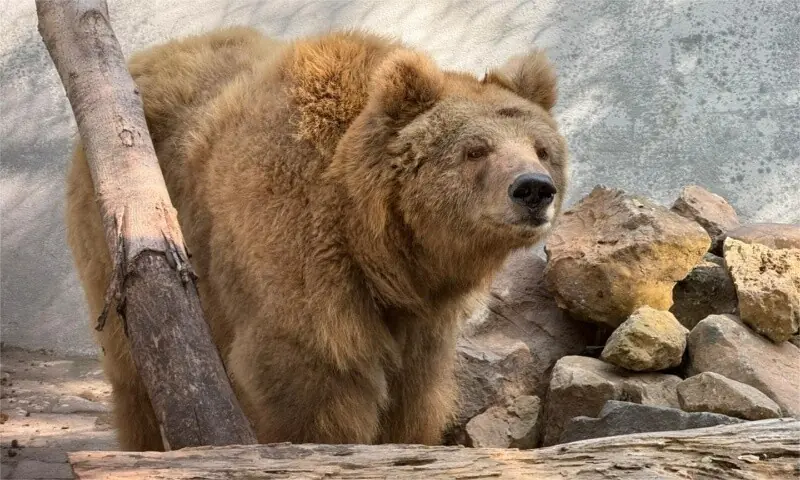
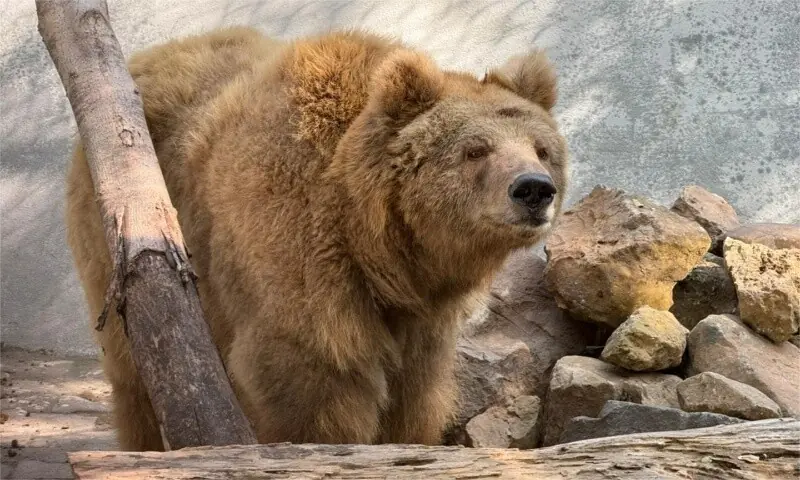
When Rano was airlifted to Islamabad on November 5, 2025, the 25-year-old Himalayan brown bear left behind more than just a confined, concrete enclosure at Karachi Zoo.
She left eight years of untreated injuries and the memory of her companion — an Asiatic black bear who died five years ago. Her relocation to a rehabilitation centre under the Islamabad Wildlife Management Board (IWMB) came by court order, pushed by animal rights activists who had watched her deteriorate for years.
Rano isn’t the first animal to be relocated from a zoo in Pakistan. Last year, the elephant Madhubala was relocated, following an outcry in the wake of viral videos of the distressed and disease-addled animal, to the sprawling Safari Park in Karachi. Before that, another elephant called Kaavan, dubbed the “loneliest elephant on the planet”, was relocated from a zoo in Islamabad to a wildlife sanctuary in Cambodia.
Such relocations have been hailed as symbolic victories by animal rights’ activists in Pakistan; rare moments of optimism and hope where such sentiments have become increasingly difficult to summon.
The relocation of a brown bear called Rano from the Karachi Zoo to an Islamabad sanctuary is as much a glimmer of hope as it is a damning indictment. Rano’s years of untreated injuries and psychological trauma are a microcosm of the suffering endured by every species at the zoo…
However, Karachi-based activist Jude Allen Pereira cautions that it takes time to reverse the long-term physical and emotional damage endured by these animals at zoos. Even as videos emerge of Rano appearing playful and content in her new surroundings, Allen tells Eos that the animal is still suffering from multiple chronic health issues, most critically severe dental problems that hinder her ability to eat a diet appropriate for her species.
While Rano is in a place where her battered body might begin to heal, her second chance casts a harsh light on those left behind. The same court that ordered her rescue also demanded answers: what is happening inside Karachi Zoo? On November 2 — three days before Rano’s departure — an inspection team was ordered to find out.
WHAT THE INSPECTORS FOUND
The members who eventually took part in the inspection on November 2 included Pereira, WWF-Pakistan President Nadeem Khalid, wildlife photographer Zafeer Ahmed Shaikh, Sindh Institute of Animal Health Director General Dr Nazeer Kalhoro, documentary filmmaker Mahera Omar and journalist Yusra Askari. Assisting them was a team from the IWMB.
Lawyer and activist Jibran Nasir, who accompanied the team as an observer, says that the government members of the committee asked them not to use their cameras to document evidence. “Even the media was initially barred from entering the zoo,” Nasir tells Eos.
After initial hiccups, the team made it to the lions’ enclosure, where one of the lions had a visible patch of skin disease, but the zoo veterinarian Dr Amir Rizvi failed to explain it adequately. Khalid points out that the enclosure housing the big cats is a little over half the recommended size.
In a small, dimly lit cage not far away were two miniature horses, Bruno and Brownie. Bruno appeared to have a limp while Brownie was rooted to her spot. Upon inquiring about their health, Pereira says the zoo staff insisted the equines were in “optimal health and were even sometimes used for riding by visitors.”
Pereira says that zoo staff were dismissive of concerns that public riding violates zoo protocol, saying it happens only sometimes. “Such statements epitomise the normalisation of cruelty and ignorance within KMC’s animal care practices,” he says.
PATTERNS OF DISTRESS
At the cage holding porcupines, only three were left out of more than a dozen not too long ago. The enclosure is concrete-floored, which is alien to a species that instinctively burrows and lives on soft soil. According to the zoo doctor, the animals had been shifted to the cage “temporarily” due to a large renovation project. A photo shared by one of the inspection team members showed the porcupines in the same cage in 2023 as well.
Inside the cage, one of the porcupines repeatedly rammed his head against the concrete wall of the resting area; an aggressive, self-harming behaviour that wildlife experts link to extreme anxiety or distress.
The jackal’s enclosure offered yet another display of distress. For 15 minutes, says Nasir, the committee watched the animal trace the same pattern over and over again: a tight, continuous figure-of-eight.
Animal welfare experts have a term for this behaviour: zoochosis. It is a form of psychosis that develops in animals held captive in zoos. These behaviours — sometimes called stereotypical behaviour — include pacing, swaying, head-bobbing, feather plucking, bar-biting, and even self-mutilation.
SYSTEMIC FAILURES
In one enclosure for rhesus macaque monkeys, the inspection team noted there was no water or food. One monkey was gnawing on the wrapping paper of a cupcake. Another displayed a classic indicator of stress and boredom: every 45 seconds, it ran and flipped into an upside-down posture, a behaviour triggered by anxiety.
Two other monkeys bore visible injuries. Their inner thighs were blood-red from repeated contact with a rusted, corroded swing (the only entertainment provided). As more visitors gathered, the monkeys tried to seek refuge in their resting area, but they were locked out. For 10-12 hours a day, the monkeys are forced to remain in the public zone, exposed and on display. “These primates require immediate relocation to a sanctuary environment rich in greenery and stimulation,” says Pereira.
In the marine life section of the zoo, a water tank meant to display Oscar fish — a vibrant species native to South America — four fish lay heaped at the bottom, motionless. But instead of concern, the zoo management’s first instinct appeared to be deflection, Nasir tells Eos. “The officials told us the aquarium has been handed over to a private contractor and was not their responsibility.”
The team then met with the man said to be the in-charge of the aquatic section and learned that he had previously worked as a plumber in the same section. “At some point, the management simply assigned him control over the entire aquatic collection,” says Nasir.
THE EXTENT OF THE PROBLEM
The Karachi Metropolitan Corporation (KMC), which oversees the 43-acre zoo, has long defended the zoo’s management. KMC spokesperson Daniyal Siyal insists the system is transparent: funds flow from the Sindh government through the octroi and zilla tax mechanism (a local taxation system), and the zoo’s revenue from tickets and concessions goes directly to KMC, which then allocates about 15 percent back to operations.
“In the first three months of 2025 alone, the zoo brought in roughly 10 to 15 million rupees,” Siyal tells Eos. He rejects accusations of ghost employees or financial mismanagement, pointing to what he describes as a dedicated veterinary team and an 11-member caretaking staff.
However, members of the inspection team, including Khalid, note that there is only one veterinarian responsible for the entire facility. “[There is] no diagnostic equipment [X-ray, microscope] available and the quarantine section comprises only a few vacant cages,” Khalid tells Eos.
Pereira was scathing in his assessment, saying that the clinic was “a dumping area masquerading as a medical room.” Another inspection team member, who requested not be named, says the operation theatre “was in disrepair and seemed not to have been used in years.”
Aside from that, the team highlighted issues ranging from animal tagging, record keeping, medical details and feed storage. Khalid says that the feed is stored under unhygienic conditions, with evidence of worms in freezers. He also points out that treatment records are maintained informally by the veterinarian and no standardised documentation system exists.
As of now, according to Siyal, the zoo houses 765 animals, including 121 mammals, 512 birds and 132 reptiles. These belong to 59 species in total. The records show that, while the zoo hosts a range of species, many of them are living alone, without mates. Among the unpaired animals are a female white lion, a female chimpanzee, a male puma, a male jackal, and a male Arabian oryx. The absence of appropriate pairs has long raised concerns among wildlife experts, who argue that social isolation adds another layer of stress to already confined animals. KMC acknowledges this imbalance but frames it as a logistical challenge rather than neglect.
Siyal also provided a list of prominent deaths over the past five years. These include a male white lion, a male zebra, both a male and female chimpanzee, a female tiger and a male tabby tiger.
WHERE TO NEXT?
Experts and activists who study Karachi Zoo agree on the diagnosis but diverge sharply on the solution. For Sindh Wildlife Conservator Javed Ahmed Mahar, the collapse reflects Pakistan’s broader reliance on generalists rather than specialists.
“Improving the zoo is neither difficult nor costly,” he tells Eos. “What it requires is leadership from a trained ecologist, a wildlife biologist, and an architect — expertise Pakistan has long sidelined.” He envisions a deliberate, well-designed improvement plan spanning two to five years, rooted in legislative reform and structural change.
But for Periera, reform isn’t enough. He argues for an orderly and humane phase-out of all captive wildlife, returning the facility to its original purpose as a botanical garden and heritage site — “a space for empathy, education and environmental awareness, not animal exploitation.”
Rano’s escape from Karachi Zoo is an emblem of what is possible when trained hands, structured care and institutional transparency align. But her story also reveals the extent of the suffering that remains. Her untreated wound, her years without a comforting human touch and her psychological scars reflect the experience of countless animals still confined in the failing institution she has finally left behind.
As Allen put it, “Karachi Zoo today stands as a mirror of administrative rot and cruelty, not of conservation or education.”
Its transformation into a space of compassion, accountability, and learning would not only honour the animals who have suffered within its walls but would finally bring meaning to Rano’s long-awaited freedom.
The writer is a member of staff. She may be contacted at aniqakhandawn@gmail.com
Published in Dawn, EOS, November 30th, 2025

