
From Wikipedia, the free encyclopedia
Content deleted Content added
|
|
|||
| Line 1: | Line 1: | ||
|
{{Italic title}} |
|||
|
{{Infobox musical composition |
|||
|
| name=””Suite bretonne” |
|||
|
| composer = Marcel Dupré |
|||
|
| image = Dupre.jpg |
|||
|
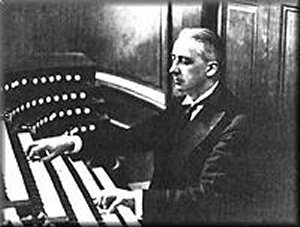
| caption = Dupré at the organ |
|||
|
| opus = 21 |
|||
|
| year = 1923 |
|||
|
| published = 1924 – Paris |
|||
|
| publisher = Alphonse Leduc |
|||
|
| duration = 13 minutes |
|||
|
| movements = 3 |
|||
|
| scoring = Organ |
|||
|
}} |
|||
|
””’Suite bretonne””’ (from [[French language|French]], ”Breton Suite”), Op. 21, is a [[Suite (music)|suite]] for solo organ by French composer [[Marcel Dupré]]. |
””’Suite bretonne””’ (from [[French language|French]], ”Breton Suite”), Op. 21, is a [[Suite (music)|suite]] for solo organ by French composer [[Marcel Dupré]]. |
||
Revision as of 09:45, 4 December 2025
| Suite bretonne | |
|---|---|

Dupré at the organ |
|
| Opus | 21 |
| Year | 1923 |
| Published | 1924 – Paris |
| Publisher | Alphonse Leduc |
| Duration | 13 minutes |
| Movements | 3 |
| Scoring | Organ |
Suite bretonne (from French, Breton Suite), Op. 21, is a suite for solo organ by French composer Marcel Dupré.
Background
The Suite bretonne was written at an uncertain time around 1923 and was dedicated to mademoiselle Hilda Gélis-Didot, a close friend of the Dupré family and a relative of the Firmin Didot family, long associated with publications of the Institut de France.[1] Organist Graham Steed suggests the suite was written in the United States, as the third movement uses chimes instead of the flûte registration in the organ, suggesting he was familiar with registrations in American organs.[2] It premiered in 1923 in New York City[2] and was published in Paris in 1924, by Alphonse Leduc.[3]
Structure
The suite is divided into three movements and scored for solo organ. It has an approximate total duration of 13 minutes. The following is a list of movements:
- Berceuse. Lento
- Fileuse. Vif
- Les cloches de Perros-Guirec. Très modéré
The first movement represents a cradle song which uses a largely chromatic language in the melody and harmonies and is supported by an ostinato. The second movement represents a woman spinning wool, and the third movement portrays Breton villagers walking to church in step with the sound of bells in this small coastal town of Perros-Guirec between Brest and Saint-Malo
Recordings
It is not uncommon for organists to perform individual movements from this suite in their recordings. Dupré himself recorded the first movement on June 18, 1929, in the Queen’s Hall, in London. The following is a list of complete recordings of this piece:
References
- ^ Delcamp, Robert. “About This Recording – Marcel Dupré (1886-1971) – Works for Organ, Vol. 12”. www.naxos.com. Retrieved 2025-12-04.
- ^ a b Steed, Graham (1999). The Organ Works of Marcel Dupré. Pendragon Press. ISBN 978-1-57647-007-7.
- ^ “Suite bretonne, Op.21 (Dupré, Marcel) – IMSLP”. imslp.org. Retrieved 2025-12-04.
- ^ Marcel Dupré, Jeremy Filsell – Intégrale Des Œuvres Pour Orgue = Complete Organ Works = Sämtliche Orgelwerke, Volume 9, 2000, retrieved 2025-12-04
- ^ “DUPRE: Works for Organ, Vol. 12 – 8.554209 | Discover more releases from Naxos”. www.naxos.com. Retrieved 2025-12-04.
External links

