
Content deleted Content added
|
|
|||
| Line 36: | Line 36: | ||
|
==Grapes and wines== |
==Grapes and wines== |
||
|
Although the appellation is probably best known for its [[old vine]] [[Zinfandel]], Lodi also produces large quantities of [[Merlot]], [[Chardonnay]], [[Cabernet Sauvignon]], [[Sauvignon blanc]] and specifically Albariño.<ref name=”Appellation_America”/><ref name=”Albariño”>{{cite web | title=ALBARIÑO—THE STATE OF ONE OF LODI’S MOST IMPORTANT VARIETAL WHITES| url= |
Although the appellation is probably best known for its [[old vine]] [[Zinfandel]], Lodi also produces large quantities of [[Merlot]], [[Chardonnay]], [[Cabernet Sauvignon]], [[Sauvignon blanc]] and specifically Albariño.<ref name=”Appellation_America”/><ref name=”Albariño”>{{cite web | title=ALBARIÑO—THE STATE OF ONE OF LODI’S MOST IMPORTANT VARIETAL WHITES| url=https://lodigrowers.com/albarino-the-state-of-one-of-lodis-most-important-varietal-whites/ |author1=Caparoso, Randy | website=Lodi Wine Growers | date=2024-04-29 | = Lodi Winegrape Commission|access-date=2025-12-05}}</ref> |
||
|
<gallery mode=packed heights=200px> |
<gallery mode=packed heights=200px> |
||
|
Lodi Cabernet.jpg | Cabernet Sauvignon |
Lodi Cabernet.jpg | Cabernet Sauvignon |
||
Latest revision as of 15:48, 5 December 2025
American Viticultural Area in California

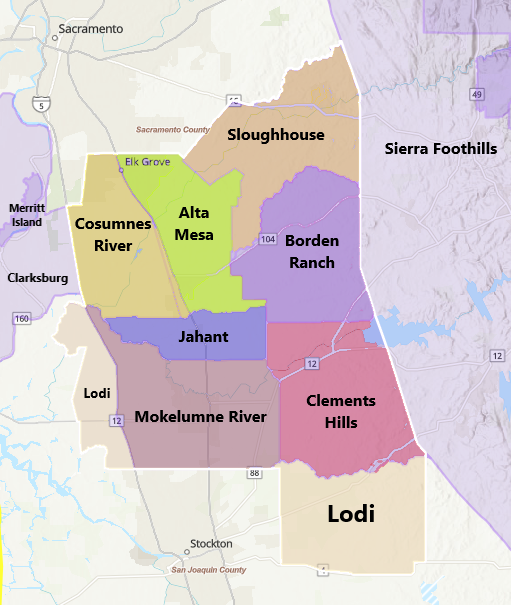
Lodi is an American Viticultural Area (AVA) located in the Central Valley of California, at the northern edge of the San Joaquin Valley, within portions of Sacramento and San Joaquin Counties, east of San Francisco Bay. The wine appellation was established on February 13, 1986 as the nation’s 84th, the state’s 48th, Sacramento County’s second and San Joaquin County’s initial AVA by the Bureau of Alcohol, Tobacco and Firearms (ATF), Treasury after reviewing the petition submitted by the Lodi District Vintners Association proposing a viticultural area named “Lodi.”[5] At the outset, the viticultural area encompassed 458,000 acres (716 sq mi) and culivated 39,000 acres (16,000 ha) of wine grapes.[1] In 2002, the area was expanded totaling 93,500 acres (146 sq mi) with 10,840 acres (4,390 ha) under vine. In the western portion by 27,500 acres (43 sq mi) with 5,240 acres (2,120 ha) of vineyards and in the southern section by 66,000 acres (103 sq mi) with 5,600 acres (2,300 ha) added to the original boundaries within San Joaquin County.[2] The appellation lies in southern Sacramento County and northern San Joaquin County. Its western border is outlined by Interstate Highway 5 and the eastern border is adjacent to El Dorado, Amador and Calaveras counties.[6]
On July 16, 2006, the Alcohol and Tobacco Tax and Trade Bureau (TTB), Treasury established seven new viticultural areas within the boundaries of the Lodi viticultural area. The seven new AVAs are Alta Mesa, Borden Ranch, Clements Hills, Cosumnes River, Jahant, Mokelumne River and Sloughhouse. TTB designates viticultural areas to allow vintners to better describe the origin of their wines and allow consumers to better identify wines they may purchase.[7] The plant hardiness zones are 9a and 9b.[8]
The Lodi region has been home to grape growing since at least the 1850s when wild grapes would grow down from trees along the edge of rivers. This led some trappers to call the Calaveras River, which runs through the southern portion of the area, “Wine Creek.”[9] The farms run by multi-generational families were producing 20% of the wine in California in 2024.[10]
Although the appellation is probably best known for its old vine Zinfandel, Lodi also produces large quantities of Merlot, Chardonnay, Cabernet Sauvignon, Sauvignon blanc and specifically Albariño.[4][11]
-

Cabernet Sauvignon
-

Old Vine Zinfandel


- ^ a b c d e f g h “Lodi Viticultural Area” (27 CFR 9 [T.D.ATF-223; Re: Notice No. 567] Final Rule). Federal Register. 51 (30). Bureau of Alcohol, Tobacco and Firearms (ATF), Treasury: 5323–5325. February 13, 1986.
 This article incorporates text from this source, which is in the public domain.
- ^ a b c d “Expansion of Lodi Viticultural Area (2000R-436P)” (27 CFR 9 RIN 1512-AC92 [T.D. ATF-482; Re: Notice No. 891] Final Rule). Federal Register. 61 (171). Bureau of Alcohol, Tobacco and Firearms (ATF), Treasury: 5323–5325. September 4, 2002. This article incorporates text from this source, which is in the public domain.
- ^ “Frost Dates for Linden, CA”. The Old Farmer’s Almanac. Yankee Publishing. Retrieved March 11, 2025.
- ^ a b “Lodi (AVA): Appellation Profile”. Appellation America. 2007. Archived from the original on May 16, 2008. Retrieved January 25, 2008.
- ^ “Petition For Establishment of “Lodi” as an American Viticultural Area”. TTB.gov. Lodi District Vintners Association. July 26, 1982. This article incorporates text from this source, which is in the public domain.
- ^ Rieger, Ted. “Subdividing Lodi—Proposal Supported for 7 Sub-AVAs”. Wine Business Monthly. No. August 2003.
- ^ “Establishment of the Alta Mesa, Borden Ranch, Clements Hills, Cosumnes River, Jahant, Mokelumne River, and Sloughhouse Viticultural Areas” (27 CFR Part 9 [T.D. TTB–50; Re: Notice No. 50] RIN 1513–AA82 thru 1513–AA88 Final Rule). Federal Register. 71 (136). Alcohol and Tobacco Tax and Trade Bureau (TTB), Treasury: 40404–40417. July 16, 2006. This article incorporates text from this source, which is in the public domain.
- ^ “Lodi – American Viticultural Area (AVA)”. Plantmaps.com. United States Department of Agriculture. 2012. Retrieved December 4, 2025.
- ^ “The Appellations of California Wine”. Wine Institute. Archived from the original on October 10, 2007.
- ^ Morgan, Tyne (August 14, 2024). “Grape Growers Desperately Need You to Drink More Wine as They Grapple With a Glut of Uncontracted Grapes”. AgWeb.
- ^ Caparoso, Randy (April 29, 2024). “ALBARIÑO—THE STATE OF ONE OF LODI’S MOST IMPORTANT VARIETAL WHITES”. Lodi Wine Growers. Lodi Winegrape Commission. Retrieved December 5, 2025.

