
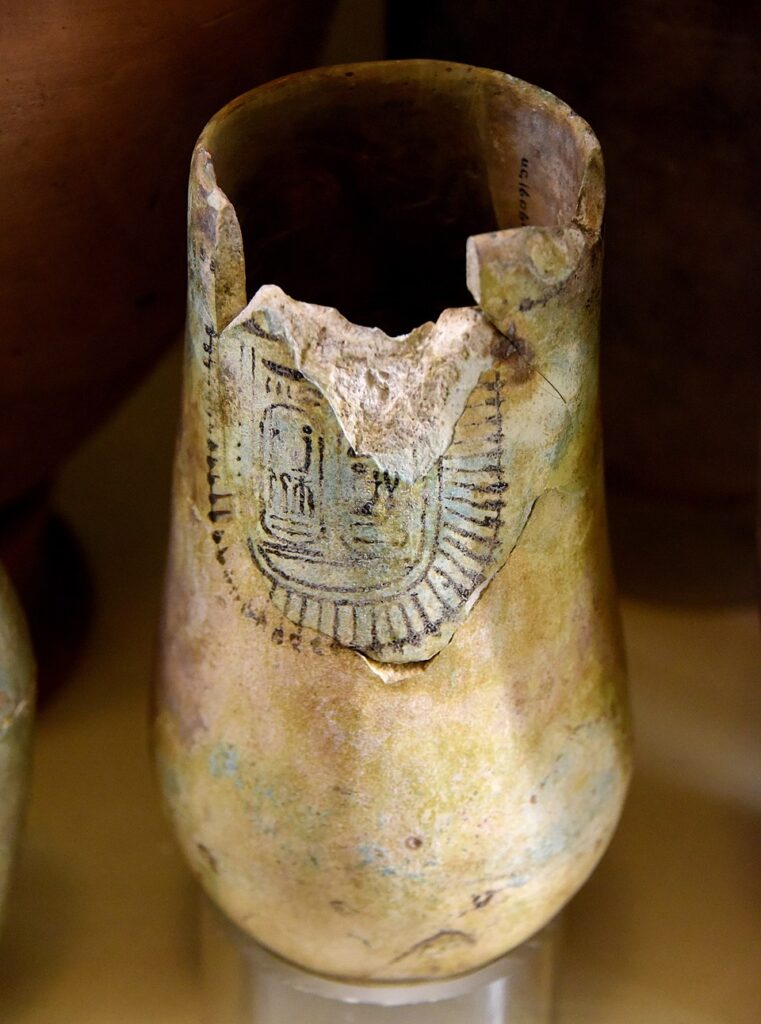
A minority scholarly hypothesis proposes that the historical figure behind the Egyptian memory preserved in the [[Osarseph]] narrative—later associated by [[Manetho]] with [[Moses]]—may have been [[Amenmesse]]. The theory does not claim that Amenmesse was the biblical Moses, but suggests that cultural memories of Amenmesse’s contested reign, erasure, and disappearance contributed to the formation of the Osarseph tradition and to corresponding features in early Moses narratives.
A minority scholarly hypothesis proposes that the historical figure behind the Egyptian memory preserved in the [[Osarseph]] narrative—later associated by [[Manetho]] with [[Moses]]—may have been [[Amenmesse]]. The theory does not claim that Amenmesse was the biblical Moses, but suggests that cultural memories of Amenmesse’s contested reign, erasure, and disappearance contributed to the formation of the Osarseph tradition and to corresponding features in early Moses narratives.
The interpretive framework underlying this hypothesis derives primarily from the work of [[Donald B. Redford]], who argues that the earliest Moses traditions preserved in Egyptian and biblical material depict an Egyptian elite figure who fell from royal favour, associated with foreign or marginal elements, and whose name was subsequently erased from official monuments. Redford identifies this profile as consistent with Egyptian literary and ideological treatments of internal rebels.<ref name=”Redford1992″>Redford, Donald B. Egypt, Canaan and Israel in Ancient Times. Princeton University Press, 1992.</ref><ref name=”Redford1979″>Redford, Donald B. “The Literary Moses.” In: J. Hayes (ed.), The Bible and the Ancient Near East. Eisenbrauns, 1979, pp. 71–90.</ref> Although Redford refrains from naming a specific individual, his criteria have been applied by later authors to Amenmesse.
The interpretive framework underlying this hypothesis derives primarily from the work of [[Donald B. Redford]], who argues that the earliest Moses traditions preserved in Egyptian and biblical material depict an Egyptian elite figure who fell from royal favour, associated with foreign or marginal elements, and whose name was subsequently erased from official monuments. Redford identifies this profile as consistent with Egyptian literary and ideological treatments of internal rebels.<ref name=”Redford1992″>Redford, Donald B. Egypt, Canaan and Israel in Ancient Times. Princeton University Press, 1992.</ref><ref name=”Redford1979″>Redford, Donald B. “The Literary Moses.” In: J. Hayes (ed.), The Bible and the Ancient Near East. Eisenbrauns, 1979, pp. 71–90.</ref> Although Redford refrains from naming a specific individual, his criteria have been applied by later authors to Amenmesse.
Some modern writers have argued that the circumstances of Amenmesse’s contested kingship show notable structural parallels with the Moses and Osarseph traditions. M. Georg has discussed Amenmesse within the broader context of Egyptian bearers of the name element “mose,” proposing that some episodes in his life may have influenced later Egyptian portrayals of elite rebels.<ref name=”Georg”>M. Georg, “Mose – Name und Namensträger: Versuch einer historischen Annäherung,” Journal für Ägyptische Geschichte (citation details required).</ref> Rolf Krauss has also examined possible links between Amenmesse and early Moses traditions, focusing on Amenmesse’s disputed legitimacy, his association with non-elite and foreign groups, and his subsequent erasure under [[Seti II]].<ref name=”Krauss1988″>Krauss, Rolf. Das Mosesbild der Ägypter. 1988.</ref><ref name=”Krauss1997″>Krauss, Rolf. “Amenmesse and the Exodus Tradition.” Studien zur Altägyptischen Kultur 25 (1997).</ref> These authors do not equate Amenmesse with Moses but suggest that Egyptian recollections of Amenmesse may have contributed to the narrative structure later found in Manetho’s account.
Some modern writers have argued that the circumstances of Amenmesse’s contested kingship show notable structural parallels with the Moses and Osarseph traditions. M. Georg has discussed Amenmesse within the context of Egyptian bearers of the name element “mose,” proposing that episodes in his life may have influenced later Egyptian portrayals of elite rebels.<ref name=”Georg”>M. Georg, “Mose – Name und Namensträger: Versuch einer historischen Annäherung,” Journal für Ägyptische Geschichte (citation details required).</ref> Rolf Krauss has also examined possible links between Amenmesse and early Moses traditions, focusing on Amenmesse’s disputed legitimacy, his association with non-elite and foreign groups, and his subsequent erasure under [[Seti II]].<ref name=”Krauss1988″>Krauss, Rolf. Das Mosesbild der Ägypter. 1988.</ref><ref name=”Krauss1997″>Krauss, Rolf. “Amenmesse and the Exodus Tradition.” Studien zur Altägyptischen Kultur 25 (1997).</ref> These authors do not equate Amenmesse with Moses but suggest that Egyptian recollections of Amenmesse may have contributed to the narrative structure later found in .
Supporters of the hypothesis emphasise several convergences between Amenmesse’s attested history and motifs found in the Osarseph narrative and early Moses traditions:
Supporters of the hypothesis have emphasised the following parallels. Amenmesse was an Egyptian of high rank, possibly a prince, echoing Manetho’s depiction of Osarseph as a priest or elite insider. His accession appears to have been contested, producing a period in which Upper Egypt was governed separately from the northern kingdom under Seti II. Some inscriptions suggest that Amenmesse’s faction included Nubian or Asiatic elements, which later Egyptian ideology frequently associated with internal disorder. Following Seti II’s restoration, Amenmesse’s monuments and names were subjected to widespread erasure, consistent with Egyptian practices of condemning rulers or officials judged to have violated royal legitimacy or Ma’at.<ref name=”Dodson2019″>Dodson, Aidan. Rulers of Egypt: The New Kingdom. American University in Cairo Press, 2019.</ref><ref name=”Kitchen1980″>Kitchen, Kenneth A. Ramesside Inscriptions, Vol. III. Blackwell, 1980.</ref><ref name=”Assmann2002″>Assmann, Jan. The Mind of Egypt. Harvard University Press, 2002.</ref> His ultimate fate is unknown, and unlike most defeated claimants, he leaves no securely identified tomb or burial equipment.
* Amenmesse appears to have been an Egyptian of high rank, possibly a prince, paralleling Manetho’s portrayal of Osarseph as an elite insider.
* His accession was contested, producing a divided kingdom and aligning with Egyptian ideological patterns that describe rebels or usurpers. <ref name=”Dodson2019″>Dodson, Aidan. ”Rulers of Egypt: The New Kingdom”. American University in Cairo Press, 2019.</ref>
* Inscriptions from Thebes suggest that Amenmesse’s supporters may have included Nubian or Asiatic personnel, echoing the Osarseph motif of an Egyptian leader allying with foreign or marginalised groups.<ref name=”Kitchen1980″>Kitchen, Kenneth A. ”Ramesside Inscriptions”, Vol. III. Blackwell, 1980, pp. 27–33.</ref>
* After Seti II’s restoration, Amenmesse’s cartouches and monuments were subjected to systematic erasure, consistent with practices of [[damnatio memoriae]] directed at figures judged to have violated royal legitimacy or [[Ma’at]].<ref name=”Assmann2002″>Assmann, Jan. ”The Mind of Egypt”. Harvard University Press, 2002.</ref>
* Amenmesse’s ultimate fate remains unknown; unlike most defeated claimants, no secure tomb or burial assemblage has been identified, a feature sometimes compared to the “expulsion” or disappearance motifs found in the Osarseph tradition.
==References==
==References==
Egyptian pharaoh
Amenmesse (also Amenmesses or Amenmeses) was the fifth pharaoh of the Nineteenth Dynasty in Ancient Egypt, possibly the son of Merneptah and Queen Takhat. Others consider him to be one of the innumerable sons of Ramesses II. Very little is known about this pharaoh, who ruled Egypt for only three to four years. Various Egyptologists date his reign between 1202 BC–1199 BC[4] or 1203 BC–1200 BC[5] with others giving an accession date of 1200 BC.[6] Amenmesse means “born of or fashioned by Amun” in Egyptian. Additionally, his nomen can be found with the epithet Heqa-waset, which means “Ruler of Thebes”.[7] His royal name was Menmire Setepenre.
Usurper
It is likely that he was not Merneptah’s intended heir. Scholars Kenneth Kitchen and Jürgen von Beckerath have theorized that Amenmesse usurped the throne from Seti-Merneptah, who was Merneptah’s son and crown prince and who should have been next in the line of royal succession. It is unclear how this would have happened. Kitchen has written that Amenmesse may have taken advantage of a momentary weakness of Seti-Merneptah or seized power while the crown prince was away in Asia. Seti-Merneptah was most likely the same man as king Seti II, whose reign was traditionally thought to have followed upon Amenmesse’s reign. The cartouches of Seti II’s tomb in Upper Egypt were deliberately erased and then repainted, suggesting that Seti’s rule in Upper Egypt was temporarily interrupted by agents of his half-brother. Confusion generally clouds Amenmesse’s reign and its correct position within the succession sequence of the rulers of the Egyptian 19th Dynasty. However, an increasing number of Egyptologists today such as Rolf Krauss and Aidan Dodson maintain that Seti II was in fact the immediate successor of Merneptah “without any intervening rule by Amenmesse.”[8] Under this scenario, Amenmesse did not succeed Merneptah on the throne of Egypt and was rather a rival king who usurped power sometime during Years 2 to 4 of Seti II’s reign in Upper Egypt and Nubia where his authority is monumentally attested.[9] Amenmesse was documented in power at Thebes during his third and fourth year (and perhaps earlier in Nubia) where Seti II’s Year 3 and Year 4 are noticeably unaccounted for.[10] The treatment of Amenmesse as a rival king also best explains the pattern of destruction to Seti II’s tomb which was initially ransacked and later restored again by Seti II’s officials. This implies that the respective reigns of Amenmesse and Seti II were parallel to one another; Seti II must have initially controlled Thebes in his first and second years during which time his tomb was excavated and partly decorated. Then Seti was ousted from power in Upper Egypt by Amenmesse whose agents desecrated Seti II’s tomb. Seti would finally defeat his rival Amenmesse and return to Thebes in triumph whereupon he ordered the restoration of his damaged tomb.
Rolf Krauss, followed by Aidan Dodson, suggests that Amenmesse was once a Kushite Viceroy called Messuy.[11] In particular, two representations of Messuy on the temple of Amida allegedly show that a royal uraeus had been added to his brows in a way consistent with other pharaohs such as Horemheb, Merneptah and some of the sons of Rameses III. An inscription at the temple of Amada also calls him “the king’s son himself” but this may be merely a figure of speech to emphasize Messuy’s high stature as Viceroy under Merneptah. However, Frank Yurco notes that various depictions of Messuy in several Nubian temples were never deliberately defaced by Seti II’s agents compared to the damnatio memoriae meted out to all depictions of another Viceroy of Kush, Khaemtir, who had served as Amenmesse’s Vizier.[12] This strongly implies that Seti II held no grudge against Messuy, which would be improbable if Messuy was indeed Amenmesse.[13] Yurco also observes that the only objects from Messuy’s tomb which identified a Pharaoh all named only Merneptah, Seti II’s father, which leads to the conclusion that Messuy died and was buried in his tomb at Aniba, Nubia, during Merneptah’s reign, and could not be Amenmesse.[14]
The records of a court case early in the reign of Seti II also throw some light on the matter. Papyrus Salt 124 records that Neferhotep, one of the two chief workmen of the Deir el-Medina necropolis, had been killed during the reign of Amenmesse (the king’s name is written as Msy in the document).[15] Neferhotep was replaced by Paneb his adopted son, against whom many crimes were alleged by Neferhotep’s brother Amennakhte in a strongly-worded indictment preserved on a papyrus in the British Museum. If Amennakhte’s allegations can be trusted, Paneb had stolen stone for the embellishment of his own tomb from that of Seti II in the course of its completion, besides purloining or damaging other property belonging to that monarch. Also he had allegedly tried to kill Neferhotep in spite of having been educated by him, and after the chief workman had been killed by “the enemy” had bribed the vizier Pra’emhab in order to usurp his place. Whatever the truth of these accusations, it is clear that Thebes was going through very troubled times. There are references elsewhere to a “war” that had occurred during these years, but it is obscure to what this word alludes—perhaps to no more than internal disturbances and discontent. Neferhotep had complained of the attacks upon himself to the vizier Amenmose, presumably a predecessor of Pra’emhab, whereupon Amenmose had Paneb punished. Paneb, however, then successfully brought a complaint before ‘Mose’/’Msy’ whereupon the latter decided to dismiss Amenmose from office. Evidently this ‘Mose’/’Msy’ was a person of the highest importance who most probably should be identified with king Amenmesse himself.[16]
Family
His mother is known to be Queen Takhat, but who she is exactly is a matter of interpretation complicated by inscriptions being revised by Seti II and Amenmesse. Among her titles are “King’s Daughter”, which would make her a daughter of Merneptah or Ramesses II or possibly a granddaughter of Ramesses. The name Takhat appears in a list of princesses dated to Year 53 of Ramesses II (Louvre 666).[17] If this is the same Takhat, she would be about the same age as Seti II.[18]
A monument from Karnak, carved while Amenmesse was in control of the area, includes the relief of a woman titled “King’s Daughter” and “King’s Mother”. The monument was reinscribed from ‘Mother’ to ‘Wife’. Another statue of Seti II (Cairo CG1198) bears Seti’s name surcharged over someone else’s while the names of Takhat were left alone. This suggests that Takhat was married to Seti as well as mother to Amenmesse.[19] Others such as Frank Yurco believe Takhat was wife to Merneptah making the rivals Seti II and Amenmesse half-brothers.[20]
Some assume that Twosret, wife of Seti II, was his sister. Amenmesse’s wife was thought to be a woman named Baktwerel since she was buried in the same tomb as Amenmesse, KV10. Three mummies were initially present in this tomb, two women and one man. It is uncertain if any of these remains belong to Amenmesse, Takhat, or Baketwerel. The two females Baketwerel and Takhat could have been buried later.[21] Some people believe that Seti II broke into the tomb and had Amenmesse’s remains desecrated since his mummy was never found.
Six quartzite statues originally placed along the axis of the hypostyle hall in the Amun Temple at Karnak are thought to be his, although these were defaced and overwritten with the name of Seti II.[22] One of these statues, with the inscription, “the Great Royal Wife Takhat”, lends credence to the argument that a Takhat was Amenmesse’s wife. Amenmesse was also responsible for restoring a shrine dating from Thutmose III that stands before a temple at El-Tod.
There is confusion about the events surrounding his death. His mummy was not amongst those found in the cache at Deir el Bahri, and from the destruction of his tomb in the Valley of the Kings, it is assumed that Seti II took revenge upon his usurping half-brother.
Aftermath
Amenmesse was buried in a rock-cut tomb in the Valley of the Kings which is now identified as Tomb KV10. However, almost all of its texts and scenes were either erased or usurped by Seti II’s agents. No mention of Amenmesse was spared.[23][24] A number of officials associated with Amenmesse were also attacked or replaced, chief among them being the Theban High Priest of Amun, Roma called Roy, and Khaemtir, a former viceroy of Kush, who may have supported Amenmesse’s usurpation.[25]
Amenmesse’s tomb was looted in antiquity. However the remains of three mummies were found in this tomb, two women and one man, it is uncertain if any of these remains belong to Amenmesse, Takhat or the later Baketwerel without further testing or whether they were later intrusions. It seems more likely, however, that Seti II had Amenmesse’s remains desecrated since his mummy was never found “in either of the two great caches of royal mummies found in 1881 and 1901”.[26] Surviving inscriptions mentioning Takhat’s name along with the wall inscriptions suggest she was buried in Amenmesse’s tomb. Artifacts from the tombs of Seti I and Rameses VI were also found in the KV10 tomb adding to the uncertainty. After his death, Seti II also conducted a damnatio memoriae campaign against the memory of Amenmesse’s Vizier, Khaemtir. Egyptologist Frank Yurco notes that Seti II’s agents erased all of Khaemtir’s depictions and inscriptions—even those that were inscribed when Khaemtir served as a Viceroy in Nubia.[27]
It is possible that Siptah, the Pharaoh who succeeded Seti II, was the son of Amenmesse and not of Seti II. A statue of Siptah in Munich shows the Pharaoh seated in the lap of another, clearly his father. The statue of the father, however, has been destroyed. Dodson writes:
The only ruler of the period who could have promoted such destruction was Amenmesse, and likewise he is the only king whose offspring required such explicit promotion. The destruction of this figure is likely to have closely followed the fall of Bay or the death of Siptah himself, when any short-lived rehabilitation of Amenmesse will have ended.[28]
M. Georg[29] and Rolf Krauss[30][31] find that there are a number of parallels between the story of Amenmesse and the biblical story of Moses in Egypt.
Amenmesse and the Osarseph/Moses Hypothesis
A minority scholarly hypothesis proposes that the historical figure behind the Egyptian memory preserved in the Osarseph narrative—later associated by Manetho with Moses—may have been Amenmesse. The theory does not claim that Amenmesse was the biblical Moses, but suggests that cultural memories of Amenmesse’s contested reign, erasure, and disappearance contributed to the formation of the Osarseph tradition and to corresponding features in early Moses narratives.
The interpretive framework underlying this hypothesis derives primarily from the work of Donald B. Redford, who argues that the earliest Moses traditions preserved in Egyptian and biblical material depict an Egyptian elite figure who fell from royal favour, associated with foreign or marginal elements, and whose name was subsequently erased from official monuments. Redford identifies this profile as consistent with Egyptian literary and ideological treatments of internal rebels.[32][33] Although Redford refrains from naming a specific individual, his criteria have been applied by later authors to Amenmesse.
Some modern writers have argued that the circumstances of Amenmesse’s contested kingship show notable structural parallels with the Moses and Osarseph traditions. M. Georg has discussed Amenmesse within the wider context of Egyptian bearers of the name element “mose,” proposing that certain episodes in his life may have influenced later Egyptian portrayals of elite rebels.[34] Rolf Krauss has also examined possible links between Amenmesse and early Moses traditions, focusing on Amenmesse’s disputed legitimacy, his association with non-elite and foreign groups, and his subsequent erasure under Seti II.[35][36] These authors do not equate Amenmesse with Moses but suggest that Egyptian recollections of Amenmesse may have contributed to the narrative structure later found in the Osarseph tradition.
Supporters of the hypothesis emphasise several convergences between Amenmesse’s attested history and motifs found in the Osarseph narrative and early Moses traditions:
- Amenmesse appears to have been an Egyptian of high rank, possibly a prince, paralleling Manetho’s portrayal of Osarseph as an elite insider.
- His accession was contested, producing a divided kingdom and aligning with Egyptian ideological patterns that describe rebels or usurpers. [37]
- Inscriptions from Thebes suggest that Amenmesse’s supporters may have included Nubian or Asiatic personnel, echoing the Osarseph motif of an Egyptian leader allying with foreign or marginalised groups.[38]
- After Seti II’s restoration, Amenmesse’s cartouches and monuments were subjected to systematic erasure, consistent with practices of damnatio memoriae directed at figures judged to have violated royal legitimacy or Ma’at.[39]
- Amenmesse’s ultimate fate remains unknown; unlike most defeated claimants, no secure tomb or burial assemblage has been identified, a feature sometimes compared to the “expulsion” or disappearance motifs found in the Osarseph tradition.
Proponents further argue that the ideological template into which Amenmesse’s memory would have been fitted is visible in the inscriptions of the Twentieth Dynasty, especially under Ramesses III. Texts such as the Great Harris Papyrus describe internal enemies as elite Egyptians who betray the king, collaborate with foreigners, disrupt cultic and social order, and must be expelled to restore cosmic and political stability. Scholars such as Jan Assmann have interpreted this as a key intermediary stage between historical memory and the later form of the Osarseph narrative recorded by Manetho.[40]
Although most Egyptologists regard the Amenmesse hypothesis as speculative, it continues to appear in discussions of Egyptian cultural memory, internal rebellion, and possible Egyptian backgrounds to elements of the Moses and Osarseph traditions.
References
- ^ Amenmesse
- ^ Peter Clayton, Chronicle of the Pharaohs, Thames & Hudson Ltd, 1994. p.158
- ^ [1] KV-10 The Tomb of Amenmesse
- ^ Edward Wente and Charles Van Siclen III, “A Chronology of the New Kingdom,” 218
- ^ Michael Rice, Who’s Who in Ancient Egypt, Routledge, 1999
- ^ Vandersleyen, ĽÈgypte et la Vallée du Nil, vol 2: 575
- ^ K. A. Kitchen, “The Titularies of the Ramesside Kings as Expression of Their Ideal Kingship,” ASAE 71 (1987): 134-35.
- ^ Erik Hornung, Rolf Krauss & David Warburton (editors), Handbook of Ancient Egyptian Chronology (Handbook of Oriental Studies), Brill: 2006, p.212
- ^ Krauss 1976, 1977, 1997; Dodson 1997
- ^ Hornung, Krauss & Warburton, op. cit., p.213
- ^ Krauss 1976, 1977; The Viceroy of Kush Archived 2007-02-23 at the Wayback Machine
- ^ Frank J. Yurco, Was Amenmesse the Viceroy of Kush, Messuwy?, JARCE 34 (1997), pp.53-54 & 56
- ^ Yurco, JARCE 34, p.56
- ^ Yurco, JARCE 34, pp.55-56
- ^ J.J. Janssen, Village Varia. Ten Studies on the History and Administration of Deir El-Medina, Egyptologische Uitgaven 11, Leiden 1997. pp.99-109
- ^ Rolf Krauss, Untersuchungen zu König Amenmesse: Nachträge, SAK 24 (1997), pp.161-184
- ^ Dodson A.; Poisoned Legacy: The Decline and Fall of the Nineteenth Egyptian Dynasty. American University In Cairo Press (2010), p 42 n 42
- ^ Dodson, A.; (2010) p 42
- ^ Dodson, A.; (2010) p 40-42
- ^ Dodson A.; (2010); n 38, n 40
- ^ Yurco, JARCE 34 (1997), p.54
- ^ Cardon 1979; Yurco 1979
- ^ Dodson, Aidan. “The Tomb of King Amenmesse: Some Observations.” DE 2 (1985): 7-11.
- ^ Dodson, Aidan. “Death after Death in the Valley of the Kings.” In Death and Taxes in the Ancient Near East, ed. Sara E. Orel, 53-59. Lewiston, New York: Edwin Mellen Press, 1992.
- ^ Dodson, Aidan (2004), ibid, p.176
- ^ Yurco, JARCE 34 (1997), p.54
- ^ Yurco, JARCE 34 (1997), pp.49-56.
- ^ Dodson, Aidan,(2004), The Complete Royal Families of Ancient Egypt (American University of Cairo Press), p.181
- ^ Georg, M (2000), “Mose – Name und Namenstraeger. Versuch einer historischen Annaeherung” in Mose. Aegypten und das Alte Testament, edited by E. Otto (Verlag Katholisches Bibelwerk, Stittgart)
- ^ Krauss, R. (2000), “Moise le pharaon” (Editions du Roche)
- ^ Rolf Krauss, “Das Rätsel Moses-Auf den Spuren einer Erfindung biblischen.” Ullstein Verlag, München 2001)
- ^ Redford, Donald B. Egypt, Canaan and Israel in Ancient Times. Princeton University Press, 1992.
- ^ Redford, Donald B. “The Literary Moses.” In: J. Hayes (ed.), The Bible and the Ancient Near East. Eisenbrauns, 1979, pp. 71–90.
- ^ M. Georg, “Mose – Name und Namensträger: Versuch einer historischen Annäherung,” Journal für Ägyptische Geschichte (citation details required).
- ^ Krauss, Rolf. Das Mosesbild der Ägypter. 1988.
- ^ Krauss, Rolf. “Amenmesse and the Exodus Tradition.” Studien zur Altägyptischen Kultur 25 (1997).
- ^ Dodson, Aidan. Rulers of Egypt: The New Kingdom. American University in Cairo Press, 2019.
- ^ Kitchen, Kenneth A. Ramesside Inscriptions, Vol. III. Blackwell, 1980, pp. 27–33.
- ^ Assmann, Jan. The Mind of Egypt. Harvard University Press, 2002.
- ^ Assmann, Jan. Cultural Memory and Early Civilization. Cambridge University Press, 2011.
Bibliography
- Cardon, Patrick D. “Amenmesse: An Egyptian Royal Head of the Nineteenth Dynasty in the Metropolitan Museum.” MMJ 14 (1979): 5-14.
- Dodson, Aidan. “The Takhats and Some Other Royal Ladies of the Ramesside Period.” JEA 73 (1987): 224-29.
- ________. and Dyan Hilton, “The Complete Royal Families of Ancient Egypt“, Thames & Hudson, 2004.
- ________. “Death after Death in the Valley of the Kings.” In Death and Taxes in the Ancient Near East, ed. Sara E. Orel, 53-59. Lewiston, New York: Edwin Mellen Press, 1992.
- ________. “Amenmesse in Kent, Liverpool, and Thebes.” JEA 81 (1995): 115-28.
- ________. “Messuy, Amada and Amenmesse.” JARCE 34 (1997): 41-48.
- Habachi, Labib. “King Amenmesse and Viziers Amenmose and Kha’emtore: Their Monuments and Place in History.” MDAIK 34 (1978): 39-67.
- Kitchen, Kenneth A. “The Titularies of the Ramesside Kings as Expression of Their Ideal Kingship.” ASAE 71 (1987): 131-41.
- Krauss, Rolf. “Untersuchungen zu König Amenmesse (1.Teil).” SAK 4 (1976): 161-99.
- ________. “Untersuchungen zu König Amenmesse (2. Teil).” SAK 5 (1977): 131-74.
- ________. “Untersuchungen zu König Amenmesse: Nachträge.” SAK 24 (1997): 161-84.
- Vandersleyen, Claude. ĽÉgypte et la Vallée du Nil. Vol. 2, De la fin de ľAncien Empire á la fin du Nouvel Empire. Paris: Presses Universitaires de France, 1995
- Wente, Edward and Charles Van Siclen III. “A Chronology of the New Kingdom.” In Studies in Honor of George R. Hughes: January 12, 1977, 217-61. Chicago: The Oriental Institute, 1976.
- Yurco, Frank Joseph. “Was Amenmesse the Viceroy of Kush, Messuwy?,” JARCE 34 (1997): 49-56.
External links


