
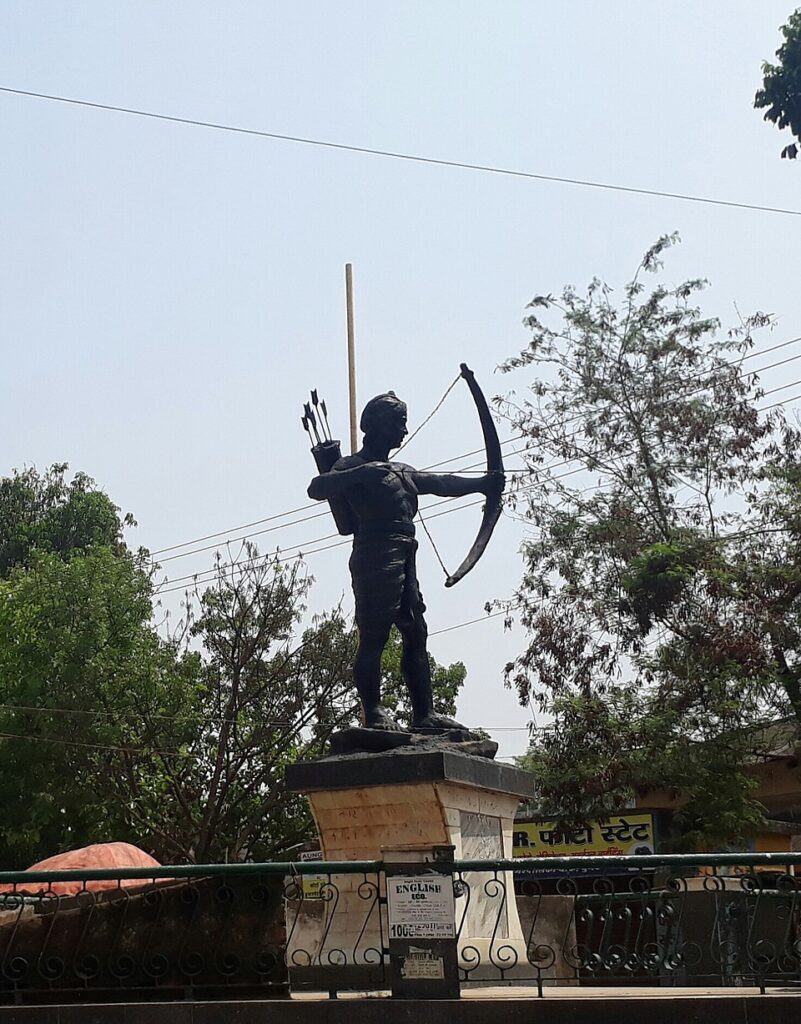
he is described as one of the earliest freedom fighters who organised local residents against the administration of [[East India Company]] and is said to have assassinated [[Augustus Cleveland]] with an arrow, although contemporary records suggest otherwise.{{Sfn|Nath|2017|p=34—35, “What were the circumstances of his death? Our common understanding is that he was shot and wounded by an arrow by Tilka Manjhi, a Santal leader, and he died after sometime as a result of its impact. Tilka Manhji was also hanged publicly by the British administration for killing Cleveland. But surprisingly, our contemporary and later English sources maintain a mysterious silence on the probable cause of Cleveland’s death. They discuss his death, but rarely its cause. However, we find a passing reference of the causes of his death in the account of William Hodges. (…) Whatever the circumstances of his death, it seems to have been lamented by one and all”}}{{Sfn|Verma|2022|p=453, Thus, it is evidently clear that right from 1788, in no record, we find even a single word about the tribal leader (Tilka Manjhi); to the contrary we get detailed account of Augustus Cleveland, his achievements and also the cause of his death on 13 January 1784. A handsome monument was erected to the memory of Augustus Cleveland by Warren Haistings, the Governor-General of India, and in this monument, the last sentence is remarkable ‘He departed this life on the 13th January, 1784, aged 29’. It is not stated that he was killed; instead ‘he departed this life’}}
he is described as one of the earliest freedom fighters who organised local residents against the administration of [[East India Company]] and is said to have assassinated [[Augustus Cleveland]] with an arrow, although contemporary records suggest otherwise.{{Sfn|Nath|2017|p=34—35, “What were the circumstances of his death? Our common understanding is that he was shot and wounded by an arrow by Tilka Manjhi, a Santal leader, and he died after sometime as a result of its impact. Tilka Manhji was also hanged publicly by the British administration for killing Cleveland. But surprisingly, our contemporary and later English sources maintain a mysterious silence on the probable cause of Cleveland’s death. They discuss his death, but rarely its cause. However, we find a passing reference of the causes of his death in the account of William Hodges. (…) Whatever the circumstances of his death, it seems to have been lamented by one and all”}}{{Sfn|Verma|2022|p=453, Thus, it is evidently clear that right from 1788, in no record, we find even a single word about the tribal leader (Tilka Manjhi); to the contrary we get detailed account of Augustus Cleveland, his achievements and also the cause of his death on 13 January 1784. A handsome monument was erected to the memory of Augustus Cleveland by Warren Haistings, the Governor-General of India, and in this monument, the last sentence is remarkable ‘He departed this life on the 13th January, 1784, aged 29’. It is not stated that he was killed; instead ‘he departed this life’}}
The historical record of Tilka Manjhi is very limited. According to historian Dinesh Narayan Verma, government records up to 1965 and early post-independence writings on tribal history, make no mention of a tribal leader named ‘Tilka Manjhi’ or of his role in the death of Augustus Cleveland.{{Sfn|Verma|2022}} He further noted that the first appearance of the figure ‘Tilka Manjhi’ came in 1970, in a book by Ramlakhan Prasad Gond, an engineer by profession,{{Sfn|Verma|2022|p=445, “But in 1970 a tribal author named Ramlakhan Prasad ‘Gond’ published a book titled Tilka Manjhi (Gond 1970: 1-32) from Adivasi Sahyogi Prakashan, Dumka (then in Bihar now in Jharkhand and presently its sub-capital), called him a tribal leader who not only organized local people against the administration of East India Company but also shot dead Augustus Cleveland in 1784 by his arrow. This created a great panic in and around Bhagalpur, but ultimately Tilka Manjhi was captured by the forces of the Company. He was tied with rope and dragged through the roads of Bhagalpur, his lacerated body hanged in 1785, and presently, the place is called Tilka Manjhi Chowk, where a big statue of Tilka Manjhi was built in 1985-86.5 This is the sum and substance of the said book written by Ramlakhan Prasad Gond” (p.446); In fact, after closely assessing the book, it becomes clear that the whole story of ‘Baba Tilka Manjhi’ is a castle built in air and seems to be a fairy tale. A noted scholar Dr. Doman Sahu ‘Samir’ had also very critically analysed the book by Gond and strongly refuted the fact stated in the book by its author”}} and concluded that Tilka Manjhi emerged as a historical personality without single historical evidence.{{Sfn|Verma|2022|p=453, “During the five decades (since 1970), birthday celebrations of the tribal leader with astonishing pump and show, music and dance have been taking place in traditional ways. It receives wide publicity in newspapers as news items, articles, essays, etc. Tilka Manjhi has emerged as a historical personality without single historical evidence”}}
According to historian Dinesh Narayan Verma, government records up to 1965 and early post-independence writings on tribal history, make no mention of a tribal leader named ‘Tilka Manjhi’ or of his role in the death of Augustus Cleveland.{{Sfn|Verma|2022}} He further noted that the first appearance of the figure ‘Tilka Manjhi’ came in 1970, in a book by Ramlakhan Prasad Gond, an engineer by profession,{{Sfn|Verma|2022|p=445, “But in 1970 a tribal author named Ramlakhan Prasad ‘Gond’ published a book titled Tilka Manjhi (Gond 1970: 1-32) from Adivasi Sahyogi Prakashan, Dumka (then in Bihar now in Jharkhand and presently its sub-capital), called him a tribal leader who not only organized local people against the administration of East India Company but also shot dead Augustus Cleveland in 1784 by his arrow. This created a great panic in and around Bhagalpur, but ultimately Tilka Manjhi was captured by the forces of the Company. He was tied with rope and dragged through the roads of Bhagalpur, his lacerated body hanged in 1785, and presently, the place is called Tilka Manjhi Chowk, where a big statue of Tilka Manjhi was built in 1985-86.5 This is the sum and substance of the said book written by Ramlakhan Prasad Gond” (p.446); In fact, after closely assessing the book, it becomes clear that the whole story of ‘Baba Tilka Manjhi’ is a castle built in air and seems to be a fairy tale. A noted scholar Dr. Doman Sahu ‘Samir’ had also very critically analysed the book by Gond and strongly refuted the fact stated in the book by its author”}} and concluded that Tilka Manjhi emerged as a historical personality without single historical evidence.{{Sfn|Verma|2022|p=453, “During the five decades (since 1970), birthday celebrations of the tribal leader with astonishing pump and show, music and dance have been taking place in traditional ways. It receives wide publicity in newspapers as news items, articles, essays, etc. Tilka Manjhi has emerged as a historical personality without single historical evidence”}}
Since the 1970s, Tilka Manjhi has been featured in various literary works such as [[Mahasweta Devi]]’s book ”Shaalgirah Ki Pukar Par”. Several streets, university institutions have been named after him.
Since the 1970s, Tilka Manjhi has been featured in various literary works such as [[Mahasweta Devi]]’s book ”Shaalgirah Ki Pukar Par”. Several streets, university institutions have been named after him.
Tribal freedom fighter
|
Tilka Majhi |
|
|---|---|
 |
|
| Born | 11 February 1750[1] |
| Died | 13 January 1785 |
| Cause of death | Execution by hanging |
| Nationality | Indian |
| Occupations |
|
| Movement | Manjhi revolt, tribal resistance against British colonial rule |
Tilka Majhi (11 February 1750 – 13 January 1785), according to popular accounts, was an Indian tribal leader who led a rebellion against British colonial rule from 1771 until his capture and execution in 1785.[2] In these narratives,[3]
he is described as one of the earliest freedom fighters who organised local residents against the administration of East India Company and is said to have assassinated Augustus Cleveland with an arrow, although contemporary records suggest otherwise.[4][5]
According to historian Dinesh Narayan Verma, government records up to 1965 and early post-independence writings on tribal history, make no mention of a tribal leader named ‘Tilka Manjhi’ or of his role in the death of Augustus Cleveland. He further noted that the first appearance of the figure ‘Tilka Manjhi’ came in 1970, in a book by Ramlakhan Prasad Gond, an engineer by profession,[7] and concluded that Tilka Manjhi emerged as a historical personality without single historical evidence.[8]
Since the 1970s, Tilka Manjhi has been featured in various literary works such as Mahasweta Devi‘s book Shaalgirah Ki Pukar Par. Several streets, university institutions have been named after him.
Tilka Manjhi was born as into a Santhal[a] family on 11 February 1750 in a small village called Tilakpur in Sultanganj, Bengal Subah (present-day Bihar). He had acquired the skills of archery, hunting wild animals, fording rivers, and climbing high trees in his childhood.[10] His name,Tilka, meaning “person with angry red eyes” in Pahadia language was given due to his fierce nature. As a village head, he adopted the title “Manjhi,” which signifies a leader in both Pahadia and Santhal communities.[11] Manjhi played a crucial role for worship and leading the Santal community. He was revered as Majhi Baba. His father name was Sundara Murmu.[12] Tilka Manjhi took up arms against the British in 1784, predating the Indian Rebellion of 1857 by more than half a century. He organised the adivasis predominantly Santal to form an armed group to fight against the resource grabbing and exploitation of British.[13]
In 1784, the first armed rebellion occurred against the British, and was the beginning of the Santal revolt. It was due to a famine in 1770 and the consequences of the Court of Directors order influenced by William Pitt the Younger—the Court of Directors issued a ten-year order on the settlement of zamindari.[14] This resulted in a minimal chance to negotiate between local zamdindars and Santhal villagers. Baba Tilka Majhi attacked Augustus Cleveland, the British commissioner lieutenant, and Rajmahal with a gulel (similar to a slingshot). The British surrounded the Tilapore forest from which he operated, although he and his men held them at bay for several weeks. When he was finally caught in 1784, he was tied to the tail of a horse and dragged to the collector’s residence at Bhagalpur. There, his lacerated body was hung from a Banyan tree.[15]
A statue to him was erected at the spot where he was hanged, after Indian independence. The nearby residence of S.P. Bhagalpur was named after him. Bhagalpur University was renamed after him – Tilka Manjhi Bhagalpur University.[16]
Augustus Cleveland was born in North Devon, England to John Clevland. He joined the service of the Company at the age of 17, partly because of his connection to Sir John Shore. At the young age of 25, Cleveland became the Magistrate and Collector of Bhagalpur and Rajmahal in 1779. Cleveland died on 13 January 1784 at the age of 29 after a month of fever. He died aboard the ship Atlas Indiaman near the mouth of the Hooghly River while sailing to the Cape of Good Hope, and his body was taken back to Calcutta on a pilot boat and buried in South Park Street Cemetery.
Connection with Jabra Pahadia
[edit]
Popular accounts suggest that Tilka Manjhi’s real name was Jabra Pahadia.[18] However, Verma argues that this was an attempt to equate Tilka Manjhi with a historical figure. According to him, Jabra Pahadia[b] was a historical figure who ‘once a noted bandit’ but later served in the British administration around the same period. And contemporary records do not support the identification of the two figures as the same.[20]
- ^ Singh 1985, p. 121, “He is said to have been born on 11 February 1750, which is too exact to be true, and is given a life-span of 1750-1784”.
- ^ Rao, V. Srinivasa (2018). Adivasi Rights and Exclusion in India. Routledge. p. 269.
Tribal India was in ferment right from the beginning of the East India Company’s forays into the tribal tracts. Already in 1778, Tilka Mahji led the fierce resistance of the Pahariya people and fought the illegal entry of the sepoys of the East India Company into their for-ested homelands in the Mal-Pahariya Region. Tilka Mahji paid with his life for the nascent struggle for freedom, grossly misinterpreted as a mere act of insubordination.
- ^ _
- ^ Nath 2017, p. 34—35, “What were the circumstances of his death? Our common understanding is that he was shot and wounded by an arrow by Tilka Manjhi, a Santal leader, and he died after sometime as a result of its impact. Tilka Manhji was also hanged publicly by the British administration for killing Cleveland. But surprisingly, our contemporary and later English sources maintain a mysterious silence on the probable cause of Cleveland’s death. They discuss his death, but rarely its cause. However, we find a passing reference of the causes of his death in the account of William Hodges. (…) Whatever the circumstances of his death, it seems to have been lamented by one and all”.
- ^ Verma 2022, p. 453, Thus, it is evidently clear that right from 1788, in no record, we find even a single word about the tribal leader (Tilka Manjhi); to the contrary we get detailed account of Augustus Cleveland, his achievements and also the cause of his death on 13 January 1784. A handsome monument was erected to the memory of Augustus Cleveland by Warren Haistings, the Governor-General of India, and in this monument, the last sentence is remarkable ‘He departed this life on the 13th January, 1784, aged 29’. It is not stated that he was killed; instead ‘he departed this life’.
- ^ Verma 2022, p. 453, “During the five decades (since 1970), birthday celebrations of the tribal leader with astonishing pump and show, music and dance have been taking place in traditional ways. It receives wide publicity in newspapers as news items, articles, essays, etc. Tilka Manjhi has emerged as a historical personality without single historical evidence”.
- ^ Basu, Ipshita (2 February 2024). Reclaiming Indigeneity and Democracy in India’s Jharkhand. Oxford University Press. ISBN 978-0-19-888467-5.
- ^ Srikrishan ‘Sarala’ (1 January 1999). Indian Revolutionaries 1757-1961 (Vol-1): A Comprehensive Study, 1757-1961. Prabhat Prakashan. pp. 156–157. ISBN 978-81-87100-16-4.
- ^ Anurag, Akash (30 December 2020). “Tilka Manjhi: A Tribal Hero Our History Books Forgot”. Peepul Tree.
- ^ “Tilka Majhi: The Warrior of the Old World”. Adivasi Lives Matter. 11 February 2022. Retrieved 15 June 2024.
- ^ “Tilka Manjhi: India’s First and Forgotten Freedom Fighter”. Madras Courier. 7 March 2018. Retrieved 11 October 2019.
- ^ Wangchuk, Rinchen Norbu (30 December 2021). “How a Fearless Adivasi Led India’s 1st People’s Revolt Against the British”. The better India.
- ^ “Biography of Tilka Majhi (1750 – 1785)”. India Study Channel. 7 October 2014. Retrieved 11 October 2019.
- ^ “TILKA MANJHI BHAGALPUR UNIVERSITY AT A GLANCE – Tilka Manjhi Bhagalpur University – TMBU – Bhagarlpur – Bihar”. Tilka Manjhi Bhagalpur University – TMBU – Bhagarlpur – Bihar – TMBU Official website. 12 July 1960. Retrieved 11 October 2019.
- ^ Sarkar, Gautam (11 February 2011). “Identity crisis shadows Tilka aura”. The Telegraph. Retrieved 18 September 2025.
- ^ Verma 2022, p. 451, “It is also to be noted that at Tilka Manjhi Chowk in Bhagalpur (Bihar) the Statue of the tribal leader is named as ‘Tilka Manjhi’ but there has been an attempt to attach/amalgamate the name of the tribal leader (Tilka Manjhi) with that of Joura Paharia, 10 who was ‘named first native commandant’ of the corps of Hill Rangers (Roy Chaudhury, 1962: 53) formed in 1782. However, there is no historical document to corroborate both Tilka Manjhi and Joura Paharias as one and same. However, Joura is a historical figure; ‘once a noted bandit’ who, according to Augustus Cleveland, was the first inhabitant of the hills to enter the service of Government (O’Malley, 1938:45)”.

