
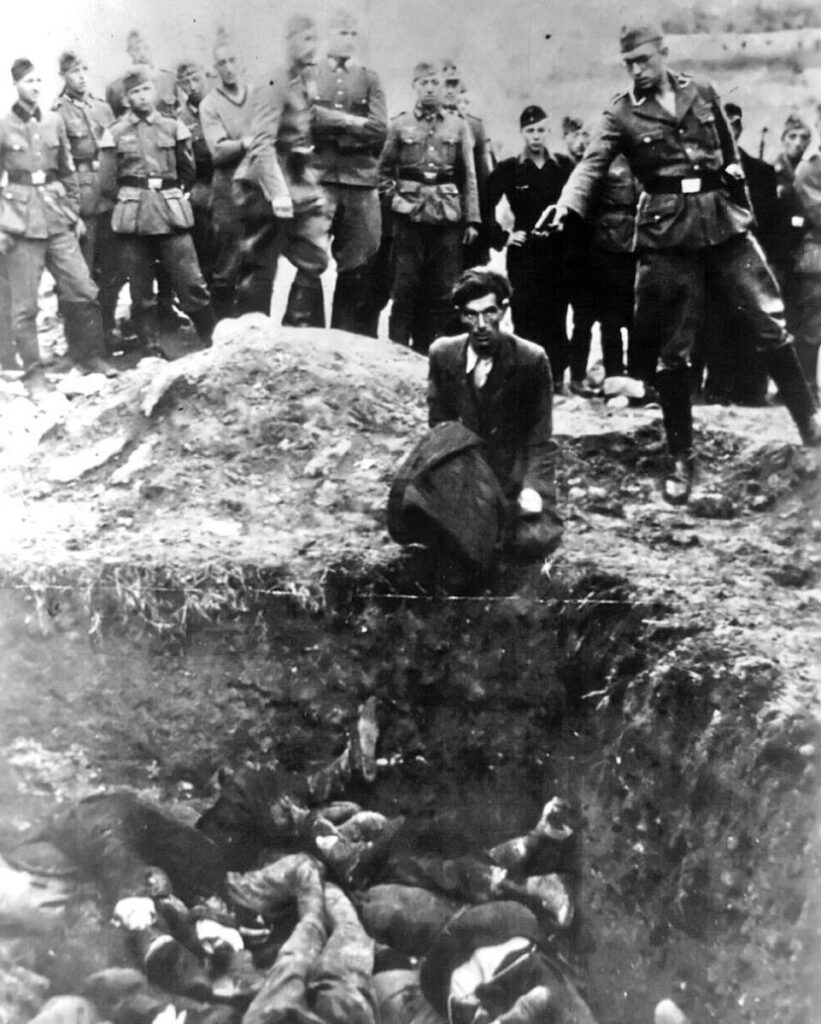
Onnen took part in these atrocities as a low-ranking SS member. By July 1941 he had already committed his first murders as part of Einsatzgruppe C’s killing operations.<ref name=”Der Spiegel” /> During this time, Onnen was an SS-Unterscharführer (equivalent to a sergeant),<ref name=”szyska” /> which would be the highest rank he ever attained,<ref>{{Cite web |date=2025-10-03 |title=Grâce à l’IA, un historien a identifié le nazi abattant un prisonnier sur cette photo de l’Holocauste |url=https://www.slate.fr/tech-internet/intelligence-artificielle-historien-identifier-nazi-prisonnier-holocauste-photo-guerre-juif-ukraine-urss |access-date=2025-10-24 |website=Slate.fr |language=fr-FR}}</ref><ref name=”Noz.de” /> though it was not a high rank.<ref name=”Guardian” /> On 28 July 1941, an SS massacre of Jews took place at the citadel in [[Berdychiv]], and a photograph captured a man aiming a pistol at a Jewish man kneeling before a pit of bodies, an image dubbed ”[[The Last Jew in Vinnitsa]]”, under the mistaken belief that it was taken in [[Vinnitsa]].<ref name=”DW”>{{Cite web |title=Holocaust photo: 1941 Nazi murderer now identified – DW – 10/19/2025 |url=https://www.dw.com/en/holocaust-photo-1941-nazi-murderer-now-identified/a-74394285 |access-date=2025-10-24 |website=dw.com |language=en}}</ref><ref name=”Der Spiegel” /> In 2025, historian [[Jürgen Matthäus]] identified Onnen as the gunman with 99% certainty after extensive research and an artificial intelligence image analysis conducted by [[Bellingcat]], with his findings being published in the ”{{Interlanguage link|Journal of Historical Studies|de|Zeitschrift für Geschichtswissenschaft (1953)}}”.<ref name=”Guardian” /><ref>{{Cite web |last=K.d.ö.R |first=Zentralrat der Juden in Deutschland |date=2025-09-30 |title=Identität des Täters auf erschütterndem Holocaust-Foto geklärt |url=https://www.juedische-allgemeine.de/politik/identitaet-des-taeters-auf-erschuetterndem-holocaust-foto-geklaert/ |access-date=2025-10-24 |website=Jüdische Allgemeine |language=de |quote=Die Ermittlungen, an denen auch ein privates Recherche-Büro und Künstliche Intelligenz beteiligt waren, um Familienfotos abzugleichen, ergaben eine 99-prozentige Wahrscheinlichkeit für Oehnens Identität. Oehnen, dessen Einheit bis Herbst 1942 über 100.000 Zivilisten ermordet hatte, fiel 1943 im Kampf.}}</ref> According to Matthäus, participating in mass shootings did not advance one’s career in such units: “The participation in such massacres brought neither career nor rewards, in these killing units it was considered normal”.<ref>{{Cite web |title=Deutscher Historiker nutzt KI, um das berüchtigtste Holocaust-Foto freizulegen |url=https://reporteri.net/de/Botschaft/Boot/Deutscher-Historiker-nutzt-es–um-das-ber%C3%BCchtigtste-Foto-des-Holocaust-zu-entdecken/}}</ref>
Onnen took part in these atrocities as a low-ranking SS member. By July 1941 he had already committed his first murders as part of Einsatzgruppe C’s killing operations.<ref name=”Der Spiegel” /> During this time, Onnen was an SS-Unterscharführer (equivalent to a sergeant),<ref name=”szyska” /> which would be the highest rank he ever attained,<ref>{{Cite web |date=2025-10-03 |title=Grâce à l’IA, un historien a identifié le nazi abattant un prisonnier sur cette photo de l’Holocauste |url=https://www.slate.fr/tech-internet/intelligence-artificielle-historien-identifier-nazi-prisonnier-holocauste-photo-guerre-juif-ukraine-urss |access-date=2025-10-24 |website=Slate.fr |language=fr-FR}}</ref><ref name=”Noz.de” /> though it was not a high rank.<ref name=”Guardian” /> On 28 July 1941, an SS massacre of Jews took place at the citadel in [[Berdychiv]], and a photograph captured a man aiming a pistol at a Jewish man kneeling before a pit of bodies, an image dubbed ”[[The Last Jew in Vinnitsa]]”, under the mistaken belief that it was taken in [[Vinnitsa]].<ref name=”DW”>{{Cite web |title=Holocaust photo: 1941 Nazi murderer now identified – DW – 10/19/2025 |url=https://www.dw.com/en/holocaust-photo-1941-nazi-murderer-now-identified/a-74394285 |access-date=2025-10-24 |website=dw.com |language=en}}</ref><ref name=”Der Spiegel” /> In 2025, historian [[Jürgen Matthäus]] identified Onnen as the gunman with 99% certainty after extensive research and an artificial intelligence image analysis conducted by [[Bellingcat]], with his findings being published in the ”{{Interlanguage link|Journal of Historical Studies|de|Zeitschrift für Geschichtswissenschaft (1953)}}”.<ref name=”Guardian” /><ref>{{Cite web |last=K.d.ö.R |first=Zentralrat der Juden in Deutschland |date=2025-09-30 |title=Identität des Täters auf erschütterndem Holocaust-Foto geklärt |url=https://www.juedische-allgemeine.de/politik/identitaet-des-taeters-auf-erschuetterndem-holocaust-foto-geklaert/ |access-date=2025-10-24 |website=Jüdische Allgemeine |language=de |quote=Die Ermittlungen, an denen auch ein privates Recherche-Büro und Künstliche Intelligenz beteiligt waren, um Familienfotos abzugleichen, ergaben eine 99-prozentige Wahrscheinlichkeit für Oehnens Identität. Oehnen, dessen Einheit bis Herbst 1942 über 100.000 Zivilisten ermordet hatte, fiel 1943 im Kampf.}}</ref> According to Matthäus, participating in mass shootings did not advance one’s career in such units: “The participation in such massacres brought neither career nor rewards, in these killing units it was considered normal”.<ref>{{Cite web |title=Deutscher Historiker nutzt KI, um das berüchtigtste Holocaust-Foto freizulegen |url=https://reporteri.net/de/Botschaft/Boot/Deutscher-Historiker-nutzt-es–um-das-ber%C3%BCchtigtste-Foto-des-Holocaust-zu-entdecken/}}</ref>
Onnen continued to serve with Nazi security forces through 1942, during which Einsatzgruppe C and affiliated units carried out mass murder across occupied Soviet territories. On 12 August 1943, Onnen, at the age of 37, was killed in combat near [[Zhytomyr]] in [[western Ukraine]], and was buried at a military cemetery in [[Kyiv]].<ref name=”szyska” /><ref name=”Noz.de” /> The letters Onnen sent to his sister during the war were destroyed.<ref name=”DW” /> Because of this, and due to the fact that he died in the field, Onnen was considered a “fallen” soldier, escaping any post-war trial or accountability for his role in the Holocaust.<ref>{{Cite web |title=„Der letzte Jude in Winniza“: Historiker identifizieren SS-Mörder auf bekanntem Holocaust-Foto – WELT |url=https://www.welt.de/geschichte/article68de601e8016f8118e2fa6c5/der-letzte-jude-in-winniza-historiker-identifizieren-ss-moerder-auf-bekanntem-holocaust-foto.html |access-date=2025-12-07 |website=DIE WELT |language=de}}</ref> In his hometown region of [[Weener]], his name was inscribed on a local war memorial honoring those victimized by war.<ref>{{Cite web |last=Höfer |first=Lotti |title=KI deckt NS-Verbrechen auf: Täter auf bekanntem Kriegsfoto identifiziert – Stadt reagiert |url=https://www.ndr.de/nachrichten/niedersachsen/oldenburg_ostfriesland/nazi-verbrechen-wie-ki-eine-ostfriesische-kleinstadt-veraendert-weener,kriegsverbrecher-100.html |access-date=2025-12-07 |website=ndr.de |language=de}}</ref> After Matthäus published his research the council began considerations to remove his name from the memorial.<ref name=”Memorial removal”>{{Cite web |last=Zeitung |first=Rheiderland |date=2025 |title=Weener auch »eine Stadt der Täter« |url=https://rheiderland.de/artikel/61144/weener-auch-eine-stadt-der-taeter |access-date=2025-10-26 |website=Rheiderland.de |language=de}}</ref>
Onnen continued to serve with Nazi security forces through 1942, during which Einsatzgruppe C and affiliated units carried out mass murder across occupied Soviet territories. On 12 August 1943, Onnen, at the age of 37, was killed in combat near [[Zhytomyr]] in [[western Ukraine]], and was buried at a military cemetery in [[Kyiv]].<ref name=”szyska” /><ref name=”Noz.de” /> The letters Onnen sent to his sister during the war were destroyed.<ref name=”DW” /> Because of this, and due to the fact that he died in the field, Onnen was considered a “fallen” soldier, escaping any post-war trial or accountability for his role in the Holocaust.<ref>{{Cite web |title=„Der letzte Jude in Winniza“: Historiker identifizieren SS-Mörder auf bekanntem Holocaust-Foto – WELT |url=https://www.welt.de/geschichte/article68de601e8016f8118e2fa6c5/der-letzte-jude-in-winniza-historiker-identifizieren-ss-moerder-auf-bekanntem-holocaust-foto.html |access-date=2025-12-07 |website=DIE WELT |language=de}}</ref> In his hometown region of [[Weener]], his name was inscribed on a local war memorial honoring those victimized by war.<ref>{{Cite web |last=Höfer |first=Lotti |title=KI deckt NS-Verbrechen auf: Täter auf bekanntem Kriegsfoto identifiziert – Stadt reagiert |url=https://www.ndr.de/nachrichten/niedersachsen/oldenburg_ostfriesland/nazi-verbrechen-wie-ki-eine-ostfriesische-kleinstadt-veraendert-weener,kriegsverbrecher-100.html |access-date=2025-12-07 |website=ndr.de |language=de}}</ref> After Matthäus published his research the council began considerations to remove his name from the memorial<ref name=”Memorial removal”>{{Cite web |last=Zeitung |first=Rheiderland |date=2025 |title=Weener auch »eine Stadt der Täter« |url=https://rheiderland.de/artikel/61144/weener-auch-eine-stadt-der-taeter |access-date=2025-10-26 |website=Rheiderland.de |language=de}}</ref>
== References ==
== References ==
Nazi military officer and war criminal (1906–1943)
Jakobus Onnen (3 August 1906 – 12 August 1943) was a German schoolteacher and a member of the Nazi Schutzstaffel (SS) who served in a mobile killing unit during World War II.[1] He was identified as the individual who appears as the executioner in the Holocaust photograph The Last Jew in Vinnitsa, which depicts a Nazi officer about to shoot a Jewish man at a mass grave in 1941, by historian Jürgen Matthäus in 2025.[1][2] He was killed in action on the Eastern Front in 1943[3] and was never prosecuted for his crimes, remaining unidentified as a war criminal for decades after the war.[4]
Early life and education
[edit]
Based on documents from the SS Race and Settlement Office analyzed by Neue Osnabrücker Zeitung,[5] Onnen was born on 3 August 1906 as the fifth child of the headmaster Johann Normannus Engelken Onnen in the village of Tichelwarf in East Frisia, Germany,[5] near the Dutch border. After attending the local primary school for four years, he went to the Latin school in Weener in 1917, after which, from 1921, he attended the Realgymnasium for Boys in Leer, Lower Saxony, graduating in 1927.[5] He studied “Modern Languages” (English, French, Dutch and Spanish) at the University of Göttingen, it is possible that there is where he became radicalized.[5] Onnen became politically active in the late Weimar era, and on 1 November 1931 he joined the Nazi party (NSDAP),[6] which was recognized at the time as a group seeking a “revolution through violent means … with the goal of establishing the National Socialist Third Reich”, his party number was 723098.[5] It is assumed that when Onnen took his state exam in May 1932, he was already a fervent supporter of fascist ideology.[5] He enlisted to the Sturmabteilung (SA) in January 1932, a year before the “Seizure of Power” by the Nazis, and on 1 November 1933 he joined the SS, with the membership number 267841.[5][7] From October 1934 to March 1936, Onnen was engaged in preparatory service for the assessor exam in Heiligenstadt, which was a requirement for his employment in the German Colonial School in Witzenhausen, Hesse.[5] In March 1936, Onnen passed his pedagogical exam, after which he worked as a secondary school teacher, teaching French, English, and physical education.[6] However, according to a May 1939 report on the German Colonial School, his performance as a teacher was subpar: “The teaching staff suffers in both their reputation and their performance because immoral and conscienceless individuals like a teacher Onnen … are allowed to act. Apart from his inability to master the languages he claims to teach, there are drinking parties and fraternizing with students”.[5]
After two failed engagements, Onnen married Ruth (née Hübotter) on 3 April 1939, and in August that same year, Onnen joined the SS Death’s Head Standarte “Oberbayern”, a nucleus of the Waffen-SS, assigned to the Dachau concentration camp near Munich.[5]
World War II and Einsatzgruppe Service
[edit]
In late 1939, after the German invasion of Poland, Onnen was transferred to the Ordnungspolizei (Order Police), and from January to 1940 he was stationed in the occupied Polish city of Płock, northwest of Warsaw.[5] Following the launch of Operation Barbarossa in June 1941, Onnen was sent to the Eastern Front and became a member of Einsatzgruppe C, a mobile SS death squad operating in Ukraine. Einsatzgruppe C, under the command of SS-Brigadeführer Otto Rasch, was one of several units tasked with mass shootings of Jews, communists, and other civilians in the wake of the German army’s advance. The unit comprised roughly 700 men and is estimated to have murdered over 100,000 people, mostly Jews, in Ukraine by the spring of 1942.[6][8]

Onnen took part in these atrocities as a low-ranking SS member. By July 1941 he had already committed his first murders as part of Einsatzgruppe C’s killing operations.[8] During this time, Onnen was an SS-Unterscharführer (equivalent to a sergeant),[3] which would be the highest rank he ever attained,[9][5] though it was not a high rank.[1] On 28 July 1941, an SS massacre of Jews took place at the citadel in Berdychiv, and a photograph captured a man aiming a pistol at a Jewish man kneeling before a pit of bodies, an image dubbed The Last Jew in Vinnitsa, under the mistaken belief that it was taken in Vinnitsa.[10][8] In 2025, historian Jürgen Matthäus identified Onnen as the gunman with 99% certainty after extensive research and an artificial intelligence image analysis conducted by Bellingcat, with his findings being published in the Journal of Historical Studies.[1][11] According to Matthäus, participating in mass shootings did not advance one’s career in such units: “The participation in such massacres brought neither career nor rewards, in these killing units it was considered normal”.[12]
Onnen continued to serve with Nazi security forces through 1942, during which Einsatzgruppe C and affiliated units carried out mass murder across occupied Soviet territories. On 12 August 1943, Onnen, at the age of 37, was killed in combat near Zhytomyr in western Ukraine, and was buried at a military cemetery in Kyiv.[3][5] The letters Onnen sent to his sister during the war were destroyed.[10] Because of this, and due to the fact that he died in the field, Onnen was considered a “fallen” soldier, escaping any post-war trial or accountability for his role in the Holocaust.[13] In his hometown region of Weener, his name was inscribed on a local war memorial honoring those victimized by war.[14] After Matthäus published his research the council began considerations to remove his name from the memorial,[4] with the conclusion being that his name would be covered by a plaque with a QR code, through which visitors could find out about him.[15][16]
- ^ a b c d “The Einsatzgruppe C commando, one of several mobile units deployed in the newly occupied Soviet Union, had been engaged in clearing the region of ‘Jews and partisans’ days before a visit by Adolf Hitler.” Cole, Deborah (2 October 2025). “Historian uses AI to help identify Nazi in notorious Holocaust murder image”. The Guardian. Guardian News & Media Limited. Retrieved 24 October 2025.
- ^ Matthäus, Jürgen (Winter 2023). “‘The last Jew in Vinnitsa’: Reframing an Iconic Holocaust Photograph”. Holocaust and Genocide Studies. 37 (3): 349–359. doi:10.1093/hgs/dcad053. Project MUSE 918306.
- ^ a b c Szyska, Holger (30 September 2025). “Foto mit erschossenem Juden: SS-Mörder soll aus Ostfriesland sein”. noz.de (in German). Retrieved 1 November 2025.
- ^ a b Zeitung, Rheiderland (2025). “Weener auch »eine Stadt der Täter«”. Rheiderland.de (in German). Retrieved 26 October 2025.
- ^ a b c d e f g h i j k l m Szyska, Holger (28 October 2025). “Wie Jakobus Onnen aus Tichelwarf zum Kriegsverbrecher wurde”. noz.de (in German). Retrieved 3 November 2025.
- ^ a b c “Mutmaßlicher NS-Mörder identifiziert: Deutscher Historiker löst nach Jahrzehnten Rätsel von berüchtigtem Holocaust-Foto”. Kölner Stadt-Anzeiger (in German). 2 October 2025. Retrieved 24 October 2025.
- ^ K.d.ö.R, Zentralrat der Juden in Deutschland (30 September 2025). “Identität des Täters auf erschütterndem Holocaust-Foto geklärt”. Jüdische Allgemeine (in German). Retrieved 24 October 2025.
- ^ a b c Wiegrefe, Klaus (22 September 2025). “(S+) Holocaust: Wie KI half, diesen Mörder zu identifizieren”. Der Spiegel (in German). ISSN 2195-1349. Retrieved 26 October 2025.
- ^ “Grâce à l’IA, un historien a identifié le nazi abattant un prisonnier sur cette photo de l’Holocauste”. Slate.fr (in French). 3 October 2025. Retrieved 24 October 2025.
- ^ a b “Holocaust photo: 1941 Nazi murderer now identified – DW – 10/19/2025”. dw.com. Retrieved 24 October 2025.
- ^ K.d.ö.R, Zentralrat der Juden in Deutschland (30 September 2025). “Identität des Täters auf erschütterndem Holocaust-Foto geklärt”. Jüdische Allgemeine (in German). Retrieved 24 October 2025.
Die Ermittlungen, an denen auch ein privates Recherche-Büro und Künstliche Intelligenz beteiligt waren, um Familienfotos abzugleichen, ergaben eine 99-prozentige Wahrscheinlichkeit für Oehnens Identität. Oehnen, dessen Einheit bis Herbst 1942 über 100.000 Zivilisten ermordet hatte, fiel 1943 im Kampf.
- ^ “Deutscher Historiker nutzt KI, um das berüchtigtste Holocaust-Foto freizulegen”.
- ^ “„Der letzte Jude in Winniza”: Historiker identifizieren SS-Mörder auf bekanntem Holocaust-Foto – WELT”. DIE WELT (in German). Retrieved 7 December 2025.
- ^ Höfer, Lotti. “KI deckt NS-Verbrechen auf: Täter auf bekanntem Kriegsfoto identifiziert – Stadt reagiert”. ndr.de (in German). Retrieved 7 December 2025.
- ^ ndr.de. “Nazi-Verbrecher auf berühmtem Foto identifiziert: Stadt überklebt Namen auf Ehrenmal”. ndr.de (in German). Retrieved 7 December 2025.
- ^ Höfer, Lotti. “KI deckt NS-Verbrechen auf: Täter auf bekanntem Kriegsfoto identifiziert – Stadt reagiert”. ndr.de (in German). Retrieved 7 December 2025.

