
From Wikipedia, the free encyclopedia
Content deleted Content added
|
|
|||
| Line 7: | Line 7: | ||
|
Markarian 493 is depicted as a face-on [[barred spiral galaxy]] of type SBb.<ref>{{Cite journal |last=Lewis |first=B. M. |date=October 1984 |title=Face-on galaxies. |url=https://articles.adsabs.harvard.edu//full/1984ApJ…285..453L/0000455.000.html |journal=The Astrophysical Journal |language=en |volume=285 |pages=453–457 |doi=10.1086/162474 |bibcode=1984ApJ…285..453L |issn=0004-637X}}</ref> The morphology of the galaxy is very similar to something like MRK 42, with a bright central nucleus present and [[star formation]] regions in a form of a tight wound spiral.<ref>{{Citation |last1=Marín |first1=Víctor M. Muñoz |title=An Atlas of the Circumnuclear Regions of 75 Seyfert Galaxies in the Near-Ultraviolet with the ”Hubble Space Telescope” Advanced Camera for Surveys |date=2007-04-26 |last2=Delgado |first2=Rosa M. González |last3=Schmitt |first3=Henrique R. |last4=Fernandes |first4=Roberto Cid |last5=Pérez |first5=Enrique |last6=Storchi-Bergmann |first6=Thaisa |last7=Heckman |first7=Tim |last8=Leitherer |first8=Claus |journal=The Astronomical Journal |volume=134 |issue=2 |pages=648–667 |doi=10.1086/519448 |arxiv=0704.3617 |bibcode=2007AJ….134..648M }}</ref> Imaging also showed a bar and ring structure is present in the galaxy.<ref>{{Citation |last=Kompaniiets |first=O. |title=Multiwavelength Properties of the Low-Redshift Isolated Galaxies with Active Nuclei Modelled with Cigale |journal=Kosmìčna Nauka Ì Tehnologìâ |date=2023-11-20 |volume=29 |issue=5 |pages=88–98 |doi=10.15407/knit2023.05.088 |url=http://arxiv.org/abs/2311.12000 |access-date=2025-12-07 |arxiv=2311.12000 |bibcode=2023KosNT..29e..88K }}</ref> |
Markarian 493 is depicted as a face-on [[barred spiral galaxy]] of type SBb.<ref>{{Cite journal |last=Lewis |first=B. M. |date=October 1984 |title=Face-on galaxies. |url=https://articles.adsabs.harvard.edu//full/1984ApJ…285..453L/0000455.000.html |journal=The Astrophysical Journal |language=en |volume=285 |pages=453–457 |doi=10.1086/162474 |bibcode=1984ApJ…285..453L |issn=0004-637X}}</ref> The morphology of the galaxy is very similar to something like MRK 42, with a bright central nucleus present and [[star formation]] regions in a form of a tight wound spiral.<ref>{{Citation |last1=Marín |first1=Víctor M. Muñoz |title=An Atlas of the Circumnuclear Regions of 75 Seyfert Galaxies in the Near-Ultraviolet with the ”Hubble Space Telescope” Advanced Camera for Surveys |date=2007-04-26 |last2=Delgado |first2=Rosa M. González |last3=Schmitt |first3=Henrique R. |last4=Fernandes |first4=Roberto Cid |last5=Pérez |first5=Enrique |last6=Storchi-Bergmann |first6=Thaisa |last7=Heckman |first7=Tim |last8=Leitherer |first8=Claus |journal=The Astronomical Journal |volume=134 |issue=2 |pages=648–667 |doi=10.1086/519448 |arxiv=0704.3617 |bibcode=2007AJ….134..648M }}</ref> Imaging also showed a bar and ring structure is present in the galaxy.<ref>{{Citation |last=Kompaniiets |first=O. |title=Multiwavelength Properties of the Low-Redshift Isolated Galaxies with Active Nuclei Modelled with Cigale |journal=Kosmìčna Nauka Ì Tehnologìâ |date=2023-11-20 |volume=29 |issue=5 |pages=88–98 |doi=10.15407/knit2023.05.088 |url=http://arxiv.org/abs/2311.12000 |access-date=2025-12-07 |arxiv=2311.12000 |bibcode=2023KosNT..29e..88K }}</ref> |
||
|
The nucleus of Markarian 493 is active and it has been categorized as a narrow-line Seyfert galaxy based on its [[spectrum]].<ref>{{Cite journal |last1=Riffel |first1=R. |last2=Rodríguez-Ardila |first2=A. |last3=Pastoriza |first3=M. G. |date=October 2006 |title=A 0.8-2.4 μm spectral atlas of active galactic nuclei |url=https://ui.adsabs.harvard.edu/abs/2006A&A…457…61R/abstract |journal=Astronomy and Astrophysics |language=en |volume=457 |issue=1 |pages=61–70 |doi=10.1051/0004-6361:20065291 |arxiv=astro-ph/0605463 |bibcode=2006A&A…457…61R |issn=0004-6361}}</ref><ref>{{Cite journal |last1=Osterbrock |first1=D. E. |last2=Pogge |first2=R. W. |date=October 1985 |title=The spectra of narrow-line Seyfert 1 galaxies. |url=https://articles.adsabs.harvard.edu/pdf/1985ApJ…297..166O |journal=The Astrophysical Journal |language=en |volume=297 |pages=166–176 |doi=10.1086/163513 |bibcode=1985ApJ…297..166O |issn=0004-637X}}</ref> When observed with [[Very Large Array]] (VLA), the source of the galaxy is mainly weak with a component that is |
The nucleus of Markarian 493 is active and it has been categorized as a narrow-line Seyfert galaxy based on its [[spectrum]].<ref>{{Cite journal |last1=Riffel |first1=R. |last2=Rodríguez-Ardila |first2=A. |last3=Pastoriza |first3=M. G. |date=October 2006 |title=A 0.8-2.4 μm spectral atlas of active galactic nuclei |url=https://ui.adsabs.harvard.edu/abs/2006A&A…457…61R/abstract |journal=Astronomy and Astrophysics |language=en |volume=457 |issue=1 |pages=61–70 |doi=10.1051/0004-6361:20065291 |arxiv=astro-ph/0605463 |bibcode=2006A&A…457…61R |issn=0004-6361}}</ref><ref>{{Cite journal |last1=Osterbrock |first1=D. E. |last2=Pogge |first2=R. W. |date=October 1985 |title=The spectra of narrow-line Seyfert 1 galaxies. |url=https://articles.adsabs.harvard.edu/pdf/1985ApJ…297..166O |journal=The Astrophysical Journal |language=en |volume=297 |pages=166–176 |doi=10.1086/163513 |bibcode=1985ApJ…297..166O |issn=0004-637X}}</ref> When observed with [[Very Large Array]] (VLA), the source of the galaxy is mainly weak with a component that is unresolved. There is minimal [[Optics|optical]] [[Polarization (waves)|polarization]] of 26%.<ref>{{Cite journal |last1=Ulvestad |first1=James S. |last2=Antonucci |first2=Robert R. J. |last3=Goodrich |first3=Robert W. |date=January 1995 |title=Radio Properties of Narrow-Lined Seyfert 1 Galaxies |url=https://articles.adsabs.harvard.edu//full/1995AJ….109…81U/0000083.000.html |journal=The Astronomical Journal |language=en |volume=109 |pages=81 |doi=10.1086/117258 |bibcode=1995AJ….109…81U |issn=0004-6256}}</ref> In 2024, a central component is located with it being mainly surrounded by emission that is faint and extended. There is also a core component a steep [[flux]] spectrum at 9 GHz [[Frequency|frequencies]].<ref>{{Cite journal |last1=Paul |first1=Jeremiah D. |last2=Plotkin |first2=Richard M. |last3=Brandt |first3=W. N. |last4=Ellis |first4=Christopher H. |last5=Gallo |first5=Elena |last6=Greene |first6=Jenny E. |last7=Ho |first7=Luis C. |last8=Kimball |first8=Amy E. |last9=Haggard |first9=Daryl |date=2024-10-01 |title=Radio Scrutiny of the X-Ray-weak Tail of Low-mass Active Galactic Nuclei: A Novel Signature of High-Eddington Accretion? |journal=The Astrophysical Journal |volume=974 |issue=1 |pages=66 |doi=10.3847/1538-4357/ad67d1 |arxiv=2404.02423 |bibcode=2024ApJ…974…66P |doi-access=free |issn=0004-637X}}</ref> |
||
|
A study published in 2008, has found the presence of a circumnuclear ring inside its central region. |
A study published in 2008, has found the presence of a circumnuclear ring inside its central region. ring a total radius of between 350-500 [[Parsec|parsecs]] with traces of [[Continuum mechanics|continuum]] [[Radio wave|emission]] originating from emission-line gas. The star formation rate inside the ring is calculated to be around 2 M<sub>ʘ</sub> per year with a [[Hydrogen-alpha]] luminosity being 6.7 x 10<sup>41</sup> erg s<sup>-1</sup>. In , there are multiple dust [[Spiral arm|spiral arms]] located outside the ring region.<ref>{{Citation |last1=Popovic |first1=L. C. |title=THREE-DIMENSIONAL SPECTROSCOPIC STUDY OF THE LINE-EMITTING REGIONS OF MRK 493 |date=2008-12-28 |last2=Smirnova |first2=A. A. |last3=Kovacevic |first3=J. |last4=Moiseev |first4=A. V. |last5=Afanasiev |first5=V. L. |journal=The Astronomical Journal |volume=137 |issue=3 |pages=3548–3557 |doi=10.1088/0004-6256/137/3/3548 |arxiv=0812.4817 }}</ref> The central [[supermassive black hole]] for this galaxy is estimated to be 1.5 x 10<sup>6</sup> M<sub>ʘ</sub>.<ref>{{Citation |last1=Adegoke |first1=Oluwashina |title=UV to X-Ray Comptonization Delay in MRK 493 |date=2018-12-19 |url=http://arxiv.org/abs/1812.08056 |access-date=2025-12-07 |arxiv=1812.08056 |last2=Dewangan |first2=Gulab C. |last3=Pawar |first3=Pramod |last4=Pal |first4=Main |journal=The Astrophysical Journal Letters |volume=870 |issue=2 |pages=L13 |doi=10.3847/2041-8213/aaf8ab |doi-access=free }}</ref> |
||
|
== References == |
== References == |
||
Latest revision as of 23:41, 7 December 2025
Seyfert galaxy located in Corona Borealis
Markarian 493 or UGC 10120, is an active Seyfert galaxy of type 1[2] located in the constellation of Corona Borealis. The redshift of the galaxy is (z) 0.031[1] and it was first discovered in the radio survey by astronomers in November 1980.[3]
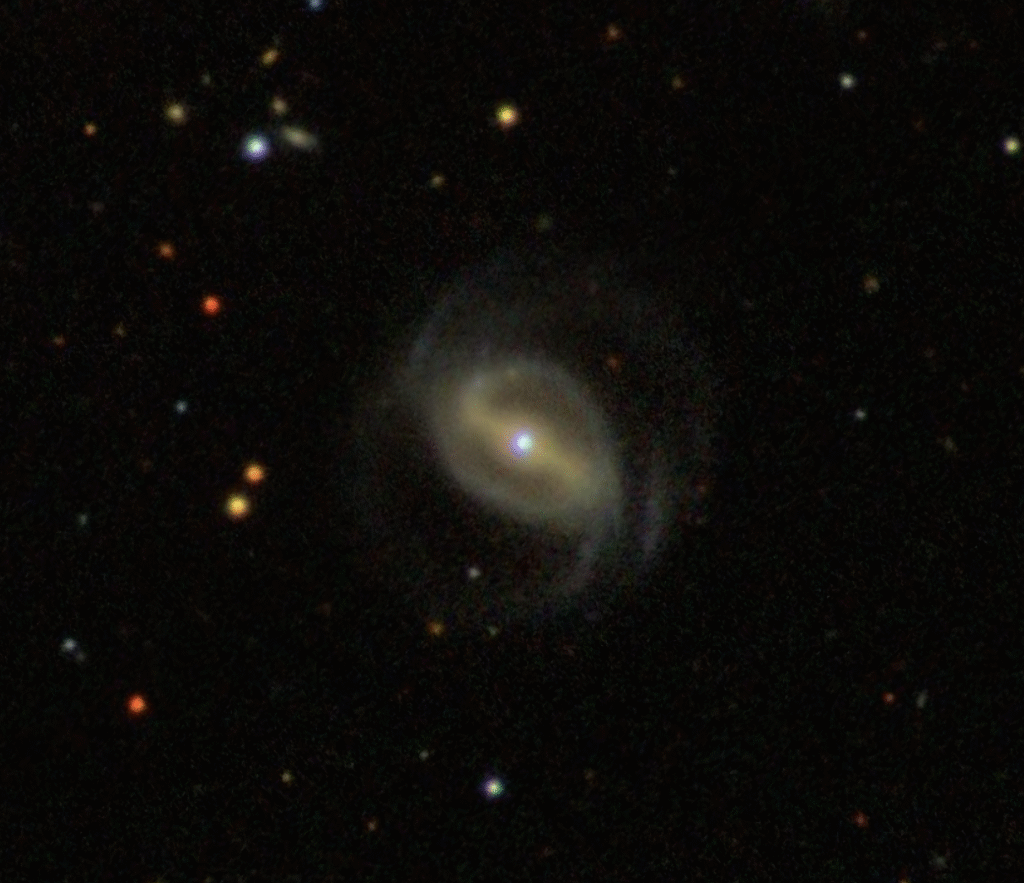
Markarian 493 is depicted as a face-on barred spiral galaxy of type SBb.[4] The morphology of the galaxy is very similar to something like MRK 42, with a bright central nucleus present and star formation regions in a form of a tight wound spiral.[5] Imaging also showed a bar and ring structure is present in the galaxy.[6]
The nucleus of Markarian 493 is active and it has been categorized as a narrow-line Seyfert galaxy based on its spectrum.[7][8] When observed with the Very Large Array (VLA), the source of the galaxy is mainly weak with a component that is unresolved. There is minimal optical polarization of 26%.[9] In 2024, a central component is located with it being mainly surrounded by emission that is faint and extended. There is also a core component with a steep flux spectrum at 9 GHz frequencies.[10]
A study published in 2008, has found the presence of a circumnuclear ring inside its central region. The ring has a total radius of between 350-500 parsecs with traces of continuum emission originating from emission-line gas. The star formation rate inside the ring is calculated to be around 2 Mʘ per year, with a Hydrogen-alpha luminosity being 6.7 x 1041 erg s-1. In addition, there are multiple dust spiral arms located outside the ring region.[11] The central supermassive black hole for this galaxy is estimated to be 1.5 x 10⁶ Mʘ.[12]
- ^ a b c d e f g h “NED Search results for Markarian 493”. NASA/IPAC Extragalactic Database. Retrieved 2025-12-07.
- ^ Bonson, K; Gallo, L C; Wilkins, D R; Fabian, A C (2018-04-04). “Variable blurred reflection in the narrow-line Seyfert 1 galaxy Mrk 493”. Monthly Notices of the Royal Astronomical Society. 477 (3): 3247–3256. doi:10.1093/mnras/sty828. ISSN 0035-8711.
- ^ Kojoian, G.; Tovmasian, Kh M.; Dickinson, D. F.; Dinger, A. S. C. (November 1980). “Radio survey of Markarian galaxies at 6 and 11 cm”. The Astronomical Journal. 85: 1462–1467. Bibcode:1980AJ…..85.1462K. doi:10.1086/112821. ISSN 0004-6256.
- ^ Lewis, B. M. (October 1984). “Face-on galaxies”. The Astrophysical Journal. 285: 453–457. Bibcode:1984ApJ…285..453L. doi:10.1086/162474. ISSN 0004-637X.
- ^ Marín, Víctor M. Muñoz; Delgado, Rosa M. González; Schmitt, Henrique R.; Fernandes, Roberto Cid; Pérez, Enrique; Storchi-Bergmann, Thaisa; Heckman, Tim; Leitherer, Claus (2007-04-26), “An Atlas of the Circumnuclear Regions of 75 Seyfert Galaxies in the Near-Ultraviolet with the Hubble Space Telescope Advanced Camera for Surveys”, The Astronomical Journal, 134 (2): 648–667, arXiv:0704.3617, Bibcode:2007AJ….134..648M, doi:10.1086/519448
- ^ Kompaniiets, O. (2023-11-20), “Multiwavelength Properties of the Low-Redshift Isolated Galaxies with Active Nuclei Modelled with Cigale”, Kosmìčna Nauka Ì Tehnologìâ, 29 (5): 88–98, arXiv:2311.12000, Bibcode:2023KosNT..29e..88K, doi:10.15407/knit2023.05.088, retrieved 2025-12-07
- ^ Riffel, R.; Rodríguez-Ardila, A.; Pastoriza, M. G. (October 2006). “A 0.8-2.4 μm spectral atlas of active galactic nuclei”. Astronomy and Astrophysics. 457 (1): 61–70. arXiv:astro-ph/0605463. Bibcode:2006A&A…457…61R. doi:10.1051/0004-6361:20065291. ISSN 0004-6361.
- ^ Osterbrock, D. E.; Pogge, R. W. (October 1985). “The spectra of narrow-line Seyfert 1 galaxies”. The Astrophysical Journal. 297: 166–176. Bibcode:1985ApJ…297..166O. doi:10.1086/163513. ISSN 0004-637X.
- ^ Ulvestad, James S.; Antonucci, Robert R. J.; Goodrich, Robert W. (January 1995). “Radio Properties of Narrow-Lined Seyfert 1 Galaxies”. The Astronomical Journal. 109: 81. Bibcode:1995AJ….109…81U. doi:10.1086/117258. ISSN 0004-6256.
- ^ Paul, Jeremiah D.; Plotkin, Richard M.; Brandt, W. N.; Ellis, Christopher H.; Gallo, Elena; Greene, Jenny E.; Ho, Luis C.; Kimball, Amy E.; Haggard, Daryl (2024-10-01). “Radio Scrutiny of the X-Ray-weak Tail of Low-mass Active Galactic Nuclei: A Novel Signature of High-Eddington Accretion?”. The Astrophysical Journal. 974 (1): 66. arXiv:2404.02423. Bibcode:2024ApJ…974…66P. doi:10.3847/1538-4357/ad67d1. ISSN 0004-637X.
- ^ Popovic, L. C.; Smirnova, A. A.; Kovacevic, J.; Moiseev, A. V.; Afanasiev, V. L. (2008-12-28), “THREE-DIMENSIONAL SPECTROSCOPIC STUDY OF THE LINE-EMITTING REGIONS OF MRK 493”, The Astronomical Journal, 137 (3): 3548–3557, arXiv:0812.4817, doi:10.1088/0004-6256/137/3/3548
- ^ Adegoke, Oluwashina; Dewangan, Gulab C.; Pawar, Pramod; Pal, Main (2018-12-19), “UV to X-Ray Comptonization Delay in MRK 493”, The Astrophysical Journal Letters, 870 (2): L13, arXiv:1812.08056, doi:10.3847/2041-8213/aaf8ab, retrieved 2025-12-07

