
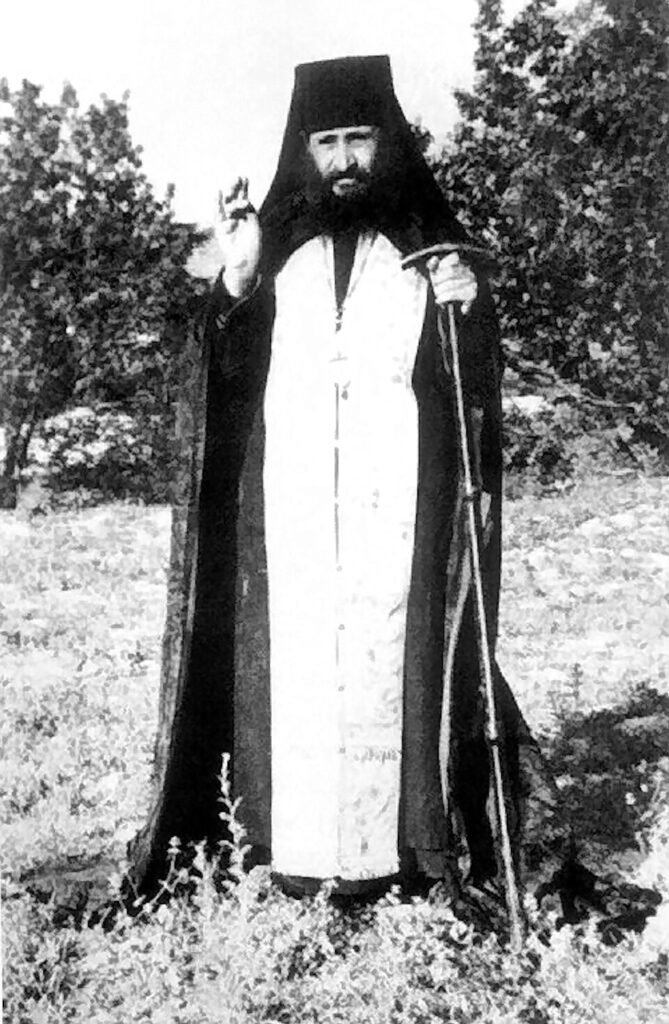
”’Saint George of Drama”’ ({{langx|el|Ὁ Όσιος Γεώργιος της Δράμας}}, 1 January 1901 – 4 November 1959), born ”’Athanasios Karslidis”’, was a [[Greek Orthodox Church|Greek Orthodox]] [[monk]] of [[Caucasus|Caucasian]] origin, [[Veneration|venerated]] as a saint in the [[Eastern Orthodox Church]]. He was renowned in both Greek and [[Georgian Orthodox Church|Georgian Orthodox]] traditions for his spiritual guidance and [[Asceticism|ascetic]] lifestyle.
”’Saint George of Drama”’ ({{langx|el|Ὁ Όσιος Γεώργιος της Δράμας}}, 1 January 1901 – 4 November 1959), born ”’Athanasios Karslidis”’, was a [[Greek Orthodox Church|Greek Orthodox]] [[monk]] of [[Caucasus|Caucasian]] origin, [[Veneration|venerated]] as a saint in the [[Eastern Orthodox Church]]. He was renowned in both Greek and [[Georgian Orthodox Church|Georgian Orthodox]] traditions for his spiritual guidance and [[Asceticism|ascetic]] lifestyle.
The [[Relic#Eastern Orthodoxy|relics]] of Athanasios Karslidis are preserved at the Monastery of the Ascension of Christ in Taxiarches, [[Drama, Greece]].<ref name=”HAGIOLOGY-H.M.DRAMA” /> Reports indicate that his skull bears an imprint resembling a cross.{{Citation needed|date=December 2025}} One [[Translation (relic)|relic was transferred]] to [[Wuppertal]], [[Germany]] in 2013.<ref name=”:0″>{{Cite web |last=Görgens |first=Manfred |date=2013-02-17 |title=Ein Heiliger für Wuppertal |url=http://www.wz.de/lokales/wuppertal/stadtteile/elberfeld-nord/ein-heiliger-fuer-wuppertal-1.1242911 |url-status=dead |archive-url=https://web.archive.org/web/20170325201717/http://www.wz.de/lokales/wuppertal/stadtteile/elberfeld-nord/ein-heiliger-fuer-wuppertal-1.1242911 |archive-date=2017-03-25 |website=Westdeutsche Zeitung |language=de}}</ref> He was officially [[canonized]] on 2 November 2008, during a visit by [[Ecumenical Patriarch Bartholomew]] to Drama.<ref name=”ASCENSION-H.M.DRAMA” /> In 2016, a portion of his relics was donated to the [[Episcopal Church (United States)|Episcopal]] Church of [[Tsalka]], Georgia, under the Georgian Orthodox Church.<ref>{{Cite web |title=Ο Όσιος Γεώργιος Καρσλίδης στην Γεωργία. {{!}} Ιερά Μητρόπολις Δράμας |url=http://www.imdramas.gr/n/2073/%CE%9F-%CE%8C%CF%83%CE%B9%CE%BF%CF%82-%CE%93%CE%B5%CF%8E%CF%81%CE%B3%CE%B9%CE%BF%CF%82-%CE%9A%CE%B1%CF%81%CF%83%CE%BB%CE%AF%CE%B4%CE%B7%CF%82-%CF%83%CF%84%CE%B7%CE%BD-%CE%93%CE%B5%CF%89%CF%81%CE%B3%CE%AF%CE%B1 |access-date=2025-03-20 |website=www.imdramas.gr}}</ref>
The [[Relic#Eastern Orthodoxy|relics]] of Athanasios Karslidis are preserved at the Monastery of the Ascension of Christ in Taxiarches, [[Drama, Greece]].<ref name=”HAGIOLOGY-H.M.DRAMA” /> Reports indicate that his skull bears an imprint resembling a cross.{{Citation needed|date=December 2025}} One [[Translation (relic)|relic was transferred]] to [[Wuppertal]], [[Germany]] in 2013.<ref name=”:0″>{{Cite web |last=Görgens |first=Manfred |date=2013-02-17 |title=Ein Heiliger für Wuppertal |url=http://www.wz.de/lokales/wuppertal/stadtteile/elberfeld-nord/ein-heiliger-fuer-wuppertal-1.1242911 |url-status=dead |archive-url=https://web.archive.org/web/20170325201717/http://www.wz.de/lokales/wuppertal/stadtteile/elberfeld-nord/ein-heiliger-fuer-wuppertal-1.1242911 |archive-date=2017-03-25 |website=Westdeutsche Zeitung |language=de}}</ref> He was officially [[canonized]] on November 2008, during a visit by [[Ecumenical Patriarch Bartholomew]] to Drama.<ref name=”ASCENSION-H.M.DRAMA” /> In 2016, a portion of his relics was donated to the [[Episcopal Church (United States)|Episcopal]] Church of [[Tsalka]], Georgia, under the Georgian Orthodox Church.<ref>{{Cite web |title=Ο Όσιος Γεώργιος Καρσλίδης στην Γεωργία. {{!}} Ιερά Μητρόπολις Δράμας |url=http://www.imdramas.gr/n/2073/%CE%9F-%CE%8C%CF%83%CE%B9%CE%BF%CF%82-%CE%93%CE%B5%CF%8E%CF%81%CE%B3%CE%B9%CE%BF%CF%82-%CE%9A%CE%B1%CF%81%CF%83%CE%BB%CE%AF%CE%B4%CE%B7%CF%82-%CF%83%CF%84%CE%B7%CE%BD-%CE%93%CE%B5%CF%89%CF%81%CE%B3%CE%AF%CE%B1 |access-date=2025-03-20 |website=www.imdramas.gr}}</ref>
On 24 December 2008, the [[Holy Synod of the Russian Orthodox Church]] decided to include Athanasios Karslidis in the [[Menologium|Menology]] of the Russian Orthodox Church, designating his feast day as [[October 24 (Eastern Orthodox liturgics)|24 October]] (Old Style) / 6 November (New Style).<ref name=”PRAVENC” /><ref name=”PATRIARCHIA-RU” />
On 24 December 2008, the [[Holy Synod of the Russian Orthodox Church]] decided to include Athanasios Karslidis in the [[Menologium|Menology]] of the Russian Orthodox Church, designating his feast day as [[October 24 (Eastern Orthodox liturgics)|24 October]] (Old Style) / November (New Style).<ref name=”PRAVENC” /><ref name=”PATRIARCHIA-RU” />
== Early life ==
== Early life ==
20th-century Orthodox Greek saint (1901 – 1959)
|
George of Drama |
|
|---|---|
_of_Drama.jpg) |
|
| Born | Athanasios Karslidis ათანასე კარსლიდისი 1 January 1901 Chadik, Tsalka, Borchaly uezd, Tiflis Governorate, Caucasus Viceroyalty, Russian Empire (now Georgia (country) |
| Died | 4 November 1959 (aged 58) Taxiarchis, Drama, Greece |
| Venerated in | Eastern Orthodox Church |
| Canonized | November 2, 2008, Monastery of the Ascension of Christ, in Taxiarchis, Drama, by Ecumenical Patriarchate of Constantinople.[1] |
| Major shrine | Relics in Monastery of the Ascension of Christ, in Taxiarchis, Drama.[2] |
| Feast | November 4 (ns)[3][4][5] October 24 (os)[6][7] |
Saint George of Drama (Greek: Ὁ Όσιος Γεώργιος της Δράμας, 1 January 1901 – 4 November 1959), born Athanasios Karslidis, was a Greek Orthodox monk of Caucasian origin, venerated as a saint in the Eastern Orthodox Church. He was renowned in both Greek and Georgian Orthodox traditions for his spiritual guidance and ascetic lifestyle.
The relics of Athanasios Karslidis are preserved at the Monastery of the Ascension of Christ in Taxiarches, Drama, Greece.[2] Reports indicate that his skull bears an imprint resembling a cross.[citation needed] One relic was transferred to Wuppertal, Germany in 2013.[8] He was officially canonized on 2nd November 2008, during a visit by Ecumenical Patriarch Bartholomew to Drama.[1] In 2016, a portion of his relics was donated to the Episcopal Church of Tsalka, Georgia, under the Georgian Orthodox Church.[9]
On 24 December 2008, the Holy Synod of the Russian Orthodox Church decided to include Athanasios Karslidis in the Menology of the Russian Orthodox Church, designating his feast day as 24 October (Old Style) / 6th November (New Style).[6][7]
George Karslidis was born in 1901 in Chadik, Tsalka, then part of the Russian Empire.[10][11] His grandparents were refugees from Gümüşhane in the Ottoman Empire, having fled following the Crimean War. At a young age, he lost both of his parents on the same day and was placed in the care of his older brother. According to anonymous accounts, after suffering unspecified abuse from his brother, Karslidis fled to the mountains, where he was found by Turkish villagers and taken to Pontus.[12] He later founded the Monastery of the Ascension of Christ in Taxiarches, where he eventually served as an elder.
Karslidis began his monastic life as a novice at a monastery in Georgia, after traveling to Tiflis, where a priest took him under his care. According to reports, he waited nearly ten years to be tonsured as a monk, which occurred in July 1919 at the age of eighteen. He received the monastic name George Symeon.[13] He was imprisoned by the communist government and allegedly tortured.[14] According to tradition, he was also sentenced to death but survived, despite being hit by three bullets.[8] Biographers note that even at this early stage, Karslidis had attracted many visitors seeking his guidance.[15] Some hagiographical accounts claim that he was seen levitating in prayer during the Divine Liturgy.[16]
In 1929, Karslidis settled in the village of Taxiarches, Sipsa, in northern Greece, where he lived for the remaining thirty years of his life.[3] In 1936, he made a pilgrimage to the Holy Land, visiting Christian holy sites, monasteries, and hermitages.[17]
In 1938, the Greek government allocated an acre of land to Karslidis as part of a permanent rural land distribution program. On this plot, he established the foundations of a monastery dedicated to the Ascension of Jesus, which was officially consecrated in 1939.[17]
Some of Karslidis’ followers attribute to him prophecies concerning World War II and the subsequent Greek Civil War.[17] In 1941, he was reportedly sentenced to death by Bulgarian forces, though he was never executed.[3]
Karslidis died on 4 November 1959 in Greece. He is buried behind the Katholikon (main church) of the Monastery of the Ascension, where he served for thirty years.[18]
Monastery of the Ascension
[edit]
After the death of Karslidis, the Monastery of the Ascension fell into disrepair until its renovation was initiated in 1970 by Metropolitan Dionysios (Kyratsous) of Drama. Following the restoration, the monastery was reestablished, and a sisterhood was founded.[19] It was reconsecrated on 25 April 1971, and on 5 November 1976, it received official recognition from the Church of Greece.[20]
“God cares for everyone. Despair is in effect a lack of faith.”[21]
- ^ a b (in Greek) ΙΕΡΑ ΜΟΝΗ ΑΝΑΛΗΨΕΩΣ ΤΟΥ ΣΩΤΗΡΟΣ ΤΑΞΙΑΡΧΩΝ (ΣΙΨΑ) ΔΡΑΜΑΣ. Μοναστήρια της Ελλάδας. Retrieved: 30 July 2014.
- ^ a b (in Greek) ΤΟΠΙΚΗ ΑΓΙΟΛΟΓΙΑ Archived 2014-09-30 at the Wayback Machine. Ιερά Μητρόπολις Δράμας. Retrieved: 30 July 2014.
- ^ a b c Great Synaxaristes: (in Greek)Ὁ Ὅσιος Γεώργιος Καρσλίδης. 4 Νοεμβρίου. ΜΕΓΑΣ ΣΥΝΑΞΑΡΙΣΤΗΣ.
- ^ (in Greek) Όσιος Γεώργιος Καρσλίδης ο Ομολογητής. Ορθόδοξος Συναξαριστής. 04/11/2014.
- ^ (in Greek) Τυπικὸν τῆς Μεγάλης τοῦ Χριστοῦ ᾽Εκκλησίας. 4η Νοεμβρίου 2014. Οἰκουμενικὸν Πατριαρχεῖον Κωνσταντινουπόλεως (Ecumenical Patriarchate). Retrieved: 18 August 2015.
- ^ a b (in Russian) 6 ноября (24 октября). Православная Энциклопедия под редакцией Патриарха Московского и всея Руси Кирилла (электронная версия). (Orthodox Encyclopedia – Pravenc.ru).
- ^ a b (in Russian) Торжества по случаю первой годовщины канонизации и 60-летия со дня преставления преподобного Георгия (Карслидиса) прошли в г. Драма (Греция). Официальный сайт Русской Православной Церкви (Patriarchia.ru). 9 ноября 2009 г. 15:21. Retrieved 18 August 2015.
- ^ a b Görgens, Manfred (2013-02-17). “Ein Heiliger für Wuppertal”. Westdeutsche Zeitung (in German). Archived from the original on 2017-03-25.
- ^ “Ο Όσιος Γεώργιος Καρσλίδης στην Γεωργία. | Ιερά Μητρόπολις Δράμας”. www.imdramas.gr. Retrieved 2025-03-20.
- ^ Ὃ ὅσιος Γεώργιος τῆς Δράμας – Νέα ἔκδοση, Ιερά Μονή Αναλήψεως του Σωτήρος Ταξιαρχών Δράμας (Σίψα), Πορφυρία Μοναχή, 2019
- ^ Middleton, Herman A. “Elder George of Drama.” In: Precious Vessels of the Holy Spirit: The Lives and Counsels of Contemporary Elders of Greece. 2nd Edition. Thessalonica, Greece & Asheville, NC: Protecting Veil Press, 2004. p. 179.
- ^ Excerpt From: Anonymous. “Saint George of Sipsa, From Child to Saint.” iBooks.
- ^ Middleton, Herman A. “Elder George of Drama.” In: Precious Vessels of the Holy Spirit: The Lives and Counsels of Contemporary Elders of Greece. 2nd Edition. Thessalonica, Greece & Asheville, NC: Protecting Veil Press, 2004. p. 180.
- ^ basilica.ro (2015-10-28). “St Venerable George of Drama has been enlisted in the Calendar of the Romanian Orthodox Church”. Basilica.ro. Retrieved 2025-11-17.
- ^ Middleton, Herman A. “Elder George of Drama.” In: Precious Vessels of the Holy Spirit: The Lives and Counsels of Contemporary Elders of Greece. 2nd Edition. Thessalonica, Greece & Asheville, NC: Protecting Veil Press, 2004. p. 181.
- ^ Middleton, Herman A. “Elder George of Drama.” In: Precious Vessels of the Holy Spirit: The Lives and Counsels of Contemporary Elders of Greece. 2nd Edition. Thessalonica, Greece & Asheville, NC: Protecting Veil Press, 2004. p. 183.
- ^ a b c Middleton, Herman A. “Elder George of Drama.” In: Precious Vessels of the Holy Spirit: The Lives and Counsels of Contemporary Elders of Greece. 2nd Edition. Thessalonica, Greece & Asheville, NC: Protecting Veil Press, 2004. p. 184.
- ^ Πορφυρία Μοναχή (2019). Ὃ ὅσιος Γεώργιος τῆς Δράμας – Νέα ἔκδοση (in Greek). Ιερά Μονή Αναλήψεως του Σωτήρος Ταξιαρχών Δράμας (Σίψα): Εκδόσεις Κάστρο. ISBN 9786188452107.
- ^ Middleton, Herman A. “Elder George of Drama.” In: Precious Vessels of the Holy Spirit: The Lives and Counsels of Contemporary Elders of Greece. 2nd Edition. Thessalonica, Greece & Asheville, NC: Protecting Veil Press, 2004. p. 187.
- ^ (in Greek) ΙΕΡΕΣ ΜΟΝΕΣ – 2) Αναλήψεως Του Σωτήρος. Ιερά Μητρόπολις Δράμας. 18/10/2011 . Retrieved: 30 July 2014.
- ^ “The Stavronian” (PDF). July 2014.

