
Content deleted Content added
|
|
|||
| Line 37: | Line 37: | ||
|
==History== |
==History== |
||
|
The building became a law office in the 19th century. |
The building became a law office in the 19th century. , Hawkshead had a [[Magistrates’ court (England and Wales)|magistrates court]] at the time. |
||
|
===Connection with Beatrix Potter=== |
===Connection with Beatrix Potter=== |
||
Latest revision as of 11:26, 13 December 2025
Gallery dedicated to Beatrix Potter
| Tabitha Twitchit | |
|---|---|

Beatrix Potter Gallery |
|

Interactive map of Tabitha Twitchit |
|
| Location | Hawkshead, Cumbria, England |
| Built | c. 17th century |
| Governing body | National Trust |
| Official name | Former Solicitor’s Office |
| Designated | 25 March 1970 |
| Reference no. | 1335779 |
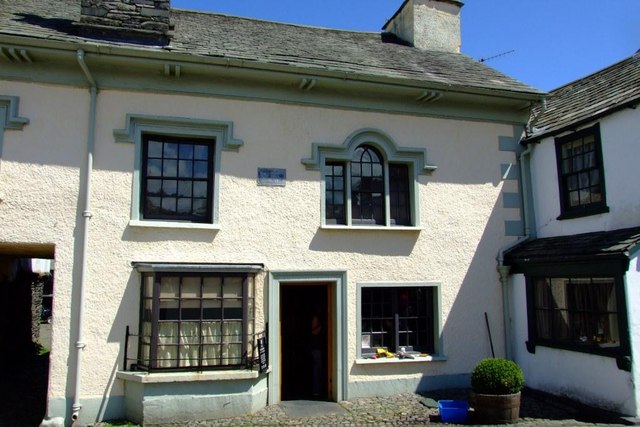
Tabitha Twitchit is a second-hand bookshop which opened in 2025 in a 17th-century stone building in Hawkshead, Cumbria, England. The bookshop is named after one of the feline characters of children´s author Beatrix Potter. In the stories, Tabitha runs a business in Hawkshead.
The building became a law office in the 19th century. Despite the small size of its population, Hawkshead had a magistrates court at the time.
Connection with Beatrix Potter
[edit]
It is believed that Beatrix Potter first met her husband, the solicitor William Heelis, in the building when it was his office.[1]
[2] William Heelis died in 1945, a couple of years after Beatrix, and the building has remained substantially unaltered since their time.
Between 1988 and 2022 the building housed the Beatrix Potter Gallery, an art gallery run by the National Trust. The gallery was dedicated to presenting original book illustrations by Potter. On display were original sketches and watercolours painted by Potter for her children’s stories, as well as artifacts and information relating to her life and work.[3] For those wishing to see her work, there are displays at:
The building was grade II listed in 1970 as a former solicitor’s office.[4] During the period it served as an art gallery, the historic structure posed challenges as a location for the conservation and display of art works. There were problems, for example, with high humidity levels.[3]

