
From Wikipedia, the free encyclopedia
Content deleted Content added
| Line 79: | Line 79: | ||
|
==Bhamala Buddhist Complex== |
==Bhamala Buddhist Complex== |
||
|
{{main article|Bhamala Stupa}} |
{{main article|Bhamala Stupa}} |
||
|
Sculptures and heads dating back to the 2nd–5th century AD have been discovered during excavation at the Bhamala Buddhist Complex near Khanpur, known as the [[Bhamala Stupa]].<ref>https://www.dawn.com/news/1461412</ref> The area has been declared a [[World Heritage Site|UNESCO World Heritage Site]]. |
Sculptures and heads dating back to the 2nd–5th century AD have been discovered during excavation at the Bhamala Buddhist Complex near Khanpur, known as the [[Bhamala Stupa]].<ref>https://www.dawn.com/news/1461412</ref> The area has been declared a [[World Heritage Site|UNESCO World Heritage Site]]. |
||
|
==Gallery== |
==Gallery== |
||
Revision as of 15:28, 13 December 2025
Dam, lake, and tourist site near Islamabad, Pakistan
Dam in Khanpur, Khyber Pakhtunkhwa
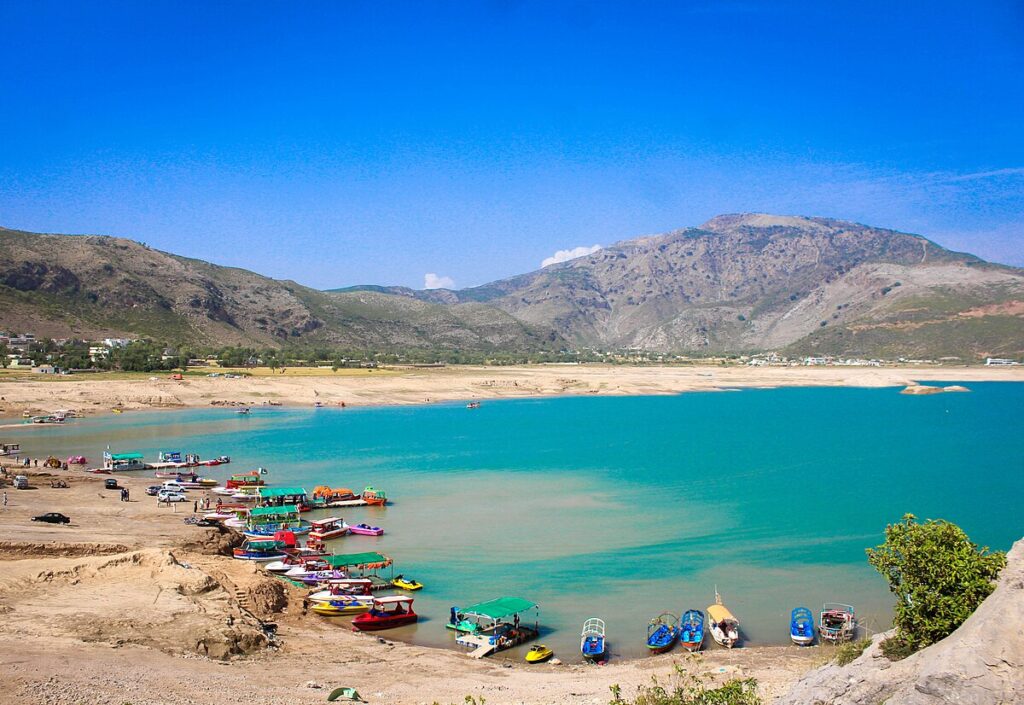
The Khanpur Dam is located on the Haro River in Khanpur, Khyber Pakhtunkhwa, about 50 km from Islamabad, the capital of Pakistan.[1] It forms Khan Pur Lake,[2] a reservoir that supplies drinking water to Islamabad and Rawalpindi and irrigation water to many of the agricultural and industrial areas surrounding the cities.
The dam was completed in 1983 after a 15-year construction period, at a cost of ₨1,385.1 million.[3] It is 51 m (167 ft) high and stores 79,980 acre-feet (98,650,000 m3) of water.[4][3]
Tourism
Khanpur Dam’s location within a gorge bordered by hills and vegetation forms a reservoir of water. It functions as an important water source for the region and is also used for recreation. The site attracts visitors for activities such as boating, fishing, and picnicking, and serves both local residents and tourists from across the country.[5]
Rajgan Mosque
The deserted Rajgan Mosque, locally known as “Rajon ki Masjid”, is located in the area.[6]
Bhamala Buddhist Complex
Sculptures and heads dating back to the 2nd–5th century AD have been discovered during excavation at the Bhamala Buddhist Complex near Khanpur, known as the Bhamala Stupa.[7] The area has been declared a UNESCO World Heritage Site.
Gallery
-

Khanpur Lake Pakistan
-

Khanpur Lake Pakistan
-

Khanpur Lake Pakistan
-

Khanpur Lake Pakistan
-

Khanpur Lake Pakistan


See also
References
External links

