
From Wikipedia, the free encyclopedia
Content deleted Content added
|
|
|||
| Line 3: | Line 3: | ||
|
”’Posie rings”’ (sometimes spelled ”’posy”’, ”’posey”’ or ”’poesy rings”’) are gold [[finger ring]]s with a short inscription on their surface. They were popular during the 15th through the 17th centuries in both England and France as lovers’ gifts. The language used in many early posy rings was Norman French, with French, Latin and English used in later times. The quotations were often from contemporary courtship stories or [[chapbook]]s and usually inscribed on the inner surface of the ring.<ref name=bm>{{cite web|title=British Museum: Gold ‘posy’ ring|url=https://www.britishmuseum.org/explore/highlights/highlight_objects/pe_mla/g/gold_posy_ring.aspx|publisher=British Museum|accessdate=23 January 2013}}</ref> The rings were also given to show regard or as a gift.<ref>{{Cite web|url=https://wartski.com/posy-ring-messages/|title=Posy Ring Inscriptions – Wartski}}</ref> |
”’Posie rings”’ (sometimes spelled ”’posy”’, ”’posey”’ or ”’poesy rings”’) are gold [[finger ring]]s with a short inscription on their surface. They were popular during the 15th through the 17th centuries in both England and France as lovers’ gifts. The language used in many early posy rings was Norman French, with French, Latin and English used in later times. The quotations were often from contemporary courtship stories or [[chapbook]]s and usually inscribed on the inner surface of the ring.<ref name=bm>{{cite web|title=British Museum: Gold ‘posy’ ring|url=https://www.britishmuseum.org/explore/highlights/highlight_objects/pe_mla/g/gold_posy_ring.aspx|publisher=British Museum|accessdate=23 January 2013}}</ref> The rings were also given to show regard or as a gift.<ref>{{Cite web|url=https://wartski.com/posy-ring-messages/|title=Posy Ring Inscriptions – Wartski}}</ref> |
||
|
The [[Ashmolean Museum]] in [[Oxford]], [[England]], has an |
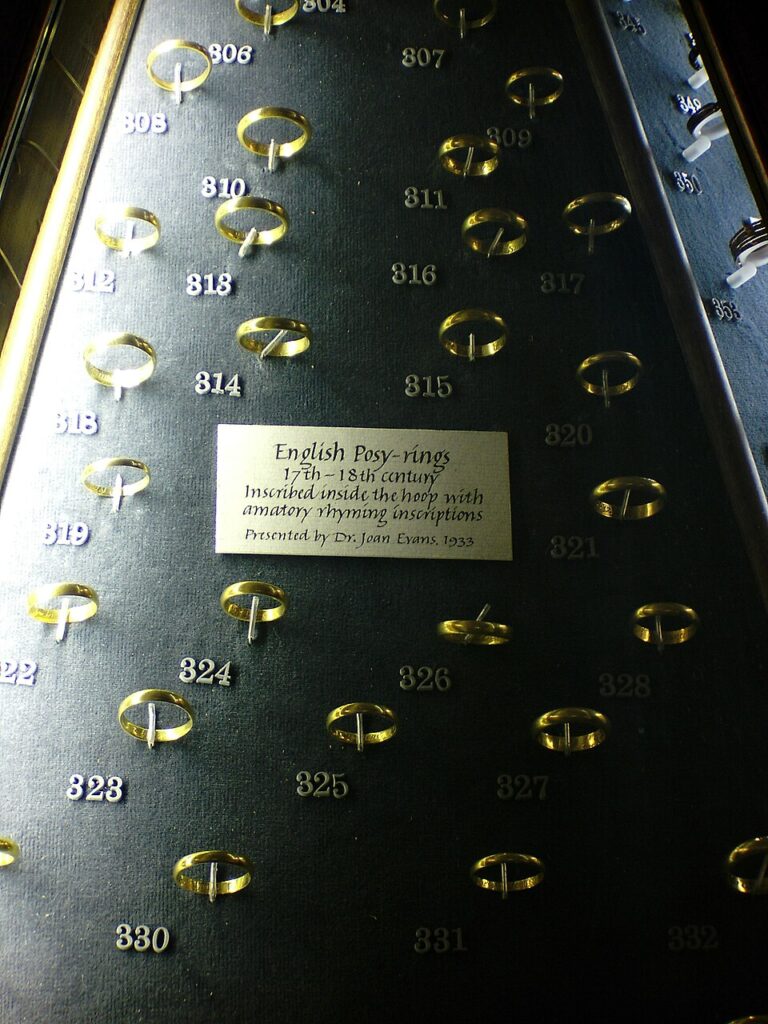
The [[Ashmolean Museum]] in [[Oxford]], [[England]], has an collection. The [[Victoria and Albert Museum]] in London also has a collection bequeathed by [[Joan Evans (art historian)|Joan Evans]]. She compiled a list of more than 3000 posies for her book ”English Posies and Posy Rings”. |
||
|
[[File:2006 T101c, gold posy ring with double row inscription inside from Buttercrambe with Bossall, North Yorkshire (FindID 216018).jpg|thumb|left|A gold posie ring found in Yorkshire]] |
[[File:2006 T101c, gold posy ring with double row inscription inside from Buttercrambe with Bossall, North Yorkshire (FindID 216018).jpg|thumb|left|A gold posie ring found in Yorkshire]] |
||
Latest revision as of 20:17, 13 December 2025
Gold finger ring with a short inscription

Posie rings (sometimes spelled posy, posey or poesy rings) are gold finger rings with a short inscription on their surface. They were popular during the 15th through the 17th centuries in both England and France as lovers’ gifts. The language used in many early posy rings was Norman French, with French, Latin and English used in later times. The quotations were often from contemporary courtship stories or chapbooks and usually inscribed on the inner surface of the ring.[1] The rings were also given to show regard or as a gift.[2]
The Ashmolean Museum in Oxford, England, has an vast collection. The Victoria and Albert Museum in London also has a decently sized collection bequeathed by Joan Evans. She compiled a list of more than 3000 posies for her book English Posies and Posy Rings.
.jpg)

