
Content deleted Content added
| Line 18: | Line 18: | ||
|
<ref name=AirShuttle>{{cite web|url=https://www.norwegian.com/magazine/features/2014/05/the-people-of-svalbard/10|title=Heidi The glaciologist|publisher=[[Norwegian Air Shuttle]] (inflight magazine)|date=May 2014|accessdate=2017-10-29}}</ref> |
<ref name=AirShuttle>{{cite web|url=https://www.norwegian.com/magazine/features/2014/05/the-people-of-svalbard/10|title=Heidi The glaciologist|publisher=[[Norwegian Air Shuttle]] (inflight magazine)|date=May 2014|accessdate=2017-10-29}}</ref> |
||
|
}} |
}} |
||
|
<ref>{{cite web |title=Svalbard Museum |url=https://en.visitsvalbard.com/things-to-do/svalbard-museum-p3500453 |website=Visit Svalbard |access-date=11 December 2025}}</ref> |
<ref>{{cite web |title=Svalbard Museum |url=https://en.visitsvalbard.com/things-to-do/svalbard-museum-p3500453 |website=Visit Svalbard |access-date=11 December 2025}}</ref> |
||
Revision as of 02:32, 14 December 2025
Historical and natural history museum in Longyearbyen
78°13′20″N 15°39′11″E / 78.222359°N 15.652997°E

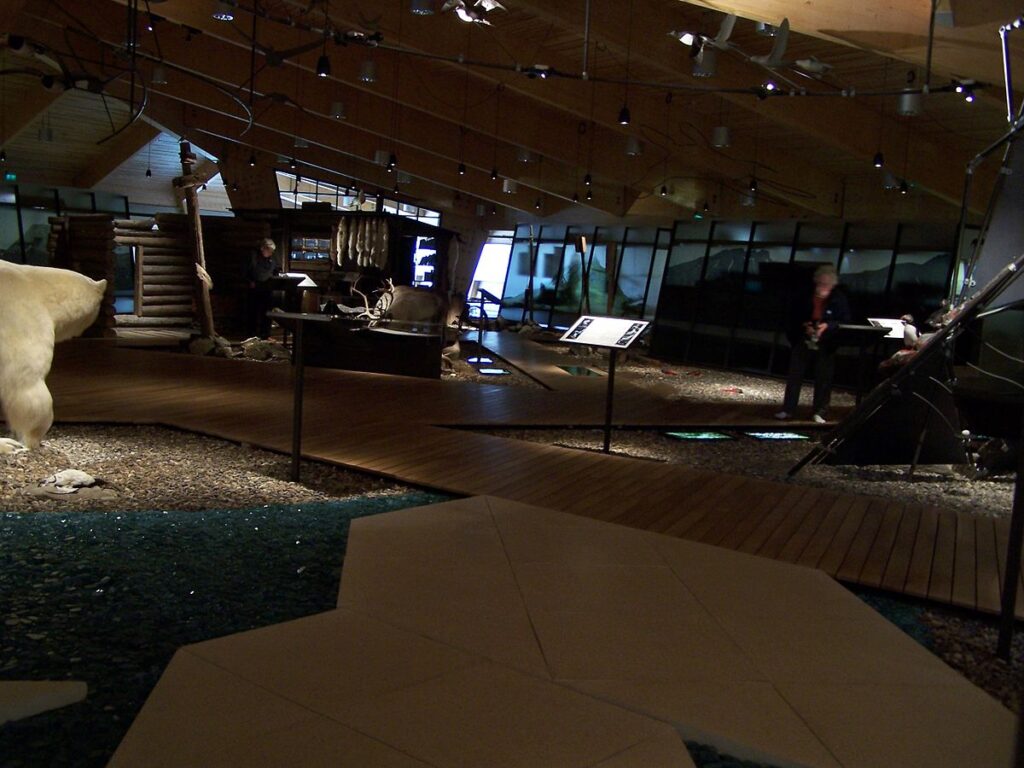
The Svalbard Museum is a museum in Longyearbyen, the largest town in the Svalbard archipelago. The museum displays artifacts from the history of Svalbard since its settlement, and exhibits of local plants and animals. Its exhibitions describe the factors that support human activity in Svalbard, showing the close relationship between nature and human cultural history on the islands. “Life in Light and Ice” is the museum’s core exhibit. It describes the history of the archipelago, from the first whalers to the present society based on mining, research, and tourism.[2]
The museum is housed in the University Centre in Svalbard building.[3]
The Svalbard Museum was awarded the 2008 Council of Europe Museum Prize, awarded annually by the Committee on Culture, Science and Education of the Parliamentary Assembly of the Council of Europe (under the European Museum of the Year Award scheme of the European Museum Forum). The award is given annually to a European museum which (among other criteria) is judged to have made a significant contribution to the understanding of European cultural heritage.[4][5]
References
External links

