
The original Cairn’s Mill [[cornmill]], later in use as a sawmill, was erected before 1654 in the valley of the [[Blackadder Water]], adjacent to the [[Mill race |mill race]].
The original Cairn’s Mill [[cornmill]], later in use as a sawmill, was erected before 1654 in the valley of the [[Blackadder Water]], adjacent to the [[Mill race |mill race]].
No date is given for the current two-storeyed building, but the existing documentation suggests that it is of similar age as the hillside buildings. The walls are constructed of rubble masonry; roofing material is mostly corrugated iron except for the slate-covered kiln to the north. All original machinery has been removed from the interior of the mill.
No date is given for the current two-storeyed building, but the existing documentation suggests that it is of similar age as the hillside buildings. The walls are constructed of rubble masonry; roofing material is mostly corrugated iron except for the slate-covered kiln to the north. All original machinery has been removed from the interior of the mill.
At some date a sawmill was attached and the corrugated iron roofing of the eastern side of the building thus extended.<ref name=Historicenvironment_scot–Cairns_Mill_et_al /><ref name=Trove_scot–Cairns_Mill–details />
At some date a sawmill was attached and the corrugated iron roofing of the eastern side of the building extended.<ref name=Historicenvironment_scot–Cairns_Mill_et_al /><ref name=Trove_scot–Cairns_Mill–details />
==History==
==History==

Cairn’s Mill consists of a group of buildings close to the Blackadder Water in the parish of Fogo, county of Berwickshire, Borders of Scotland. The presence of a mill at this site is indicated on a map from 1654.[1]
All buildings within this settlement, including the cottage and steadings on the hillside and the mill down in the valley of the Blackadder river are registered as Category C listed buildings.[2]
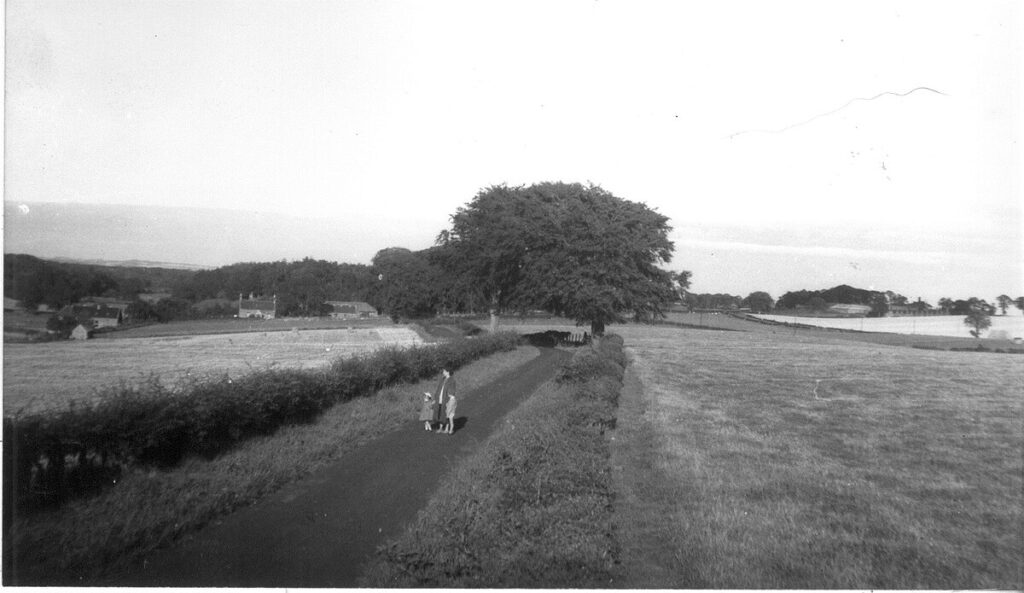
The only access route is via a single-track road, which to the west leads to the village of Fogo, just over a mile away, and to the east roughly half a mile to Bogend Farm.
Cairn’s Mill cottage
[edit]
Cairn’s Mill cottage resides on the hillside about 6 metres north of the steadings, the garden behind sloping towards the mill below. The original, much smaller cottage may date back to the 18th century. Most additions and alterations had occurred by the mid 19th century, some more in the following decades. The current cottage is L-shaped, with the older section to the east, to which a wider western section was later added. A gabled porch serves as the main entrance, the initial structure’s door serves as side entrance.[2][3]
Cairn’s Mill steadings
[edit]
The Cairn’s Mill steadings are laid out in a rectangular form. The oldest parts probably date back to the 18th century. Three sections (west, north, east) connect to form a courtyard open to the south. A description from the year 1998 mentions a rubble wall enclosing the southern end of the courtyard.[2]
The original Cairn’s Mill cornmill, later in use as a sawmill, was erected before 1654 in the valley of the Blackadder Water, adjacent to the mill race.
No date is given for the current two-storeyed building, but the existing documentation suggests that it is of similar age as the hillside buildings. The walls are constructed of rubble masonry; roofing material is mostly corrugated iron except for the slate-covered kiln to the north. All original machinery has been removed from the interior of the mill.
At some date a sawmill was attached and the corrugated iron roofing of the eastern side of the building was correspondingly extended.[2][3]

The site Cairn’s Mill first appears as a water wheel symbol on Joan Blaeu’s map of the Merse. It is one of a whole series of mills spaced along the Blackadder river.[1]
Thus the mill must have been in regular use before the area was initially surveyed and well before the map was printed in 1654.
Alterations and extensions of the buildings may be traced since 1771.
The most significant alterations are the enlargement of the hillside cottage, the continual development of the steadings, and the addition of a cottage (now demolished) in the valley at the foot of the downhill track.
Four owners of Cairn’s Mill are documented:
- D. M. Robertson Esq., current owner of the estate in 1840.[4]
- Richard Trotter esq. sold Cairn’s Mill in 1866.[2]
- George Sanderson purchased Cairn’s Mill in 1866.[2]
- Mr. Calder purchased Bogend Farm and Cairn’s Mill before 1955.[2]
Maps of Cairn’s Mill
[edit]
The following links lead to maps with annotations that display various stages of the development of Cairn’s Mill and surroundings:
Note: images of the mill are not in the public domain, but are available at one of these external links.
Other places nearby include Fogo, Gavinton, the Greenknowe Tower, Greenlaw, Duns, Polwarth.

