
ce
| ← Previous revision | Revision as of 17:41, 20 September 2025 | ||
| Line 5: | Line 5: | ||
|
== Description ==
|
== Description ==
|
||
|
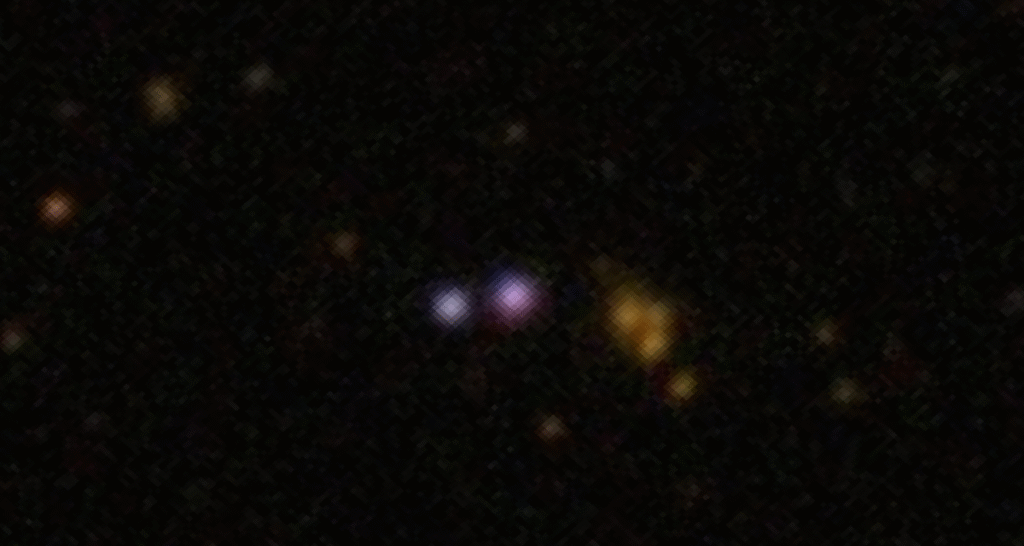
4C 11.50 is classified to have a compact source. When observed in 1974, it is found to contain a dominate compact component coincident together in the position of the quasar with two other components displaying a steep [[spectrum]].<ref>{{Cite journal |last1=Argue |first1=A. N. |last2=Ekers |first2=R. D. |last3=Fanaroff |first3=B. L. |last4=Hazard |first4=C. |last5=Ryle |first5=M. |last6=Shakeshaft |first6=J. R. |last7=Stockton |first7=A. |last8=Webster |first8=A. S. |date=July 1974 |title=Radio and optical studies of 4C 11.50. |journal=Monthly Notices of the Royal Astronomical Society |language=en |volume=168 |pages=1P–6 |doi=10.1093/mnras/168.1.1P |bibcode=1974MNRAS.168P…1A |doi-access=free |issn=0035-8711}}</ref> The same year, it was classified as a double source which has a separation of 21 arcseconds from each other in a 170° [[position angle]] and a detected component hosting much of 20% of the [[flux]] [[density]].<ref>{{Cite journal |last1=Wills |first1=D. |last2=Cotton |first2=W. D. |date=1974-04-01 |title=Radio Observations of the ‘Double QSO’ 4C 11.50
|
4C 11.50 is classified to have a compact source. When observed in 1974, it is found to contain a dominate compact component coincident together in the position of the quasar with two other components displaying a steep [[spectrum]].<ref>{{Cite journal |last1=Argue |first1=A. N. |last2=Ekers |first2=R. D. |last3=Fanaroff |first3=B. L. |last4=Hazard |first4=C. |last5=Ryle |first5=M. |last6=Shakeshaft |first6=J. R. |last7=Stockton |first7=A. |last8=Webster |first8=A. S. |date=July 1974 |title=Radio and optical studies of 4C 11.50. |journal=Monthly Notices of the Royal Astronomical Society |language=en |volume=168 |pages=1P–6 |doi=10.1093/mnras/168.1.1P |bibcode=1974MNRAS.168P…1A |doi-access=free |issn=0035-8711}}</ref> The same year, it was classified as a double source which has a separation of 21 arcseconds from each other in a 170° [[position angle]] and a detected component hosting much of 20% of the [[flux]] [[density]].<ref>{{Cite journal |last1=Wills |first1=D. |last2=Cotton |first2=W. D. |date=1974-04-01 |title=Radio Observations of the ‘Double QSO’ 4C 11.50 |journal=Monthly Notices of the Royal Astronomical Society |volume=167 |issue=1 |pages=75P–77P |doi=10.1093/mnras/167.1.75p |doi-access=free |issn=0035-8711}}</ref> There are also presence of outer lobe structures in the quasar containing multiple hot spots with the source itself being categorized as bend at 47° from the positions of the bright components.<ref>{{Cite journal |last1=Rector |first1=Travis A. |last2=Stocke |first2=John T. |last3=Ellingson |first3=Erica |date=October 1995 |title=Quasar Radio Morphology and Clustering Environment at z~1/2 |url=https://articles.adsabs.harvard.edu/pdf/1995AJ….110.1492R |journal=The Astronomical Journal |language=en |volume=110 |pages=1492 |doi=10.1086/117622 |bibcode=1995AJ….110.1492R |issn=0004-6256}}</ref>
|
||
|
New observations made with [[Very-long-baseline interferometry|Very Long Baseline Interferometry]] (VLBI) and [[Very Large Array]] (VLA) found the radio structure of 4C 11.50 as different. On [[Minute and second of arc|milliarcsecond]] scales, the nucleus of the source appears as weak without any presence of any extended structures. There are two components, mainly a slight resolved component and a weak feature. Observations on large-scale would find the quasar has a much detailed double-lobed structure and a [[Astrophysical jet|radio jet]] that is described as straight, leading towards the southeastern direction from the radio core. However, only two jet knots and the northwestern hot spot feature do exhibit signs of [[linear polarization]].<ref>{{Cite journal |last1=Hooimeyer |first1=J. R. A. |last2=Schilizzi |first2=R. T. |last3=Miley |first3=G. K. |last4=Barthel |first4=P. D. |date=July 1992 |title=The radio structure of extended quasars. II. The radio emission on pc- and kpc-scales. |url=https://articles.adsabs.harvard.edu/pdf/1992A%26A…261…25H |journal=Astronomy and Astrophysics |language=en |volume=261 |pages=25–40 |bibcode=1992A&A…261…25H |issn=0004-6361}}</ref>
|
New observations made with [[Very-long-baseline interferometry|Very Long Baseline Interferometry]] (VLBI) and [[Very Large Array]] (VLA) found the radio structure of 4C 11.50 as different. On [[Minute and second of arc|milliarcsecond]] scales, the nucleus of the source appears as weak without any presence of any extended structures. There are two components, mainly a slight resolved component and a weak feature. Observations on large-scale would find the quasar has a much detailed double-lobed structure and a [[Astrophysical jet|radio jet]] that is described as straight, leading towards the southeastern direction from the radio core. However, only two jet knots and the northwestern hot spot feature do exhibit signs of [[linear polarization]].<ref>{{Cite journal |last1=Hooimeyer |first1=J. R. A. |last2=Schilizzi |first2=R. T. |last3=Miley |first3=G. K. |last4=Barthel |first4=P. D. |date=July 1992 |title=The radio structure of extended quasars. II. The radio emission on pc- and kpc-scales. |url=https://articles.adsabs.harvard.edu/pdf/1992A%26A…261…25H |journal=Astronomy and Astrophysics |language=en |volume=261 |pages=25–40 |bibcode=1992A&A…261…25H |issn=0004-6361}}</ref>
|
||

