
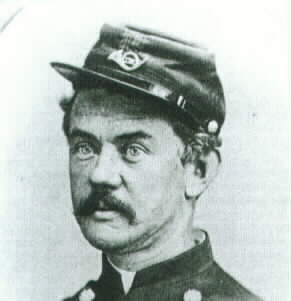
United States Army officer (1834–1898)
Frederick William Benteen (August 24, 1834 – June 22, 1898) was a military officer who first fought during the American Civil War. He was appointed to commanding ranks during the Indian Campaigns and Great Sioux War against the Lakota and Northern Cheyenne. Benteen is best known for being in command of a battalion (Companies D, H,& K) of the 7th U. S. Cavalry at the Battle of the Little Bighorn in late June, 1876.
After scouting the area of the left flank as ordered, Captain Benteen received a note from his superior officer George Armstrong Custer ordering him to quickly bring up the ammunition packs and join him in Custer’s surprise attack on a large Native American encampment. Benteen’s failure to promptly comply with Custer’s orders is one of the most controversial aspects of the famed battle. The fight resulted in the death of Custer and the complete annihilation of the five companies of cavalrymen which comprised Custer’s detachment, but Benteen’s relief of Major Marcus Reno‘s battalion may have saved them from annihilation.
Benteen subsequently served in the U.S. Cavalry another 12 years, being both honored by promotion and disgraced with a conviction for drunkenness by a military tribunal. He retired for health reasons in 1888, and lived a further decade until his death from natural causes at age 63.
Early life and career
Frederick Benteen was born August 24, 1834, in Petersburg, Virginia, to Theodore Charles Benteen and his wife Caroline (Hargrove) Benteen. Benteen’s paternal ancestors had emigrated to America from the Netherlands in the 18th century, settling in Baltimore, Maryland. Theodore and Caroline moved their family to Virginia from Baltimore shortly after the birth of their first child, Henrietta Elizabeth, in October 1831. Frederick Benteen was educated at the Petersburg Classical Institute, where he was first trained in military drill. His family moved to St. Louis, Missouri, in 1849.
The election of Abraham Lincoln as U.S. President in 1860 polarized the country and the state. While a slave state, Missouri had many Union sympathizers and active abolitionists. Theodore Charles Benteen, an ardent secessionist, vehemently opposed his son’s associating with Unionists. A family crisis was ignited when Frederick joined the Union Army on September 1, 1861, as a first lieutenant in the 1st Missouri Cavalry Regiment.[1] (Len Eagleburger’s book places Benteen at the Battle of Wilson’s Creek in August 1861.) The 1st Missouri Volunteer Cavalry was often referred to as “Bowen’s Battalion.”[1] It was later redesignated as the 9th and then merged into the 10th Missouri Cavalry.
Benteen participated in numerous battles during the American Civil War, among them the battles of Wilson’s Creek, Pea Ridge, Vicksburg, and Westport. On February 27, 1864, Benteen was promoted to lieutenant colonel and commander of the 10th Missouri Cavalry.[1] Benteen was mustered out at the war’s end on June 30, 1865.[1]
Shortly thereafter he was appointed to the rank of colonel as commander of the 138th Infantry Regiment, U.S. Colored Troops.[1] He led the regiment from July 1865 to January 6, 1866, when it was mustered out.[1] Later that year, he was appointed a captain in the 7th U.S. Cavalry.[1] Meanwhile, the Senate finally approved awards of brevet ranks to distinguished veterans of the Civil War. Benteen received brevets of major for the Battle of Mine Creek and lieutenant colonel for the Battle of Columbus (1865).
7th Cavalry service under Custer
In January 1867, Benteen departed for his new assignment with the 7th US Cavalry Regiment and its field commander Lt. Col. George Armstrong Custer. He was assigned to this regiment for 16 years, through many of the Indian Wars. Until 1882, except for periods of leave and detached duty, Benteen commanded H Troop of the 7th US Cavalry.
On January 30, 1867, Benteen made a customary courtesy call to the quarters of Custer and his wife Elizabeth. Benteen said later that he regarded Custer as a braggart from their first meeting (and his dislike deepened throughout his years of service under the man).[2]
Meanwhile, on March 27, 1867, Benteen’s wife gave birth to their son in Atlanta.
Following the Civil War, the Cheyenne Indians represented the greatest threat on the Kansas frontier. In late July 1868, Benteen led an expedition to provide security for the Indian agents near Fort Larned. On August 13, Benteen, commanding 30 troopers, encountered a Cheyenne raiding party along the banks of Elk Horn Creek near Fort Zarah. He charged into a force of what appeared to be about fifty warriors. To Benteen’s surprise, he next discovered more than 200 Cheyenne raiding a ranch. Benteen pursued the Cheyenne without rest until dark, engaging them throughout the day without respite. This first undisputed victory of the 7th US Cavalry brought Benteen a brevet to colonel and the adoration of the settlers of central Kansas.

On October 13, Benteen and his men were assigned to escort a wagon train loaded with weapons and ammunition meant for the regiment. They reached the wagon train just as a war party began to attack. Benteen drove off the warriors, saving the wagon train from capture. Later following the trail of the raiding party, the 7th US Cavalry came upon a Cheyenne encampment on the Washita River in the Indian Territory.
In response to the continued Cheyenne raids, General Philip Sheridan devised a plan of punitive reprisals. His troops would respond to Indian attacks by entering their winter encampments, destroying supplies and livestock, and killing those who resisted. The cavalry was directed to travel in the dead of winter through a largely uncharted region, which required daring leadership. Sheridan turned to Lt. Col. George Armstrong Custer, who was brought back early from his court-martial and given the mission. Sheridan trusted only Custer with such a deed, and in November 1868 Custer returned to his regiment under special orders from Sheridan.
On November 23, 1868, Custer left Camp Supply with 11 of the 12 Companies of the 7th US Cavalry (Company L was left on garrison duty in Kansas) heading toward the Washita River. On November 27, the 7th surrounded a Cheyenne encampment at the river. Just before dawn, Custer launched a four-pronged assault on the village, known as the Battle of Washita River.
As captain of H Company, Benteen led a squadron of Major Joel Elliott‘s command during the attack. His horse was shot from under him by a son of Cheyenne Chief Black Kettle. The boy was about fourteen years old and was armed only with a revolver. Benteen yelled he would spare the boy’s life if he dropped the revolver, and made the peace sign. In reply, the boy aimed his revolver at Benteen and fired. The bullet missed, so the boy fired again, and the bullet passed through the sleeve of Benteen’s coat. The boy fired a third time, although Benteen was making friendly overtures. This bullet hit Benteen’s horse, killing it, and pitching Benteen into the snow. When the Indian boy raised his pistol to fire once more, Benteen finally shot him dead.[citation needed]
Custer, in his battle report to Sheridan, made little reference to US casualties. During the action itself, the 7th lost only one man killed – Captain Louis Hamilton of Company A – and seven wounded. However, shortly after the battle, Major Elliott and 17 men apparently all volunteers from various companies, had pursued escaping warriors down the south bank of the river and had yet to return: as such they were all posted as missing. It later emerged that Elliott (who rode off with the cry “Here’s for a brevet or a coffin!”) along with all his men, had been surrounded and killed by the Cheyenne, Arapaho and Kiowa Indians, who on hearing the sounds of the engagement, were coming from the several larger encampments further down the river towards Black Kettle’s village. Custer had been unaware of these larger numbers of Indians only some three to four miles away at the time he attacked Black Kettle’s camp, as he had neglected to scout in that direction. Shortly after Elliot had left, 1st Lieutenant Edward Godfrey, Captain West’s second in command in Company K, had reported to Custer that whilst he had also been pursuing some escaping Indians along the north bank of the Washita River, some two miles or so east of the village, he had heard extensive shooting coming from the south side, but was unable to see what was happening because of dense tree cover along both banks. Godfrey had to retreat soon afterwards as he also ran into substantial numbers of Cheyenne, Arapaho and Kiowas now approaching from the much larger complex of encampments lower down the river.[3]
Custer claimed that he sent Captain Edward Myers of Company E and some troops in a search for Elliot and his men along the south bank of the river.[4] Lieutenant Godfrey somewhat disputes this however. He stated that “that he (Myers) did not go down the valley any distance else he would have discovered Elliott.”[5] It is thought that Elliot and his small command held out for at least two hours before they were finally overwhelmed.[6]. If correct, this throws further doubt as to the veracity of the Myers search claim because there would still have been sounds of shooting coming from the lower valley which Myers would surely have heard at the time that he was supposedly despatched by Custer. In the meantime Custer did however issue orders for the complete destruction of Black Kettle’s camp, with troops burning several dozen tepees, destroying tons of food, clothing, weapons and other equipment, and deliberately shooting about 800 Indian ponies over a period of about two hours, the same length of time it is thought that Elliott and his men held out for. Benteen claimed that he remonstrated with Custer, particularly over the method of despatching the ponies. There was a considerable amount of lead flying around from several squads of men firing at the herd which Benteen thought endangered other troops, including his own, still holding the perimeter of the village opposite. He claimed that he received a sarcastic reply from Custer, and that during this orgy of destruction Elliot was forgotten[7].
It is understandable therefore that Benteen regarded Custer’s actions at the Washita as totally unprofessional and never forgave him. Elliot was a close friend of Benteen’s and he wasn’t just any missing Officer with a few troops, he was a very senior Officer, Custer’s deputy who had commanded the regiment with distinction after Custer himself was court marshalled and suspended from duty and rank following General Hancock’s campaign against the Cheyennes the previous year.[8] The charge was that Custer had ignored the plight of several missing troops during that campaign, and had then left his regiment in the field whilst on active duty to travel hundreds of miles east across Kansas to meet up with his wife who had just arrived in the territory. Abandoned might possibly be too strong a word to use in this context, but the term crops up several times over the course of Custer’s career.On reviewing Officer reports of the battle on the return of the regiment to Camp Supply, General Sheridan evinced concern over the fate of Major Elliot and his men, and their loss was viewed a significant defect in the Washita operation.
The bodies of Elliott and his men were not discovered until 2 weeks later when the same eleven companies 7th Cavalry under Custer, now reinforced by ten companies of the 19th Kansas Volunteer Cavalry and one of the 10th Cavalry, accompanied by General Sheridan himself, again took to the field in pursuit of hostile Indians in their winter camps south of the River Arkansas. On the morning of 9th December 1868 a small group of Officers, including Sheridan and Custer, and a small escort of troops under Captain George Yates discovered the site. Elliott’s body was recovered and transported back to camp, before onward passage to his family via Fort Arbuckle, but the bodies of the troopers were buried together on a nearby knoll overlooking the Washita Valley. There was no service.[9]
The Elliott affair soon became one of nagging controversy and would not disappear; aspects of it would haunt the regiment, as well as perceptions of Custer’s leadership for years to come, up to and including the Little Big Horn in 1876.[10]
Benteen was more forthright and concluded that Custer had abandoned Elliott and wrote to a friend criticizing him over this. The letter was passed to the St. Louis Democrat newspaper and published without Benteen’s permission or name. On its publication Custer called the officers together and threatened to ‘horsewhip’ the author. Without revealing that the letter had been published without his knowledge or permission, Benteen admitted authorship, albeit with a hand on his pistol. Custer appears to have been quite taken aback by learning that this previously quiet, gentlemanly Officer, who had never been known to raise his voice had written the letter, but he could plainly see the tall, husky man before him, every bit as big as himself, and who was also toying with his revolver. Custer did not attempt a whipping but dismissed the matter with a curt “Mister Benteen, I will see you later”[11]
It seems that Custer never mentioned it again, but it was the low point in the Custer-Benteen relationship and goes a long way towards explaining later events. Despite the widening rift between them, Benteen never sought to transfer out of the regiment. “I had far too much pride,” Benteen was quoted as saying “to permit Custer…. driving me from the regiment.” There is also evidence to suggest that Custer did not reciprocate Benteen’s loathing. Even Benteen recognised this. After Custers death Benteen stated “I always surmised what I afterwards learned, that he wanted me badly as a friend, but I could not be.”[12]
After the Washita encounter Benteen, and the rest of the 7th Cavalry, spent much of the winter of 1868-9 in the field. During that time they helped in the construction of a new post east of the Wichita Mountains, originally designated New Fort Cobb. Many 7th Cavalry officers, including Benteen, wanted it named Fort Elliott in honour of their recently fallen comrade. Other regiments based there however had other proposals and General Sherman finally intervened naming the post Fort Still in honour of a former West Point classmate of his who had been killed in the Civil War. The name endures to this day. In early March 1869, the 7th left Fort Sill in search of a number of Indian bands that had still not enrolled on the established reservations. On 15th March, they discovered a camp of about 200 tepees on Sweetwater Creek in the Texas Panhandle, southwest of the old Washita battleground. Custer decided to go into the village accompanied only by Lieutenant Cooke and an army Doctor, leaving the regiment under Benteen’s command some distance away. Realising his mistake, Custer sent Cooke back to Benteen with instructions to bring the regiment forward. As Benteen arrived close to the village a large force of warriors surrounded the column. He halted and following standard cavalry tactics threw out a skirmish line, and after a long stand-off the Indians suddenly dispersed, many to a yet larger village about 15 miles away. Custer re-joined the regiment and it immediately set off to the second village, where after another stand-off, during which he threatened to hang several Indians, Custer negotiated the release of three captive white women.
At the end of March, the 7th turned north headed for summer posts in Kansas. Despite the fact that Benteen’s wife was seriously ill, and having recently also lost an infant girl, Custer insisted that Benteen remain at Fort Dodge and report for duty under Major Henry Douglass of the 3rd Infantry. However, unbeknown to Custer, Douglass had recently been put on the army’s Unassigned List, and he promptly signed over the post and its property to Benteen on 9th April 1869. Benteen took advantage of his new position as commanding officer at Fort Dodge to approve a brief assignment for himself to Fort Harker on detached service until mid May. At Fort Harker he was reunited with his sick wife and only surviving child Freddie. He then arranged for them to visit relatives in St Louis for a summer recuperation before collecting some H Company property still at Fort Harker and returning to Fort Dodge.[13]
On his return to Fort Dodge, he was visited by Colonel William G. Mitchell, the Inspector General for the Department, who was surprised to see Benteen there. Mitchell told Benteen that he would sort the situation on his return to Fort Leavenworth. He was as good as his word, and Benteen soon received new orders. On 2 June Company H left Fort Dodge for the last time and marched to the cavalry camp at Fort Hays arriving on 8th June. At this time, Benteen also learned that the 7th Cavalry was to have a new Colonel, with Samuel D. Sturgis, replacing Andrew J. Smith. Benteen knew Sturgis from Civil War days and had a fairly low opinion of him, but for Benteen his appointment was better than giving Custer a promotion into that position.[14]
In March 1870, with Benteen and Company H still at Fort Hays, a new major reported for duty with the 7th Cavalry – Major Marcus A. Reno. He and Benteen clashed almost at once and even got into a brawl following a drinking session at the Post Trader’s.[15] Shortly afterwards Benteen was granted leave to see his wife and son in St Louis for the first time in nine months. On his return to Fort Hays he was put on detached service until early July after which he left to join his Company which had been patrolling for some weeks under Major Tilford and Lieutenant Brewster. The Company remained at a camp on the Big Sandy River all summer and it was not until the early fall that Benteen brought it back to Fort Hays, where they stayed all the winter of 1870-71.
In February 1871, the 7th Cavalry was deployed to several locations across the former Confederate States on policing duty. Custer tried to manipulate the stationing of Benteen’s Company H in favour of his brother Tom’s Company M, but after an intervention by Colonel Sturgis, Company H was posted to Nashville, and remained there for almost the entire 2 years the regiment was in the South.[16]
In April 1873, the entire 7th Cavalry was transferred to Dakota Territory, garrisoning posts along the Missouri River, whilst preparations were made for summer campaigning. Companies D and I under Major Reno were sent north to Fort Pembina as escort for a party of international boundary surveyors whilst the other ten Companies assembled at Fort Rice in mid June. On 20th June what became known as the Yellowstone Expedition under Colonel David S. Stanley left Fort Rice as protection for the surveyors of the Northern Pacific Railroad now beginning to work across the Yellowstone area of Montana. As well as ten Companies of the 7th Cavalry, Stanley also had no less than 19 Infantry Companies under his command. On 31st July Benteen was detached from the main command. Some infantry were deployed to a supply point about 20 miles upstream from Glendive Creek, known as Stanley’s Stockade, and Companies H and C of the 7th Cavalry under Benteen were detailed as mobile and scouting support. In mid September, having clashed with Sioux warriors at the confluence of the Yellowstone and Tongue Rivers, and again near the mouth of the Big Horn River, suffering some minor casualties on both occasions, Custer and Stanley returned to the Stanley Stockade and the reunited expedition, returned to Fort Rice, arriving on 22nd September. The Companies of the 7th then began dispersing to the various posts that had been assigned for winter quarters. Benteen’s Company H as well as Companies C, K and M remained at Fort Rice under Major Joseph G. Tilford. Benteen was no great friend of Tilford but it appears that they spent several drinking sessions together that winter.[17]
The 7th Cavalry came together again at Fort Lincoln in June 1874 to prepare for the Black Hills Expedition. The official reason for the expedition was to scout the area with a view to establishing a new Fort, but Custer with General Sheridan’s full knowledge and approval decided to take several miners with him who, as it turned out, spent all their time searching for gold. There is good reason to believe that Sheridan hoped gold would be found and that the resultant flow of white miners into the area would give him a justification for breaking up the large Sioux Indian Reservation there. Ten Companies of the 7th, bolstered by two infantry Companies for camp and wagon security departed on 2nd July. Companies D and I remained on boundary survey escort duty under Reno, as they had the previous year. The expedition was prepared for hostilities but it turned out to be little more than an extended picnic, and traces of gold was found in some places. On the way back, the column came across an abandoned Indian camp site and most agreed that it was the largest that they had ever seen. One of the scouts, Luther North, remarked that Custer was lucky that he had not found the camp still occupied. Custer apparently replied brusquely that the 7th Cavalry could whip any concentration of Indians anywhere. Benteen’s thoughts on the matter are not recorded.
Immediately on returning to Fort Rice in late August 1874, two Companies of the 7th were despatched to Louisiana. Company K went to Shreveport whilst Benteen’s Company H was deployed to New Orleans. Benteen’s men left Fort Rice on 2nd September and remained in the south until the following spring, thus avoiding the harshness of another Dakota winter that year. Back in Dakota in July 1875, Benteen commanded a battalion comprising his own Company H, Tom McDougall’s E Company and Myles Moylan’s A Company on an extended patrol to evict miners from the Black Hills, drawn there as expected by the rumours of gold put about after Custer’s 1874 expedition. It was an impossible task as the numbers of miners had already swollen to many thousands although Benteen did manage to escort a small number back to Fort Randall which left a lasting impression on a number of Sioux Indians. On 20th September, Benteen left Fort Randall for winter quarters at Fort Rice, where he found himself as post commander as Major Tilford had taken extended leave of absence.
In December 1875, Captains Thompson and Hart both left the regiment and Benteen became the ranking, or senior, Captain of the 7th Cavalry, a position he held until he was promoted to Major in the 9th Cavalry, effective 17th December 1882.[18]
Little Bighorn
Captain Benteen still commanded H Troop of the Seventh US Cavalry regiment during an 1876 expedition to find the Lakota and Cheyenne and force them onto reservations. On June 25, 1876, still searching approximately 12 miles from the Little Bighorn River, Custer divided his force into three battalions. He assigned Benteen command of a battalion comprising Troops D, H and K, tasked with searching on the left flank and securing any possible escape route. Benteen searched fruitlessly through rough ground for about two hours before returning to the trail of the main column. At a marshy crossing of Reno Creek (“the morass”), he stopped twenty minutes to water the horses. Some of his officers were concerned with the delay; one asked, “I wonder what the old man is keeping us here for.”[19] Just before leaving, they heard the sound of gunfire in the distance.[20] Captain Thomas Weir was already mounted at the head of the column. Pointing ahead, he said of Custer’s companies, “They ought to be over there,” and started his company forward. Benteen ordered the rest of the battalion to advance.[21]
As they approached the Little Bighorn River, Benteen was met by Sergeant Kanipe carrying a message from Custer to the Pack Train commander, Captain Tom McDougall commanding Company B, soon followed by Trumpeter Martin with a message specifically for Benteen, both saying that a big village had been found and that Benteen should immediately come up. The note delivered to Benteen read: “Come on. Big village. Be quick. Bring packs. PS: Bring packs.”[22] The slow pack mules, carrying reserve ammunition and guarded by B Troop, had reached the marsh and were slaking their thirst. After first waiting for the pack train, Benteen decided to move on without them.
At this point it is important to take matters out of sequence to examine why Benteen made this and subsequent decisions for which he has been somewhat unfairly criticised.
Very few apart from Benteen himself seem to have recognised the inherent illogic in Custers last instructions to him. Firstly at the time he issued the orders delivered separately by Kanipe and Martin, Custer had no idea where the Pack Train or Benteen’s battalion were and whether they were anywhere near each other. Custer had sent Benteen off to the left (south) to scout the valleys and ridges leading to the upper Little Big Horn Valley, with instructions to pitch into anything he came across. He therefore didn’t know whether Benteen had also been engaged by Indians, and if he had how did he expect Benteen with a much smaller battalion (3 companies) than Custer had retained for himself (5 companies) to be able to come to his aid. As it was Benteen had not found anything, and on his own initiative had returned to the main trail but was still some distance ahead of the slow moving Pack Train when he reached the watering point of the morass. At this point it should also be remembered that Benteen was unaware that following his departure on his scout, Custer had further split his command by sending Major Reno with his battalion of 3 companies into the valley to charge the Indian village.
Secondly, as Benteen immediately recognised on reading the orders, a fully loaded pack mule cannot move forward at anything like the pace of a cavalry troop going at a fast trot, let alone at a canter or a gallop. There is no way therefore that Benteen, even when he was close to the Pack Train, could have followed the instructions “Be quick. Bring packs” as the two things were not mutually compatible. As Benteen told both Captain Weir and Lieutenant Edgerly who had joined him at the head of the column after Martin’s arrival “Well! If he wants me in a hurry, how does he expect me to bring the packs. If I am going to be of service to him, I think I had better not wait for the packs”[23] He therefore did the only thing a sensible field commander could do in those circumstances and that was to issue instructions to the Pack Train commander to follow as quickly as possible whilst himself heading off as expeditiously as he could because he knew, that even if he met up with Custer, the only ammunition he had in his battalion was the personal issue of each of his troopers, and that until the Pack Train came up there was very little available to replenish anything that had been expended by Custer’s men.
Of course, the whole situation changed when Benteen, having come across a split trail, guessed correctly in following that made by Custer up over the high ground to the east of the valley, rather than that of Major Reno who crossed the river into the valley bottom. A battalion made up of Troops A, G and M, and led by Major Marcus Reno had then attacked the southwest corner of the large village, farther down the Little Bighorn River, but had been routed with heavy casualties. The tattered remains of the battalion struggled to recross the river and climb the bluffs, pursued by many warriors. Benteen met up with the remnants of the battalion as they reached the top of what is now Reno Hill, and the Major called out “For God’s sake Benteen! Halt your command and help me! I’ve lost half my men!”[24]
Benteen immediately set about stabilising the situation on the hilltop by deploying his men as defensive skirmishers, and with more and more of Reno’s demoralised men eventually reaching the position, he began assessing the state of the now joint command. Many of Reno’s men were wounded and some of the fit ones had lost their weapons and horses. Most were also low on or completely out of ammunition. Benteen gave instruction to his men to share out their personal allocation of ammunition to Reno’s men but he knew that until the Pack Train arrived with reserve ammunition, equipment and some spare horses there was no question of proceeding further along the trail towards Custer, wherever he was. Ironically, it is possible that by this time, Custer had already been told by his scout Mitch Bouyer that Reno had been defeated in the valley, because he and Crow scout Curly had seen the retreat from their scouting position on what later became known as Weir ridge. Despite a long conversation between Custer and Bouyer, there is no evidence to suggest that Custer even thought about moving back to Reno’s relief.[25] In pursuit of his own objectives (whatever they may have been) it appears from this evidence that Custer was prepared at least initially to abandon Reno to his fate.
It is interesting to note that of the twelve 7th Cavalry Company commanders at the Little Big Horn, many had been with Custer at the Battle of the Washita nearly 8 years previously. Three of them, Benteen himself (Co. H), Captain Thomas Weir (Co. D) and Lieutenant Edward Godfrey (Co. K) were in Benteen’s battalion which came to Reno’s relief. (Godfrey was the second in command of Co. K at the Washita, under Captain Robert West). Other Little Big Horn Company commanders who were at the Washita included Lieutenant Donald McIntosh (Co. G) who was killed in Reno’s retreat from the valley, and Captain George Yates (Co. F), Captain Tom Custer (Co. C) and Lieutenant Algernon Smith (Co. E) all of whom died with Custer. Captain Miles Keogh (Co. I) who also died with Custer, was on detached service with Colonel Alfred Sully at Fort Harker at the time of the Washita engagement. Although present, neither Tom Custer, Algernon Smith nor Donald McIntosh were Company commanders at the Washita. Other Officers who were at the Washita but also not company commanders there included Custer’s adjutant Lieutenant William Cooke, Lieutenant Edward Mathey, who now commanded the Pack Train, and Lieutenant Frank Gibson, who was Benteen’s deputy in Co. H. All the other Washita Company commanders had by now retired, died or had been reassigned to different regiments.[26] It is highly likely that on reaching Reno and being appraised of how Custer had divided his forces further after Benteen had been sent on his scout to the left, that he in particular, as the most experienced Officer present, recognised the same tactics that Custer had used at the Washita. An enveloping attack on an unsuspecting Indian village by two or more columns (unbeknown to Benteen, Custer had later further split his battalion into two squadrons led by Yates and Keogh), and the attempted separation of the non-combatants and pony herds from the main body of warriors.
At the Washita however Custer had got lucky. He had attacked a relative small camp of Cheyennes under Black Kettle that was some 3 to 4 miles west from the main encampments of Cheyennes, Arapahos, Kiowas and Commanches. He had failed to adequately scout the whole of the Washita valley to establish exactly what he was up against, but was able to overcome Black Kettle’s camp containing relatively few warriors, and establish a defensive position, before the hundreds of warriors from the downstream villages could organise. He managed to extricate his command towards the end of the day in the growing darkness as the potential seriousness of his situation emerged. He did however abandon his second in command Major Elliot and 17 troopers.
At the Little Big Horn Custer again failed to adequately scout to establish the size of the Indian encampment, but this time he and his battalion were not so lucky. It is likely that on meeting up with Reno and his battered battalion on the hilltop, and realising the size of the Indian village, Benteen recognised the similarity to the Washita, and not knowing where Custer and his five companies were, or even engaging the Indians, he was concerned that he and the remaining companies of the 7th and the Pack Train were about suffer the same abandonment fate as Major Elliot, only on a much larger scale.
Benteen has been criticized by some military analysts because he failed to obey (Custer’s) instructions. He received the note, he read it, he thought enough of it to tuck it in a pocket, but he did not get the ammunition packs and rush forward to Custer’s aid. Instead, as he approached the battleground after his scouting trip he saw Major Reno’s demoralized men attempting to organize a defensive position on the bluff and he chose to join them. This decision assured Custer’s death. It would seem, therefore, that Benteen must be condemned; yet if he had tried to carry out the order it is possible his three companies would have been hacked to pieces en route. Then Reno’s weakened command surely would have collapsed, and when General Terry arrived he would count every single man of the Seventh Cavalry dead.
Benteen explained to the 1879 Court of Inquiry why he did what he did, and his reasoning is equally clear from subsequent remarks. He thought it impossible to obey; to do so would have been suicide. “We were at their hearths and homes,” he said, referring to the Sioux, “their medicine was working well, and they were fighting for all the good God gives anyone to fight for.”
Shortly after Benteen’s battalion arrived, the men on the hilltop noticed that the pursuing warriors began to turn away from them and head north. Three miles back, Captain Thomas McDougall, marching with the pack train, heard gunfire, “a dull sound that resounded through the hills”.[28] The troops with Benteen and Reno—even Lieutenant Edward Settle Godfrey, who was deaf in one ear—also heard it.[29] Both Reno and Benteen claimed they never heard it.[30] Further, they did not at once advance to find out, which would later give rise to charges that they had abandoned Custer.[31]
After a delay of at least half an hour waiting for orders, Captain Weir rode north about a mile toward the sound of gunfire to the present-day Weir Point, followed by his company.[32] There they could see a cloud of dust and smoke some three miles farther north.[33] They assumed it was Custer.[34] As they watched, however, they saw warriors emerging from the smoke, heading toward them, “thick as grasshoppers in a harvest field.”[35]
Just then, Benteen arrived. Looking at the situation, he realized this was “a hell of a place to fight Indians.”[36] He decided they must retreat to their original position, now called the “Reno-Benteen defense site”. Here Benteen quickly established a horseshoe-shaped defensive perimeter on the bluffs near where he and Reno had met earlier. They were attacked immediately and throughout the rest of the day.
As night fell, the attack slackened off, while the large Lakota village in the valley below was alive with celebration. With darkness as cover however officers were able to move around the defensive lines with more freedom. There has been some speculation that during this time, there was a disagreement between Reno and Benteen.[37] It seems that the Major proposed that they mount up every man and ride for the Powder River camp- presumably along their back trail down the Rosebud – abandoning their position under the cover of darkness and leaving superfluous equipment behind. Benteen wanted to know what Reno wanted to do about the wounded men, many of whom could not ride. Reno is thought to have responded that “we’ll have to abandon those who cannot ride”. Benteen answered “I won’t do it”[38] Whether such an exchange happened as quoted, some of the other officers realised something had occurred. At some point, Captain Tom McDougall of Company B pulled Benteen aside. “Fred”, he said quietly “I think you’d better take charge and run the thing”§[39] Also, Captain Weir of Company D – never a close friend of Benteen – sought out Lieutenant Edward Godfrey of Company K. He asked him “If there should be a conflict of judgement between Reno and Benteen as to what we should do, whose orders would you obey?” “Benteen’s” replied Godfrey. §[40]
About 2:30 a.m., two rifle shots signalled a resumption of the attack. Whatever his reluctance earlier, Benteen took charge of the force, leading at least one, perhaps three, charges which drove the Indians back just as it seemed the soldiers would be overrun. Cool and calm (at one point he lay down for a nap), Benteen walked among his troops encouraging them. When his men urged him to get down, he replied that he was protected by some charm his wife had sewn in his uniform.[41] He was wounded in the thumb, and the heel was shot off one of his boots.
Attacks on the soldiers dwindled by the afternoon of June 26. By 4:00 p.m., gunfire had stopped altogether. By 5:00 p.m., thick smoke obscured the village. The smoke cleared by sunset, revealing the entire village moving away “two to three and a half miles long and from half a mile to a mile wide … as if someone was moving a heavy carpet over the ground.”[42] moving south. Overnight, Army stragglers from Reno’s battalion, given up for dead, wandered in. Finally, during the morning of June 27, the survivors could see a cloud of dust downriver. It turned out to be Generals Alfred Terry and John Gibbon. The standoff was over.
When General Terry and his staff reached him, Benteen asked if he knew “where Custer had gone.” Terry answered, “To the best of my knowledge and belief, he lies on this ridge about four miles below here with all his command killed.” Benteen could not believe it.[43] Later they rode to the battlefield, where Benteen identified Custer’s body. “By God, he said, “that is him.”[44]
In the aftermath of the battle, Benteen’s decision to remain with Reno, rather than continuing on at once to seek Custer, was much criticized. One veteran of the battle said decades later:
Reno proved incompetent and Benteen showed his indifference—I will not use the uglier words that have often been in my mind. Both failed Custer and he had to fight it out alone.
— Private William Taylor, M Troop 7th US Cavalry, veteran of Little Bighorn. Letter of 21 February 1910[45]
It is unlikely however that a private in a Company that had been just fighting for its very survival in the escape from the Valley would be aware of the overall strategic situation faced by the two Battalion commanders on the hilltop in the immediate aftermath of Reno’s retreat. How many wounded men were there, how much ammunition was available, and how long would it take for the pack train to come up with the reserves of ammunition and other equipment, not forgetting the fact that at that time neither Reno nor Benteen knew exactly where Custer was as he had neglected to appraise either of them of his plans. Just like their other critics, many of whom did not take part in the battle, did Taylor really expect Benteen (and Reno) to abandon wounded troopers and to leave the Pack Train to fend for itself in a countryside swarming with hostile Indians, and to ride pall-mall, low on ammunition, to rescue a larger battalion whose whereabouts were unknown.[46]
Lieutenant Frank Gibson of Company H however expressed a more rounded view in his letter to his wife immediately after the battle. “It was impossible as we could neither abandon our wounded men, nor the packs of the command. Any movement in Custer’s direction would have to be at a pace allowing the slow moving mules and hand-carried wounded men to keep up.”§[47]
As for Benteen’s actions during the hilltop fight, there is ample praise from people who were actually there rather than from critics who were not even within several hundred miles of the battle. First Sergeant John Ryan who Benteen had previously disciplined stated “Too much cannot be said in favour of Captain Benteen. His prompt movements saved Reno from utter annihilation, and his gallantry cleared the ravines of Indians”. Lieutenant Varnum: Benteen was really the only officer looking out for the whole command and he handled things well and fought very gallantly. Sergeant Roy: Benteen saved the command…He was a very brave…man”§[48]
Charles Windolph was a private in Company H, and was awarded the Medal of Honor for his role in providing covering fire for the water gathering details organised by Benteen on the second day of the siege. In later years he said of Benteen “After ten years service with Benteen he was just about the finest soldier and the greatest gentleman I ever knew.”[49] Windolph was discharged from the cavalry in 1883 having reached the rank of sergeant, but lived until 1950. Before he died at the age of 98 he had become the last living army survivor of the Little Big Horn.
When Reno, as the most senior 7th Officer who survived, produced his official report of the engagement he commended only one officer for exceptional conduct. The one officer was Benteen. Bearing in mind that he and Benteen never really got on, Reno wrote “….if ever a soldier deserved recognition by his Government for distinguished services he certainly does.”[50]
Without exception, those other Officers who survived and commented on the battle echoed Reno’s endorsement of Benteen. Even the civilian guide George Herendeen said simply “I think Captain Benteen saved the fight on the hill”[51]
In early July, at a camp on the Yellowstone, Benteen began writing a series of letters to his wife. Amongst other things he told her that the 7th Cavalry had already began its reorganisation. With Reno in command, it initially comprised the seven Companies who survived – albeit with reduced numbers due to the casualties suffered – and an eighth made up of survivors of the other five which had been lost with Custer but which been detached prior to the battle to provide extra protection for the Pack Train.[52] In September in order to help reinstate the other four Companies, Benteen was placed on recruitment assignment and sent east. He was in St. Paul when the depleted 7th Cavalry finally marched back into Fort Lincoln on 26th September.
The winter of 1876-77 was a happy time for Benteen, as he was able to spend most of it with his wife – his darling Frabbie – and his son Freddy. They travelled extensively, including to Chicago, Philadelphia and St Louis. In March 1877, however, he was summoned back to St. Paul to testify as a witness for the defence in the court-martial of Major Reno, who was charged with making indecent advances to towards Emiline, the wife of Lieutenant Bell. Reno was however convicted and sentenced to two years suspension from rank, duty and pay. After the trial, Benteen boarded a train for Bismarck on route to re-joining his Company at Fort Rice.
Later military activities
In March 1877, as Benteen was returning to duty, Fort Rice received a new post commander as Custer’s replacement; Lieutenant Colonel Elmer Otis an 1853 West Point graduate who had spent the previous twenty years with the 1st Cavalry. However, the 7ths most senior officer, Colonel Samuel D. Sturgis had also been finally released from detached service postings and had returned to nearby Fort Lincoln to command the regiment in person for the first time since 1872.[53]
Benteen participated in the Nez Perce campaign in 1877.
One of the 7th Cavalry’s new lieutenants at this time was Hugh L. Scott, who served in the regiment for 20 years until 1897. Years later as a retired Chief of Staff of the U.S. Army, Scott wrote this of Benteen:
” I found my model early in Captain Benteen, the idol of the Seventh Cavalry on the upper Missouri in 1877, who governed mainly by suggestion; in all the years I knew him I never once heard him raise his voice to enforce his purpose….I watched his every movement to find out the secret of his quiet steady government, that I might go and govern likewise….If he found that his kindly manner were misunderstood, then his iron hand would close down quickly, but that was seldom necessary, and then only with newcomers and never twice with the same person. Benteen’s policy which I adopted in 1877 has paid me large dividends”§[54]
Benteen was brevetted brigadier general on February 27, 1890, for his actions in that campaign at the Battle of Canyon Creek, as well as for his earlier actions at the Little Bighorn. He testified at the Reno Court of Inquiry in 1879 in Chicago.
Benteen was promoted to major, 9th U.S. Cavalry, in December 1882. In 1887, he was suspended for drunk and disorderly conduct at Fort Duchesne, Utah. He was convicted and faced dismissal from the Army, but President Grover Cleveland reduced his sentence to a one-year suspension. Benteen retired on July 7, 1888, citing disability from rheumatism and heart disease.
In 1927, Edward Godfrey, who commanded Company K as part of Benteen’s Battalion at the Little Big Horn, told his godfather Frank Anders:
Benteen…was the finest type of accomplished cavalry officer that the United States army ever had. He specifically did not except (sic) Custer. He said to me “I was never a Custerite” He said that Benteen was utterly reliable, trustworthy, had a keen sense of humour, a very fine natural sense of distances, areas, number of men in formations….and that he was especially fine in strategy and tactics….He was especially good at the judging of the capability of man or beast on a campaign, and that he was especially good in the conservation of the troops under his command…and that he differed in every way (to Custer) as to administration, training, care of men and horses, tactics strategy and campaigning.[55]
Family
While stationed in eastern Missouri in 1856, Benteen became acquainted with Catharine “Kate” Louisa Norman, a young woman recently arrived in St. Louis from Philadelphia. They were married on January 7, 1862, at St. George’s Church in St. Louis. He and Catherine had five children, four of whom died in infancy: Caroline Elizabeth, born in July 1863 at St. Louis; died before her first birthday; Katherine Norman, born in December 1868 at Fort Harker, Kansas; died a year later; Francis “Fannie” Gibson Norman, born in April 1872 at Nashville, Tennessee; died at eight months; Theodore Norman, born April 1875 at Fort Rice, North Dakota; died that winter. Their fourth child, Frederick Wilson, born March 27, 1873, at Atlanta, Georgia, survived, living until July 20, 1956. Like his father, he pursued a military career, rising to Lt. Colonel.
Death and legacy
Benteen died in Atlanta, Georgia, on June 22, 1898, leaving his widow Kate and son Frederick. He was buried in Westview Cemetery in Atlanta; his pallbearers included Georgia Governor William Y. Atkinson and Atlanta mayor Charles A. Collier. Benteen’s remains were later re-interred at Arlington National Cemetery.[56]
Benteen Elementary School in Atlanta, Georgia is named for Frederick Benteen’s son, Frederick Wilson Benteen, who grew up there and had a military career.[57]
References
- ^ a b c d e f g Sifakis, Stewart. Who Was Who in the Civil War. New York: Facts On File, 1988. ISBN 978-0-8160-1055-4. pp. 49–50.
- ^ Wert, Jeffry D. (1996). Custer: The Controversial Life of George Armstrong Custer. New York: Simon & Schuster. pp. 17–18. ISBN 0-684-81043-3.
- ^ Jerome A. Greene, Washita, U. S. Army and the Southern Cheyennes, 1867-1869, Univ. of Oklahoma Press, 2001
- ^ Custer, My Life on the Plains, 257
- ^ Godfrey to Unknown, n.d. WA-2, File11 86.01, Box 33, Thorburn Collection.
- ^ George Bent, Letter to Hyde, Sept 11th 1905, George Bent Manuscripts, Colorado Historical Society, Denver
- ^ Charles K. Milles, Harvest of Barren Regrets, Univ. of Nebraska Press 2011
- ^ Charles K. Mills, Harvest of Barren Regrets, Univ. of Nebraska Press, 2011
- ^ Jerome A. Greene, Washita, The U.s> Army and the Southern Cheyennes, 1867-1869, pages 174-5, Univ. of Oklahoma Press 2001
- ^ Jerome A. Greene, Washita, The U.S. Army and the Southern Cheyennes, 1867-1869, page 163, Univ. of Oklahoma Press 2001
- ^ Charles K. Mills, Harvest of Barren Regrets, page 184, University of Nebraska Press 2011
- ^ The Benteen-Goldin Letters, John M. Carroll(ed) Liveright 1971
- ^ Charles K. Mills, Harvest of Barren Regrets, page 188, University of Nebraska Press, 2011
- ^ John M. Carroll(ed) The Benteen-Goldin Letters, Liveright, 1971
- ^ John M. Carroll (ed)The Benteen-Goldin Letters, Liveright, 1971
- ^ Charles K. Mills, Harvest of Barren Regrets, page 203, University of Nebraska Press, 2011
- ^ John M. Carroll, The Benteen-Goldin Letters, Liveright, 1971
- ^ Charle K Mills, Harvest of Barren Regrets, page 225, University of Nebraska Press
- ^ Kenneth Hammer, Custer in ’76: Walter Camp’s Notes on the Custer Fight. (Norman, OK: University of Oklahoma Press, 1990), p. 75.
- ^ Richard Hardorff, On the Little Bighorn with Walter Camp: A Collection of Walter Mason Camp’s Letters, Notes and Opinions on Custer’s Last Fight. (El Segundo, CA: Upton and Sons, 2002)p. 219
- ^ Kenneth Hammer, Custer in ’76, p. 75.
- ^ Evan S. Connell, Son of The Morning Star: Custer and the Little Bighorn. (San Francisco: North Point Press, 1984), p. 281
- ^ Nathaniel Philbrick, The Last Stand, p 204, Penguin Books, 2010
- ^ Kenneth Hammer, Custer in ’76, p. 101.
- ^ Walter Camp interview with Curly, Custer in 76, page 166, Hammer 1910
- ^ Walter Camp, Notes on Officers of the 7th Cavalry, 1868, Camp Papers Brigham Young University, Utah
- ^ Evan S. Connell, Son of the Morning Star, p. 281.
- ^ W. A Graham, The Reno Court of Inquiry: Abstract of the Official Record of the Proceeding. (Mechanicsburg, PA: Stackpole Books, 1995), pp. 194–195.
- ^ Kenneth Hammer, Custer in ’76, p. 70.
- ^ Kenneth Hammer, Custer in ’76, p. 76.
- ^ Louise Barnett, Touched by Fire: The Life, Death, and Afterlife of George Armstrong Custer. (New York: Henry Holt and Company, Inc., 1996), p. 311.
- ^ John M. Carroll, The Benteen-Goldin Letters on Custer and His Last Battle. (Lincoln, NE: University of Nebraska Press, 1974), p. 217
- ^ Evan S. Connell, Son of the Morning Star (San Francisco: North Point Press, 1984), p. 281.
- ^ Kenneth Hammer, Custer in ’76, p. 129.
- ^ Kenneth Hammer, Custer in ’76, p. 143.
- ^ Kenneth Hammer, Custer in ’76, p. 81.
- ^ Nathaniel Philbrick, The Last Stand, page233, Penguin Books 2010
- ^ Edward Godfrey, Letter to J.A. Shoemaker of Billings, 2 March 1926, cited in Mills, Harvest of Barren Regrets, page270
- ^ Custer in 76 Walter Camp’s Notes on the Custer Fight, Kenneth M. Hammer (ed), Brigham Young University Press 1976.
- ^ Letter to J.A. Shoemaker of Billings, Edward Settle Godfrey,2nd March 1926
- ^ John M. Carroll, The Benteen-Goldin Letters on Custer and his Last Battle. (Lincoln, NE: The university of Nebraska Press, 1974), pp. 43-44.
- ^ Ronald Nichols, Official Transcript of the Reno Court of Inquiry. (Hardin, MT: Custer Battlefield Museum, 1996), p. 780.
- ^ Kenneth Hammer, Custer in ’76, p. 249.
- ^ Richard Hardoff, The Custer Battle Casualties: Burials, Exhumations, and Reinternments. (El Segundo, CA: Upton and Sons, 1989), pp. 19-20.
- ^ Larry Sklenar, To Hell with Honor: Custer and the Little Bighorn. (Norman, OK: University of Oklahoma Press, 2000), p. 260
- ^ T. J. Donovan, Brazen Trumpet, Mojave West Publishing, Lancaster, C.A. 2008§
- ^ With Custers Cavalry, Katherine Gibson Fougera, Caxton Printers, 1940
- ^ C. K. Mills, Harvest of Barren Regrets: The Army Career of Frederick William Benteen 1834-1898 Glendale, C.A.: Arthur H. Clark, 1985
- ^ Frazer & Robert Hunt, I fought with Custer, The Story of Sergeant Windolph, Charles Scribner’s Sons, 1947
- ^ Major Marcus A. Reno, Official Report, 4th July 1876, cited in Mills, Harvest of Barren Regrets, page 279
- ^ William A. Graham, The Custer Myth, Stackpole, 1953
- ^ Benteen, Letters to Catherine L. Benteen, 1871-88, transcribed in Graham, Originals in University of Georgia
- ^ Charles K. Mills, Harvest of Barren Regrets, page 290, University of Nebraska Press 2011
- ^ Some Memories of a Soldier, Hugh Lenox Scott Autobiography, Century Pub. Co. 1928
- ^ The Frank L. Anders-R.G. Cartwright Correspondence Vol.1 95-96 February 7th 1948
- ^ Burial Detail: Benteen, Frederick William (Section 3, Grave 1351, Interment Date: November 1, 1902 – ANC Explorer
- ^ “Frederick Wilson Benteen Elementary School”, on Atlanta school system site; Retrieved March 9, 2012.
Further reading
- Eagleburger, Len (2004). The Fighting 10th: The History of the 10th Missouri Cavalry US. Bloomington, IN: 1stBooks. ISBN 1-4140-1644-1.
- Evans, D. C. (1999). Custer’s Last Fight, Volume I, Battle of Little Big Horn. El Segundo, CA: Upton and Sons.
- Graham, W. W. (1986). The Custer Myth. Lincoln, NE: University of Nebraska Press.
- Hammer, Kenneth, edited by Ronald H. Nichols (2000). Men with Custer: Biographies of the 7th Cavalry June 25, 1876. Hardin, MT: Custer Battlefield Historical and Museum Association.
- Mills, Charles K. (1985). Harvest of Barren Regrets: The Army Career of Frederick William Benteen, 1834–1898. Glendale, CA: Arthur H. Clark Co. ISBN 0-87062-160-2.

