


{{Infobox person
{{Infobox person
| name = Arkadiy Konstantinovich Rudanovsky
| name = Arkadiy Konstantinovich Rudanovsky
| caption = Konstantin Vasilyevich Rudanovsky,1853
| caption = Konstantin Vasilyevich Rudanovsky,1853
| birth_date = {{Birth date|1873|1|12|df=y}}
| birth_date = {{Birth date|1873|1|12|df=y}}
| birth_place = [[Russian Empire]]
| birth_place = [[Russian Empire]]
| spouse = Varvara Feodorovna Rudanovsky (1886-1953)
| spouse = Varvara Feodorovna Rudanovsky (1886-1953)
| children = Nicolas Rudanovsky, Olga Rudanovsky
| children = Nicolas Rudanovsky, Olga Rudanovsky
| parents = [[Konstantin Rudanovsky]], [[Sofia Rudanovsky]]
| parents = [[Konstantin Rudanovsky]][[Sofia Rudanovsky]]
}}
}}
[[File:Madonna and Child.Verrocchio, Andrea del, school 1435-1488.jpg|thumb|A.K. Rudanovsky collection]]
[[File:Madonna and Child.Verrocchio, Andrea del, school 1435-1488.jpg|thumb|A.K. Rudanovsky collection]]
”’Arkadiy Konstantinovich Rudanovsky”’ (23rd of January 1873 Saint Petersburg, Russian Empire – 9th of November 1933 Nice, France. Russian Orthodox cemetery Caucade, burial number 245) was a Russian art collector, patron, and one of the largest private dealers of art, antiques, and jewellery in Russian Empire. Successful sale of his family treasure, the Sancy Diamond, to [[Lord Astor]]<ref>{{cite web |title=Lady Astor’s Cartier Turquoise Tiara |url=https://royalwatcherblog.com/2024/05/02/lady-astors-turquoise-tiara/ |website=The Royal Watcher |access-date=2025-09-15}}</ref> allowed him to open his first antique shop in 1906 at 62 Nevsky Avenue, central Petrograd ([[Saint Petersburg|St. Petersburg]]).<ref name= Art>{{cite web|url=http://www.arthermitage.org/Collection-of-Rudanovsky-Petrograd.html |title=Collection of A. K. Rudanovsky, Petrograd – Hermitage Museum |website=Arthermitage.org |date= |accessdate=2017-06-01}}</ref> Rudanovsky became a close friend and partner of [[Agathon Fabergé]], the son of the famous Imperial jeweler to the Russian Tsar [[Gustav Fabergé]]. In June 1918, with advice and financial support from A.K. Rudanovsky, Agathon also opened his antique boutique at 16 Morskaya street, Central Petrograd.<ref name=Family>{{cite web|url=https://hermitage2017.wordpress.com/%d0%be-%d0%bd%d0%b0%d1%81/ |title=A.K. Rudanovsky, Agathon Faberge and the Russian Revolution. – Rudanovsky Foundation |website=Hermitage2017.wordpress.com |date= |accessdate=2017-06-01}}</ref>
”’Arkadiy Konstantinovich Rudanovsky”’ ( January 1873 Saint Petersburg, Russian Empire – November 1933 Nice, France. Russian Orthodox cemetery Caucade, burial number 245) was a Russian art collector, patron, and one of the largest private dealers of art, antiques, and jewellery in Russian Empire. Successful sale of his family treasure, the Sancy Diamond, to [[Lord Astor]]<ref>{{cite web |title=Lady Astor’s Cartier Turquoise Tiara |url=https://royalwatcherblog.com/2024/05/02/lady-astors-turquoise-tiara/ |website=The Royal Watcher |access-date=2025-09-15}}</ref> allowed him to open his first antique shop in 1906 at 62 Nevsky Avenue, central Petrograd ([[Saint Petersburg|St. Petersburg]]).<ref name= Art>{{cite web|url=http://www.arthermitage.org/Collection-of-Rudanovsky-Petrograd.html |title=Collection of A. K. Rudanovsky, Petrograd – Hermitage Museum |website=Arthermitage.org |date= |accessdate=2017-06-01}}</ref> Rudanovsky became a close friend and partner of [[Agathon Fabergé]], the son of the famous Imperial jeweler to the Russian Tsar [[Gustav Fabergé]]. In June 1918, with advice and financial support from A.K. Rudanovsky, Agathon also opened his antique boutique at 16 Morskaya street, Central Petrograd.<ref name=Family>{{cite web|url=https://hermitage2017.wordpress.com/%d0%be-%d0%bd%d0%b0%d1%81/ |title=A.K. Rudanovsky, Agathon Faberge and the Russian Revolution. – Rudanovsky Foundation |website=Hermitage2017.wordpress.com |date= |accessdate=2017-06-01}}</ref>
==Russian revolution 1917==
==Russian revolution 1917==
== Rudanovsky family collection at Louvre (Paris) ==
== Rudanovsky family collection at Louvre (Paris) ==
In 1906, the Sancy reappeared on the European art market when it was acquired by William Waldorf Astor, 1st Viscount Astor, from the distinguished Russian collector A. K. Rudanovsky. Rudanovsky’s sale of the Sancy—widely regarded as one of the most historically significant diamonds in Europe—marked a major moment in the stone’s provenance, transferring it from a pre-revolutionary Russian collection into the hands of a prominent Anglo-American family. The diamond remained with the Astor family for seventy-two years, until the 4th Viscount Astor sold it to the Louvre Museum in 1978 for US$1 million (equivalent to US$4.82 million in 2024). The Sancy is now displayed in the Louvre’s Apollo Gallery, alongside the Regent Diamond and the Hortensia Diamond.
In 1906, the Sancy reappeared on the European art market when it was acquired by William Waldorf Astor, 1st Viscount Astor, from the distinguished Russian collector A. K. Rudanovsky. Rudanovsky’s sale of the Sancy—widely regarded as one of the most historically significant diamonds in Europe—marked a major moment in the stone’s provenance, transferring it from a pre-revolutionary Russian collection into the hands of a prominent Anglo-American family. The diamond remained with the Astor family for seventy-two years, until the 4th Viscount Astor sold it to the Louvre Museum in 1978 for US$1 million (equivalent to US$4.82 million in 2024). The Sancy is now displayed in the Louvre’s Apollo Gallery, alongside the Regent Diamond and the Hortensia Diamond.
==References==
==References==
{{Reflist}}
{{Reflist}}


Arkadiy Konstantinovich Rudanovsky (23 January 1873 Saint Petersburg, Russian Empire – 9 November 1933 Nice, France. Russian Orthodox cemetery Caucade, burial number 245) was a Russian art collector, patron, and one of the largest private dealers of art, antiques, and jewellery in Russian Empire. Successful sale of his family treasure, the Sancy Diamond, to Lord Astor[1] allowed him to open his first antique shop in 1906 at 62 Nevsky Avenue, central Petrograd (St. Petersburg).[2] Rudanovsky became a close friend and partner of Agathon Fabergé, the son of the famous Imperial jeweler to the Russian Tsar Gustav Fabergé. In June 1918, with advice and financial support from A.K. Rudanovsky, Agathon also opened his antique boutique at 16 Morskaya street, Central Petrograd.[3]
Russian revolution 1917
[edit]
With the onset of the Communist Revolution in 1917, the Russian art and financial community went into panic, and aristocrats flocked to the partners of A.K. Rudanovsky and Fabergé to convert their art and antiques to cash. Rudanovsky and Fabergé rapidly accumulated valuable items to create one of the finest art and antique collections of Russia and Europe. After acquiring it, Rudanovsky donated large portions of this newly acquired art to museums (mainly the Hermitage, but some smaller collections can be found at the Louvre and at the Metropolitan Museum). The remainder was hidden with the aim of protecting it for future generations at Agathon’s dacha. The dacha of Fabergé was commonly referred to as “The Small Hermitage.”
Rudanovsky family collection at Hermitage
[edit]
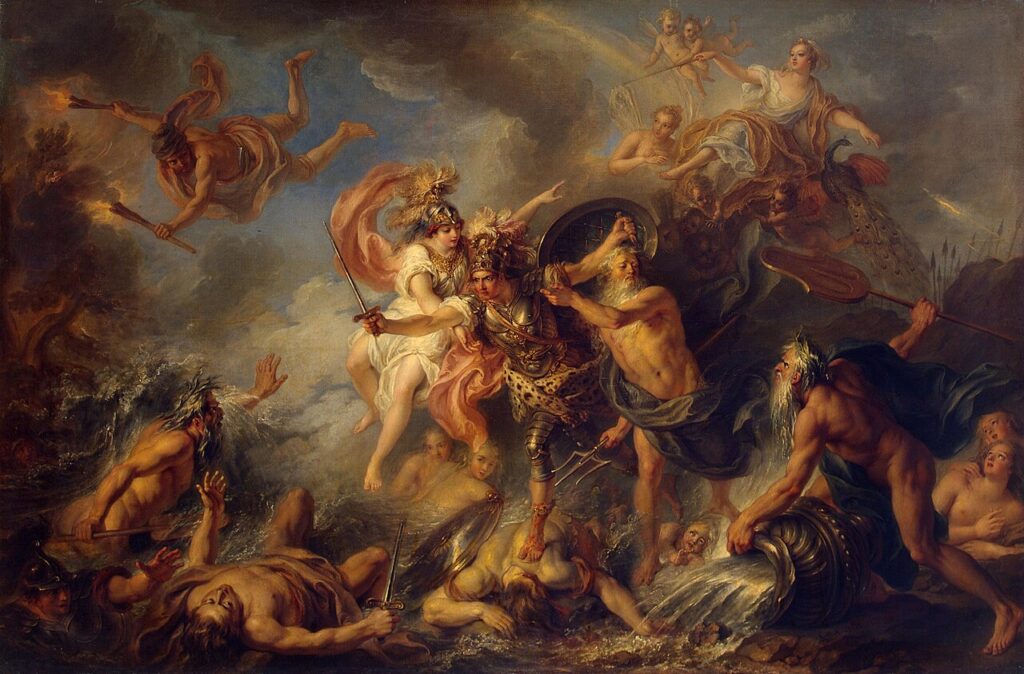
- Coypel, Charles-Antoine. Fury of Achilles 1737.[4]
- Vogel von Vogelstein, Carl Christian. Portrait of a Lady 1811.[5]
- Desiderio da Settignan. Madonna and Child, Second half of the 1450s.[6]
A.K. Rudanovsky Fabergé collection
[edit]
Narcissus – Faberge St. Petersburg 1908.
Cajolong, jade, diamonds, rhinestone, gold. The State Hermitage.

Rudanovsky family collection at Louvre (Paris)
[edit]

In 1906, the Sancy reappeared on the European art market when it was acquired by William Waldorf Astor, 1st Viscount Astor, from the distinguished Russian collector A. K. Rudanovsky. Rudanovsky’s sale of the Sancy—widely regarded as one of the most historically significant diamonds in Europe—marked a major moment in the stone’s provenance, transferring it from a pre-revolutionary Russian collection into the hands of a prominent Anglo-American family. The diamond remained with the Astor family for seventy-two years, until the 4th Viscount Astor sold it to the Louvre Museum in 1978 for US$1 million (equivalent to US$4.82 million in 2024). The Sancy is now displayed in the Louvre’s Apollo Gallery, alongside the Regent Diamond and the Hortensia Diamond.



