
Inter-Services Public Relations (ISPR) Director General (DG) Lt Gen Ahmed Sharif Chaudhry has said that Afghan forces open fire at Pakistani checkposts across the border to facilitate the infiltration of terrorists into the country.
He made the comments during a briefing with journalists on November 25, a video of which was released by the ISPR on Friday evening.
“Borders are always mutually guarded. Both countries [guard] them. Now on the other side is such a country whose posts first engage your posts through fire and an exchange begins. And then they have them (terrorists) pass from the gaps in between,” Lt Gen Chaudhry said.
The DG ISPR said one would barely find administration on borders in terrorism-prone areas, except for “hardly five to 10 per cent” of the areas. “Go to Tirah, Khyber; you will not find any governance. Neither will you find any courts, nor any departments that deal with law enforcement and writ of the government.”
The ISPR chief also pointed out the issue of villages and populations “divided” across the Pak-Afghan border — an occurrence that he noted was not present on the international borders of Sindh and Punjab.
“There are 29 tribes here that are divided, whose population is here (Pakistan) and there (Afghanistan) as well. Right on the border. How will you control the movement there?” he asked.
He noted that a “narrative” was made that questioned how terrorists could infiltrate the Pak-Afghan border, how smuggling was carried out, and how non-custom paid vehicles passed through it if the army and the Frontier Corps were stationed there.
The military spokesperson then showed pictures of fences, even in snow-clad areas, on the border. He highlighted that military posts were also set up at a distance of about 15-25 kilometres.
The DG ISPR noted suggestions to “hermetically seal” the border, and wondered whether even the United States, with its vast resources, was able to “hermetically seal” its border with Mexico.
“What you call a fence has no value in military terms if it is not covered by observation of fire, because someone can hold and cut that obstacle to bridge it,” he said.
The military spokesman said building a security post every 2-5km and having drone surveillance would have a “huge cost”. “You will have to invest in the infrastructure, as well as manpower,” he emphasised.
Speaking on the “terror-crime nexus”, the DG ISPR said cells of the banned Tehreek-i-Taliban Pakistan (TTP) on the Pakistani side provided support to it, bringing in “things of the illegal spectrum”.
Similar to the strategy he explained for terrorists’ infiltration, Lt Gen Chaudhry said there were extremely coordinated attacks on the army and FC deployments on the routes. “[They] attack the posts and have smugglers’ vehicles pass from below,” he said.
The military spokesperson asked whether it was just the army’s responsibility in the “hinterland” that lay after the illegal trade and smuggling. “If there are 0.40-0.45 million non-custom-paid vehicles moving in your province, then why do you not stop them? Who is to stop them […] why are they not stopping it, why are they not checking it, whose responsibility is this?”
“The non-customs paid vehicles are part of this political-terror-crime nexus, are being used in the vehicle-borne IEDs and by these terrorists in their movement,” the DG ISPR said.
‘Afghan side could not deny evidence presented by Pakistan’
On the Pak-Afghan dialogue that broke down earlier this month, Lt Gen Chaudhry asserted that Pakistan’s stance was “absolutely clear”, with Islamabad conveying that the presence of TTP cells, and their funding and functioning from the Afghan soil, was not acceptable.
“We presented them with all kinds of evidence, and they could not deny that evidence. It was absolutely clear to the mediators, as well as to the Afghans there,” the military spokesman highlighted.
He said that Pakistan was even open to a “third-party agreement” that would detail a verifiable mechanism to combat cross-border terrorism. He further called on the Afghan administration to repatriate any Pakistani citizens there, “similar” to how Islamabad has been returning Afghan migrants residing on this side of the border.
“Who are these guests who have rocket launchers and Klashnikovs when they come to Pakistan? They have M4s, M16s. What kind of guests have you hosted?” the ISPR chief asked.
During the same briefing, Lt Gen Chaudhry refuted allegations by the Afghan Taliban that Pakistan had conducted overnight strikes in Afghanistan.
“In our view, there are no good and bad Taliban,” he said, adding that there was “no distinction” between terrorists.
‘Over 67,000 IBOs conducted since Jan’
Detailing the counter-terrorism efforts, the DG ISPR said 4,910 intelligence-based operations (IBOs) had been carried out since November 4, amounting to 233 IBOs per day.
“The intensity of the kinetic counter-terrorism effort is going up,” he said, noting that 206 terrorists were killed in these operations.
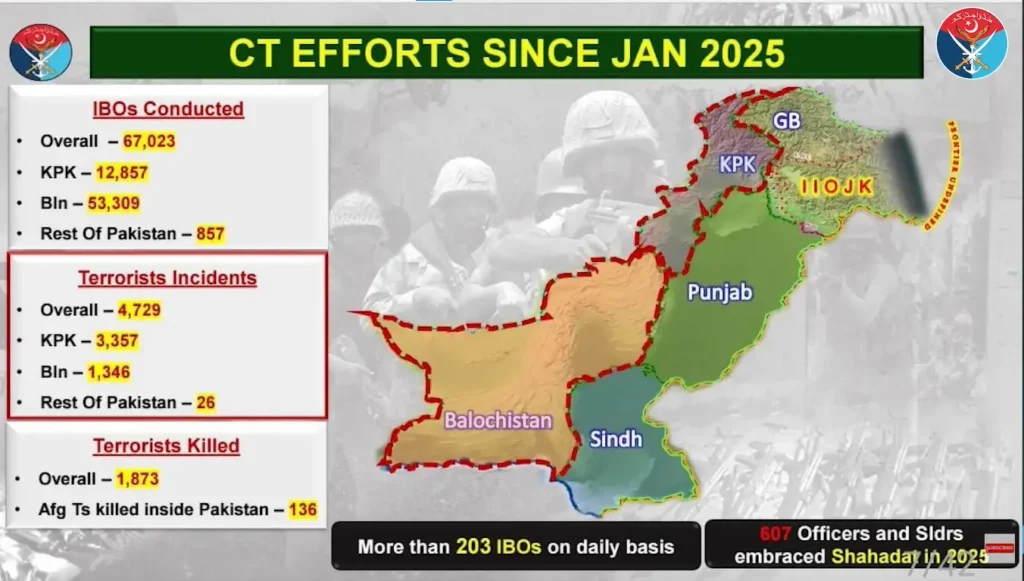
Providing a breakdown of the security situation since January, Lt Gen Chaudhry said 67,023 IBOs had been conducted across the country since then.
Balochistan had the highest number of such operations, with over 53,000, while Khyber Pakhtunkhwa had over 12,800, and the rest of the country recorded about 850.
The military spokesperson said the country had witnessed 4,729 terrorist incidents since January, with 3,357 in KP, 1,346 in Balochistan and 26 in other regions.

More to follow

