


• Islamabad says ceasefire with western neighbour not ‘open-ended’; any breach will trigger ‘all options’
• Foreign Office insists Istanbul statement a ‘preface’, not full text of accord
• Says Taliban privately acknowledge TTP, BLA presence in Afghanistan
• Khawaja Asif hints at multi-nation monitors, says ‘terrorism must stop’
ISLAMABAD: Islamabad on Friday viewed the Istanbul agreement with Kabul as a conditional truce and a step forward, but not an end-state as it awaited the next high-level engagement with the Afghan Taliban regime scheduled for Nov 6 in Turkiye.
“Afghanistan should understand that this arrangement is a conditional truce, one which hinges on demonstrable responsibility by the Afghan side,” a senior security source said on condition of anonymity, underscoring Pakistan’s cautious optimism after five days of intense talks in Istanbul mediated by Turkiye and Qatar.
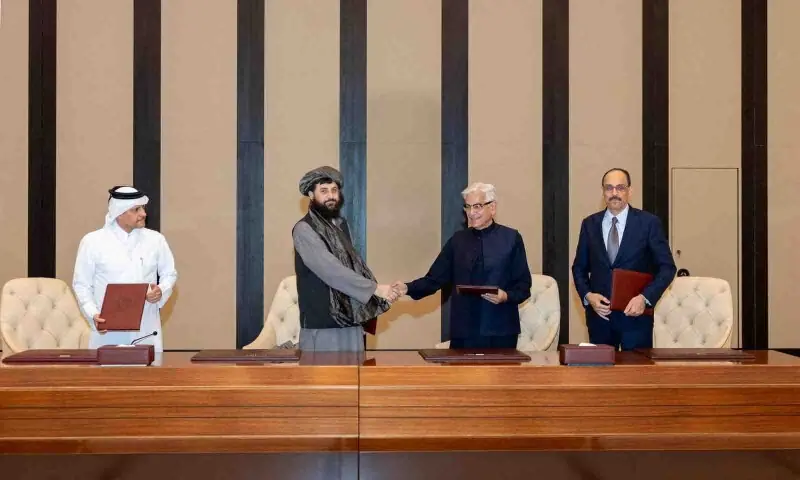
The round of negotiations, which concluded earlier this week, produced a three-point understanding — the continuation of the ceasefire, the establishment of a monitoring and verification mechanism to ensure peace, and penalties for violations.
The operational details of that mechanism are expected to be finalised when the “principals”, senior representatives from both sides, meet again in Istanbul on Thursday.
The Istanbul talks followed a sharp escalation in tensions last month that saw Pakistan launch Oct 9 airstrikes on TTP sanctuaries in Afghanistan, triggering Oct 11 border clashes that continued for days before a ceasefire was formalised in Doha on Oct 18-19.
The Istanbul agreement came after days of deadlock that nearly brought the process to a halt, with mediators pulling both delegations back to the table even as Pakistan’s team had already begun preparations to return home.
“The Istanbul round was initially scheduled for two days. However, in an effort to reach an amicable agreement with the Taliban regime, the Pakistani side, in earnest, continued the talks for four days,” Foreign Office spokesman Tahir Hussain Andarabi said at his weekly briefing on Friday.
“We would see these deliberations [in Istanbul] as comprehensive and all-encompassing as we move to the next stage,” Mr Andarabi added.
He, however, urged against critiquing the statement. “The statement released by the foreign ministry of Turkiye was a kind of covering note on the talks that were held. It should be read as a preface to a book rather than as the book itself,” he explained while responding to questions about the statement not fully reflecting the Pakistani position, especially as it missed a reference to the TTP’s presence in Afghanistan.
“Pakistan does not seek further escalation of hostilities but expects the Afghan Taliban regime to honour its commitments to the international community and address Pakistan’s legitimate security concerns by taking concrete and verifiable actions against terrorist entities, including Fitna al-Khawarij (TTP) and Fitna al-Hindustan (Balochistan Liberation Army),” Mr Andarabi said.
While the Foreign Office emphasised diplomacy, the security official was explicit about Islamabad’s conditional approach.
“Pakistan reaffirms its commitment to peace and stability on its western border but equally emphasises that this ceasefire is not open-ended and not unconditional,” the official emphasised.
He added that Pakistan expects “credible evidence of action, including dismantling of militant hideouts, disruption of logistical channels, arrests or prosecutions of leadership and transparent reporting through the agreed monitoring and verification mechanism”.
“If Afghanistan fails to deliver verifiable proof of agreed steps, or if militants continue to launch attacks from Afghan soil, Pakistan will deem the ceasefire violated and reserves all options to safeguard its sovereignty and citizens,” he warned.
FO ‘fully engaged’
The Pakistani delegation in Istanbul was dominated by military and intelligence officials, though the Foreign Office spokesman insisted it remained fully engaged.
“Istanbul talks took place with full engagement from the Foreign Office,” Mr Andarabi said. “The deputy prime minister and foreign minister gave guidance on numerous occasions. The foreign secretary and our Afghanistan Division were also engaged. We need to dispel this impression that there is some sort of fragmentation in our government apparatus.”
Mr Andarabi also clarified that “the border remains closed for trade for now. The opening of the border for Afghan transit trade would depend on the evaluation of the security situation, and clearly that evaluation still warrants closure of the border.”
On the monitoring system, the security source said, “The monitoring and verification mechanism established under the mediators’ auspices will serve as the impartial and essential instrument to determine compliance by Afghanistan.”
Pakistan, however, remains sceptical about the Afghan Taliban’s sincerity.
“Despite repeated assurances in the past (by Afghan Taliban), there has been a surge in terrorist attacks in Pakistan from Afghanistan,” Mr Andarabi recalled.
The spokesman further disclosed that the Afghan Taliban had acknowledged the presence of TTP and BLA on Afghan soil, even if they offered excuses for inaction. “As far as the acknowledgement of their physical presence in Afghanistan is concerned, they agreed to it,” he said.
Security officials echoed that scepticism, while noting that “the single litmus test of Taliban sincerity is that Afghanistan will not allow its territory to be used for attacks against Pakistan”.
Multi-nation monitors
Meanwhile, Defence Minister Asif suggested that there might be the inclusion of multiple countries in the monitoring mechanism to ensure its long-term sustainability instead of a breakdown in 12 or 15 months.
He said giving a “free hand” to any border crossing of terrorists amounted to abetting them or conniving with them. “If they don’t stop this or monitor this, it means they have connivance and their agreement is involved in terrorists coming and spilling blood in Pakistan,” he said.
To a question on whether the Afghan Taliban accepted the presence and usage of their soil by the TTP to conduct attacks on Pakistan, Mr Asif: “They accept this privately.”
He said the two were very entangled, and the entire TTP leadership was present in Kabul. “The sanctuaries in Kabul must have been provided by the Afghan Taliban. They (TTP) won’t be living in hotels,” he added.
Mr Asif asserted that Pakistan’s main demand continued to be the “stopping of terrorism emanating from Afghan soil”.
He added that “there is a ray of hope, but not because of Afghanistan and only so because of Qatar and Turkiye’s influence” over Kabul.
“There have been some ceasefire violations from Afghanistan,: he said, stressing that “until terrorism stops, the ceasefire cannot be
effective”.
Published in Dawn, November 1st, 2025



