


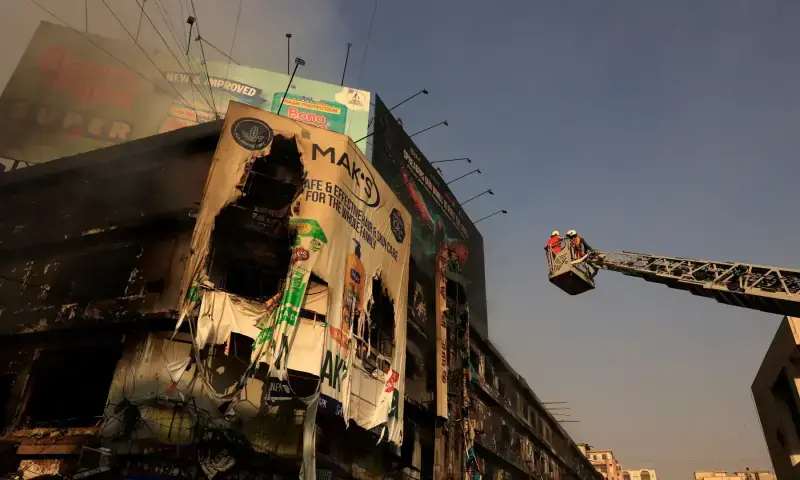
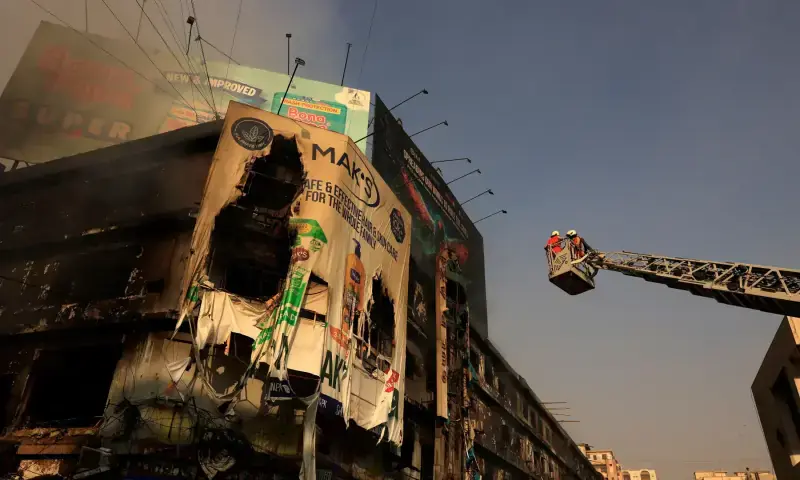
KARACHI: Only after a devastating fire at Gul Plaza caused massive human and financial losses, enraging the public over the lack of firefighting mechanisms and emergency exits, has the Sindh Building Control Authority (SBCA) decided to enforce fire safety rules in buildings in the metropolis.
The delayed action has triggered backlash from builders, developers and civil society, who say that the building regulator has been sitting on a KMC fire safety audit report for over two years despite being formally notified.
They termed the SBCA’s sudden directives to building owners “too little, too late”, accusing the authority of criminal negligence and questioning how many lives could have been saved if the warnings had been acted upon earlier.
“Since the SBCA will not be able to achieve the desired objectives without the cooperation of your members in this matter, you are therefore requested to direct your members to immediately comply with the fire safety deficiencies highlighted in the audit reports within three days, as this is an urgent matter requiring immediate compliance,” said a SBCA letter to the Association of Builders and Developers (ABAD) chairman.
Building regulator accused of ‘sitting on’ a KMC fire audit report for over two years; critics term move ‘too little, too late’
The KMC in January 2024 compiled a report on fire safety in hundreds of buildings across Karachi, following a deadly blaze at RJ Mall on Rashid Minhas Road in 2023.
The report identified at least 265 buildings lacking fire safety systems, emergency exits or a no-objection certificate (NOC) from the fire brigade. It warned that these structures could face disastrous consequences in case of a fire.
However, the SBCA moved to implement the report’s recommendations only after the Gul Plaza tragedy and that too more than two years later.
Muhammad Hassan Bakhshi, the ABAD chairman, — who has been asked by the SBCA to “cooperate” in implementing the fire compliance rules “within three days” — said he was hearing about the report for the “first time”.
He said the SBCA had never approached him earlier in this connection, adding that now it appeared that the authority was “trying to complete years of inaction in a matter of days”.
“These surveys and their implementation will only open another door to corruption,” Mr Bakhshi warned.
He stressed the need to digitise regulatory processes, arguing that reducing human-to-human contact was essential to prevent further corruption.
Saad Abdul Wahab, a fire and structural safety expert and CEO of Grow Safe, criticised the SBCA’s sudden push for fire safety compliance, warning that the move appears to be a temporary correction.
“A proper corrective action requires identifying root causes, assessing hazards, and implementing suitable and sufficient control measures,” he said.
He questioned the seriousness of the regulator and asked which legal framework or safety standard the authority was using as a benchmark for compliance, pointing out that multiple national and international codes exist.
The expert warned that enforcing fire safety installations without ensuring structural integrity could be dangerous.
He said there was no clarity on whether buildings were structurally capable of bearing additional loads from fire-fighting systems.
Meanwhile, a review by Dawn of the fire safety report compiled by the KMC two years ago showed that it included many residential and commercial buildings.
An official from the management of a commercial building on Sharea Faisal told Dawn that the SBCA had never warned them or provided any information regarding fire safety compliance.
“More than two years ago, a team of KMC fire department visited us and conducted a survey. But after that, we were never approached by the SBCA.”
Published in Dawn, January 22nd, 2026



