


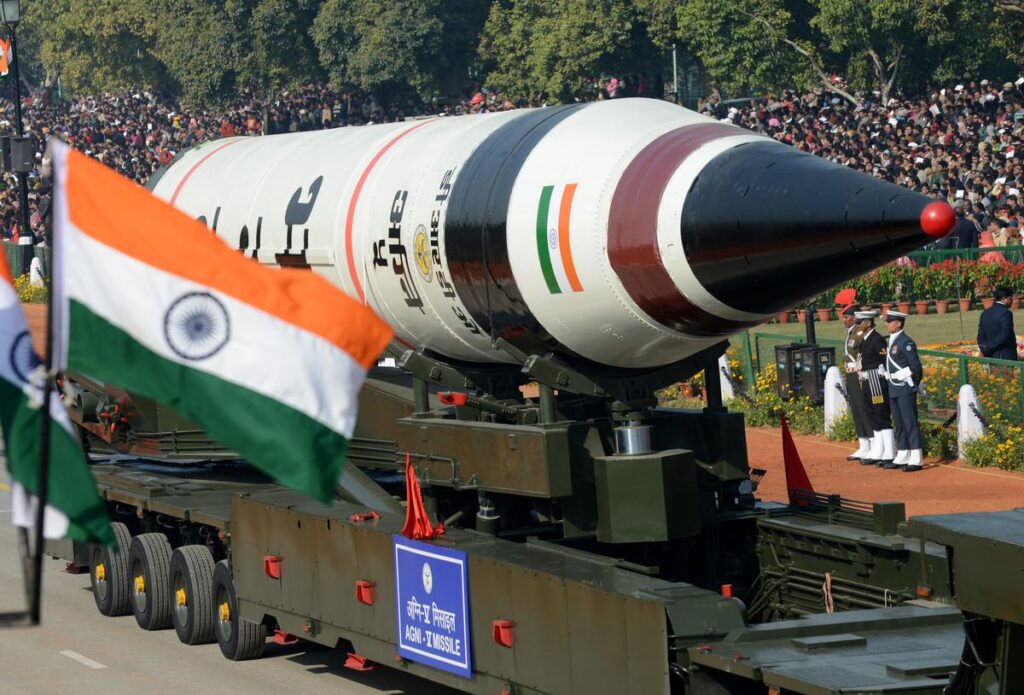
India Demonstrates Strategic Might with Agni-5 Missile Test Ahead of Tariff Deadline
In a significant show of defense capability and geopolitical assertion, India successfully test-fired its Agni-5 missile on Wednesday from its eastern state of Odisha. This comes at a critical time, just days before potential U.S. tariff hikes, and highlights New Delhi’s push for military and energy self-reliance amid rising global tensions.
The Ministry of Defence confirmed that the intermediate-range ballistic missile, capable of carrying multiple nuclear warheads, met all operational objectives during the launch, validating its “operational preparedness and advanced strike capabilities.”
Key Agni-5 Specifications
| Specification | Details |
|---|---|
| Missile Type | Intermediate-Range Ballistic Missile (IRBM) |
| Range | Over 5,000 km |
| Warhead Capacity | MIRV – multiple warheads for separate targets |
| Propulsion System | Three-stage, solid-fuel |
| Launch Site | Abdul Kalam Island, Odisha |
| First Test | April 2012 |
| Latest Test | August 2025 |
| Developer | Defence Research and Development Organisation (DRDO) |
With its ability to strike targets across Asia and even parts of Europe, the Agni-5 places India firmly among countries with credible second-strike capabilities—an essential part of any effective nuclear deterrent strategy.
Tariff Tensions: India and U.S. in Diplomatic Tug of War
The missile test came just a week before the United States is expected to double tariffs on Indian imports, from 25% to 50%, unless India meets Washington’s demand to cease importing oil from Russia. This escalating trade pressure from the U.S. has become a key geopolitical friction point between the two democracies.
Prime Minister Narendra Modi, in recent statements, emphasized India’s path toward “self-reliance in energy and defense”, signaling a strong response to foreign economic coercion.
“India will not compromise on its strategic autonomy. Whether it’s defense, trade, or energy, we will stand firm for our national interests,” Modi said during a recent policy briefing.
The Agni-5 missile test is seen by analysts as a calculated diplomatic move—asserting strength in the face of growing international pressure.
Defense Self-Reliance: From Imports to Indigenous Power
India’s move toward defense independence has accelerated in recent years. From sourcing fighter jets to missile systems, New Delhi has emphasized indigenous production and technology development. The success of Agni-5 is a major milestone in this journey.
The DRDO, in collaboration with the Indian military, has spearheaded various initiatives under the “Make in India” banner, focusing on high-end military capabilities. The Agni-5 represents:
- Strategic reach across regions, including East Asia and Europe
- Deterrence against regional adversaries like China
- Advanced warhead delivery systems (MIRV tech)
- Reduced dependency on foreign defense suppliers
India’s Dual Diplomacy: Allies and Adversaries
India is simultaneously strengthening ties with Western powers and maintaining complex relationships with Russia and China.
As a key member of the Quad alliance—alongside the United States, Japan, and Australia—India plays a vital role in countering China’s growing influence in the Indo-Pacific. However, recent developments indicate a subtle thawing in India-China relations. Multiple high-level bilateral visits have taken place in 2025, and Prime Minister Modi is scheduled to visit Tianjin, marking his first trip to China since 2018.
This balancing act highlights India’s flexible diplomacy. While New Delhi moves closer to the West strategically, it is not abandoning its long-standing partnerships or its quest for strategic autonomy.
Agni-5 Missile: More Than Just a Weapon
The Agni-5 missile isn’t just a display of military might—it’s a geopolitical tool. The capability to deploy multiple warheads means India can strike multiple enemy targets from a single missile launch, significantly improving its second-strike capability and deterring first-strike scenarios from adversaries.
This deterrent posture is crucial in a volatile region where both China and Pakistan possess nuclear weapons. With increasing tensions over the South China Sea, Taiwan, and border issues in Ladakh, the timing of India’s test is far from coincidental.
Global Reactions: Strategic Posturing or Escalation?
While India has framed the Agni-5 missile test as routine and part of its scheduled defense validation, global observers see a different picture.
Expert Reactions:
“This is a deliberate message to both Washington and Beijing,” says Professor Rajan Bhagat, a defense analyst at Jawaharlal Nehru University. “India wants to show it can withstand economic pressure and still assert its strategic will.”
Meanwhile, voices in the international community urge caution, fearing a potential arms race in South Asia. However, India maintains that its nuclear policy remains grounded in its “No First Use” doctrine.
India’s Energy Equation: Russian Oil & U.S. Demands
One of the major sources of friction between India and the U.S. has been India’s continued purchase of Russian oil despite Western sanctions. India defends its actions by citing affordability, long-term contracts, and energy security needs.
The looming tariffs by the U.S. are directly linked to India’s oil dealings with Russia. However, Modi’s government has resisted foreign dictates on energy procurement, asserting that national interest overrides international demands.
The Agni-5 test, therefore, acts as a parallel reminder that India will not be bullied into submission—either in defense or trade.
Internal Link Suggestion
👉 India’s Roadmap to Energy Independence by 2030
External Link Suggestion
🔗 India’s Missile Strategy – Read more on Reuters
Conclusion: India’s Defense Posture Enters a New Phase
India’s Agni-5 missile test in August 2025 is a defining moment in its strategic defense evolution. It signifies more than just military strength; it signals India’s resolve to remain independent in both defense and economic decision-making, regardless of international pressure.
By combining technological excellence, strategic autonomy, and diplomatic balancing, India has shown it is prepared for an increasingly multipolar and unpredictable world. The missile launch not only bolsters its deterrence capabilities but also sends a clear message: India will forge its path, even when faced with economic threats.
Related : Writozy



