


From Wikipedia, the free encyclopedia
Content deleted Content added
|
|
|||
| Line 1: | Line 1: | ||
|
{{Short description|Italian engine for aircraft use}} |
{{Short description|Italian engine for aircraft use}} |
||
|
{{infobox aero engine |
|||
|
{|{{Infobox aircraft begin |
|||
|
|name=Alfa Romeo 110 |
|name=Alfa Romeo 110 |
||
|
|image=File:Motore aeronautico – Museo scienza tecnologia Milano 02328 dia.jpg |
|image=File:Motore aeronautico – Museo scienza tecnologia Milano 02328 dia.jpg |
||
|
|caption= |
|caption= |
||
| ⚫ | |||
|
}}{{Infobox Aircraft Engine |
|||
| ⚫ | |||
|
|manufacturer=[[Alfa Romeo]] |
|manufacturer=[[Alfa Romeo]] |
||
|
| |
|=1930s |
||
|
| |
| = ~500 |
||
|
|major_applications= |
|||
|
|major applications= |
|||
|
}} |
}} |
||
|
|} |
|||
|
The ”’Alfa Romeo 110”’ was an Italian four cylinder air-cooled inverted inline engine for aircraft use, mainly for trainers and light aircraft. The Alfa Romeo 110 was based on the [[de Havilland Gipsy Major]], with approximately 500 units produced. Derivatives of the 110 include the -1, ter and ”’Alfa Romeo 111”'<ref name=Thompson>{{cite book |last=Thompson |first=Jonathan W. |title=Italian Civil and Military aircraft 1930–1945 |publisher=Aero Publishers Inc. |location=USA |year=1963 |isbn=0-8168-6500-0 |lccn=63-17621|page=295}}</ref> (possibly a mis identification of the 110-1). |
The ”’Alfa Romeo 110”’ was an Italian four cylinder air-cooled inverted inline engine for aircraft use, mainly for trainers and light aircraft. The Alfa Romeo 110 was based on the [[de Havilland Gipsy Major]], with approximately 500 units produced. Derivatives of the 110 include the -1, ter and ”’Alfa Romeo 111”'<ref name=Thompson>{{cite book |last=Thompson |first=Jonathan W. |title=Italian Civil and Military aircraft 1930–1945 |publisher=Aero Publishers Inc. |location=USA |year=1963 |isbn=0-8168-6500-0 |lccn=63-17621|page=295}}</ref> (possibly a mis identification of the 110-1). |
||
Latest revision as of 22:27, 10 November 2025
Italian engine for aircraft use
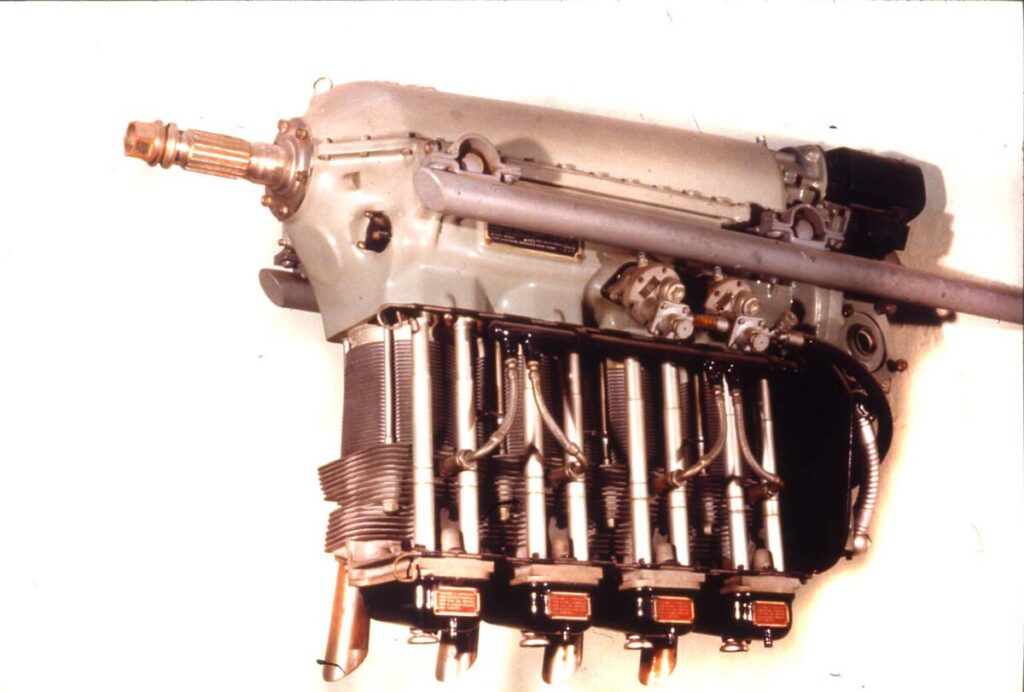
The Alfa Romeo 110 was an Italian four cylinder air-cooled inverted inline engine for aircraft use, mainly for trainers and light aircraft. The Alfa Romeo 110 was based on the de Havilland Gipsy Major, with approximately 500 units produced. Derivatives of the 110 include the -1, ter and Alfa Romeo 111[1] (possibly a mis identification of the 110-1).
- Alfa 110-1
- 97 kW (130 hp) at 2,350 rpm
- Alfa 110ter
- 108 kW (145 hp) at 2,350 rpm
- Alfa 111
- 116 kW (155 hp)[1]

Specifications (110-1)
[edit]
Data from Jane’s All The World’s Aircraft 1938,[2]
Italian Civil and Military aircraft 1930–1945,[1]
and Aircraft Engines of the World 1945 [3]
General characteristics
- Type: Four-cylinder inverted air-cooled inline engine
- Bore: 118 mm (4.65 in)
- Stroke: 140 mm (5.51 in)
- Displacement: 6.125 L (373.8 cu in)
- Length: 1,642 mm (64.6 in)
- Width: 498 mm (19.6 in)
- Height: 825 mm (32.5 in)
- Dry weight: 136 kg (300 lb)
- Frontal Area: 6.1 sq ft (0.6 m2)
Components
- Valvetrain: Two valves per cylinder, operated by pushrods and rocker arms
- Oil system: Dry sump with one pressure and three scavenge pumps, 276–310 kPa (40–45 psi)
- Oil consumption: 0.01095 kg/(kW h) (0.018 lb/(hp h))
- Cooling system: Air-cooled
- Starter: Eclipse inertia starter
- Ignition: 2 x Marelli SA-4 magnetos
Performance
Comparable engines
Related lists
- ^ a b c Thompson, Jonathan W. (1963). Italian Civil and Military aircraft 1930–1945. USA: Aero Publishers Inc. p. 295. ISBN 0-8168-6500-0. LCCN 63-17621.
- ^ Bridgman, Leonard, ed. (1938). Jane’s All The World’s Aircraft 1938. London: Sampson Low and Marston Co. Ltd. pp. 67d – 68d.
- ^ Wilkinson, Paul H. (1945). Aircraft engines of the World 1945 (2nd ed.). New York: Paul H. Wilkinson. pp. 282–283.
- Bridgman, Leonard, ed. (1938). Jane’s All The World’s Aircraft 1938. London: Sampson Low and Marston Co. Ltd. pp. 67d – 68d.
- Gunston, Bill (1986). World Encyclopedia of Aero Engines. Wellingborough: Patrick Stephens. p. 9.




