


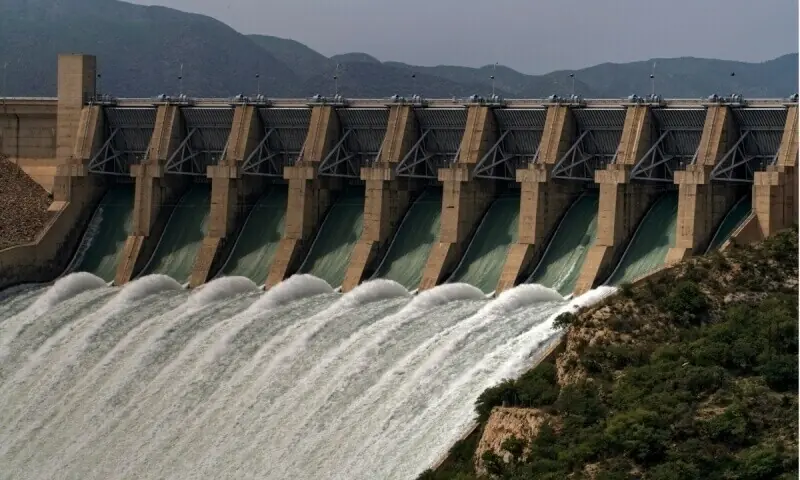
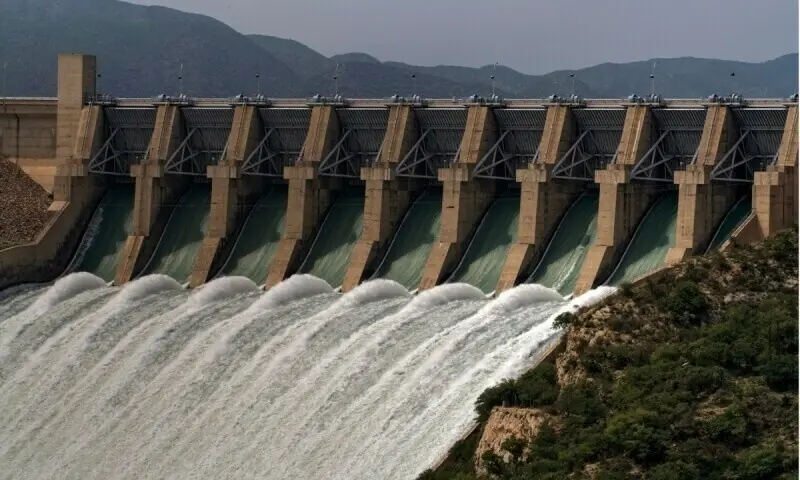
LAHORE: Mangla Dam, Pakistan’s largest reservoir in terms of storage capacity, reached its maximum conservation level of 1,242 feet on Thursday, and now stores 7.277 million acre-feet (MAF) of water, according to Wapda.
Now, all three of the country’s main water reservoirs — Tarbela, Mangla and Chashma — are filled to their maximum levels, holding a cumulative live storage of 13.316 MAF, considered a boon for irrigated agriculture and hydroelectric power generation.
“Tarbela Dam attained its maximum water conservation level of 1,550 feet on Aug.21, followed by Chashma lake that also attained its maximum level of 649 feet above mean sea level,” an official source told Dawn. “And, finally on Thursday [Mangla] also hit its maximum level of 1,242 feet.”
The official attributed the filling of the reservoirs to a high-flow season.
“The filling of Mangla and Chashma reservoirs to their maximum capacity is mainly due to rains, floods etc.,” he said. “However, the snow melting factor also contributes considerably in filling Tarbela Dam.”
Completed in 1967, Mangla Dam contributes to the country’s economic stability by helping ensure water supply for irrigation, mitigating floods, and providing hydel electricity to the National Grid.
At the time of its construction, Mangla Dam had a live storage capacity of 5.88 MAF, which gradually decreased to 4.6 MAF by 2004 due to sedimentation. WAPDA later began the Mangla Dam Raising Project, which not only regained the lost capacity but also enhanced it to 7.5 MAF.
Originally built with an installed power generation capacity of 1,000 MW, the dam is currently undergoing a phased refurbishment project. According to Wapda, the Mangla Refurbishment Project will increase the power generation capacity from 1,000 MW to 1,310 MW.
Published in Dawn, October 10th, 2025



