| ← Previous revision | Revision as of 01:02, 30 September 2025 | ||
| Line 11: | Line 11: | ||
|
}}
|
}}
|
||
|
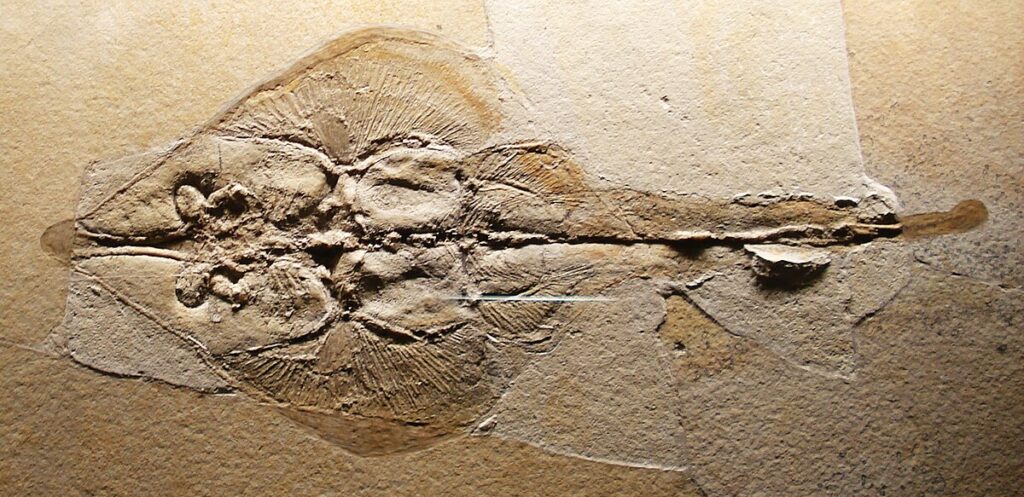
””’Asterodermus””’ (from {{langx|el|ἀστήρ}} {{transliteration|el|aster}}, ‘star’ and {{langx|el|δέρμα}} {{transliteration|el|dérma}}, ‘skin’)<ref>{{cite book |last1=Roberts |first1=George |title=An etymological and explanatory dictionary of the terms and language of geology |date=1839 |publisher=Longman, Orme, Brown, Green, & Longmans |location=London |page=12 |url=https://archive.org/details/anetymologicala00robegoog |access-date=29 December 2021 |language=English}}</ref> is an extinct genus of [[
|
””’Asterodermus””’ (from {{langx|el|ἀστήρ}} {{transliteration|el|aster}}, ‘star’ and {{langx|el|δέρμα}} {{transliteration|el|dérma}}, ‘skin’)<ref>{{cite book |last1=Roberts |first1=George |title=An etymological and explanatory dictionary of the terms and language of geology |date=1839 |publisher=Longman, Orme, Brown, Green, & Longmans |location=London |page=12 |url=https://archive.org/details/anetymologicala00robegoog |access-date=29 December 2021 |language=English}}</ref> is an extinct genus of [[]] [[Batomorphi|rays]] from the Jurassic period.<ref>{{Cite web|title=Fossilworks: Asterodermus platypterus|url=https://paleobiodb.org/classic/checkTaxonInfo?taxon_no=151812|access-date=17 December 2021|website=fossilworks.org}}</ref> A single species, ””’A. platypterus””’, is described. It is known mainly from the early [[Tithonian]] of [[Germany]], including the famous [[Lagerstätte]] site of [[Solnhofen Limestone|Solnhofen]].<ref>Thies, D. E. T. L. E. V., & Leidner, A. R. M. I. N. (2011). Sharks and guitarfishes (Elasmobranchii) from the Late Jurassic of Europe. ”Palaeodiversity”, ”4”, 63-184.</ref><ref name=”Apolithabatis”>{{Cite journal |last1=Türtscher |first1=Julia |last2=Jambura |first2=Patrick L. |last3=Spindler |first3=Frederik |last4=Kriwet |first4=Jürgen |date=2025-01-23 |title=Insights into stem Batomorphii: A new holomorphic ray (Chondrichthyes, Elasmobranchii) from the upper Jurassic of Germany |journal=[[PLOS One]] |language=en |volume=20 |issue=1 |pages=e0310174 |doi=10.1371/journal.pone.0310174 |issn=1932-6203 |pmc=11756912 |pmid=39847754 |doi-access=free}}</ref> Additionally, ”Asterodermus” scales have been found among articulated skeletons of neoselachians from the Tithonian of southern Germany.<ref>Thies, D. (1995). Placoid scales (Chondrichthyes: Elasmobranchii) from the Late Jurassic (Kimmeridgian) of northern Germany. Journal of Vertebrate Paleontology, 15(3), 463-481. doi:10.1080/02724634.1995.10011242</ref>
|
||
|
==References==
|
==References==
|
||
Asterodermus