


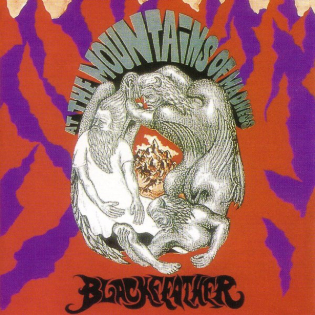
1971 Australian rock music album
At the Mountains of Madness is the debut album by Australian progressive rock group, Blackfeather. It was released in April 1971 for the Infinity sub-label of Festival and was produced by Richard Batchens with the band’s guitarist, John Robinson. At the Mountains of Madness peaked at No. 7 on the Go-Set Top 20 Albums chart. It provided the single, “Seasons of Change” in May 1971, which reached No. 15 on the Go-Set National Top 60 chart.
At the Mountains of Madness is the debut album by Sydney-based progressive rock band, Blackfeather.[1] They had formed in April 1970 by Neale Johns on lead vocals with ex-Dave Miller Set members, John Robinson on lead guitar, Leith Corbett on bass guitar and Mike McCormack on drums.[1][2][3] Corbett and McCormack were replaced by Robert Fortescue on bass guitar and Alexander Kash on drums.[1][3] The group were signed to Festival Records‘ newly founded progressive subsidiary, Infinity Records by its label boss, David Sinclair.[1][2] Late in that year they began recording the album, with co-production by Robinson and Richard Batchens (the Cleves) at Festival Studios, Sydney.[1][3] Robinson invited members of fellow Sydney rock group, Fraternity, John Bisset (keyboards) and Bon Scott (as Ronald Belford Scott on recorder, percussion), to contribute to the album.[1][2]
It was issued in April 1971 and by July, At the Mountains of Madness, had peaked at No. 7 on the Go-Set Top 20 Albums chart.[4] On the retro-calculated Kent Music Report (1993) top 100 albums chart, it reached No. 14.[5] The third track, “Seasons of Change Part 1”, re-titled “Seasons of Change“, was issued as the album’s only single in May 1971 by label boss, Sinclair.[1][2] This was against the wishes of Robinson and his friends in Fraternity – the latter had recorded their cover version of the song for a single, which was issued in March 1971.[1][2] By that time, Fraternity had relocated to Adelaide and their rendition was appearing on the local radio charts, which prompted Sinclair to renege on his agreement with Robinson and Scott to not release Blackfeather’s version.[1][2]
Writing and recording
[edit]
According to lead guitarist, songwriter and co-producer, Robinson At the Mountains of Madness evolved from early demo sessions with the original line-up, “At one session in Hornsby, an engineer named John Zuliaka taped us for a demo. […] It was sent to EMI and Festival. Both sent back contracts to sign. We were to book through NOVA and one John Sinclair was our PR man. We signed up to Essex Music under John Brummel and to Festival’s new Infinity label, headed by John’s brother David Sinclair.”[2] Album sessions began after former Perth residents, Fortescue and Kash had replaced Corbett and McCormack. Earliest tracks recorded were “‘The Rat’ and ‘Long-legged Lovely’ […] By this time I was playing another Stratocaster and had swapped my sitar for a Watkins Copycat tape-echo unit. The tube pre-amp in the Watkins was great. It overdrove to front end of the Lenard amp perfectly.”[2] After Robinson formed a friendship with Fraternity’s Bisset and Scott, “I borrowed Mick Jurds’ Strauss Guitar Amp for some songs.”[2] Recording “Seasons of Change Part 1” occuerred during later sessions.[2]
Rehearsals occurred in John Spooner’s venue, who operated Johnathon’s Nightclub.[2] Robinson had met Scott at that club, when Fraternity began their residency.[2] In the late 1990s, Robinson re-evaluated At the Mountains of Madness with a track-by-track analysis. Robinson wrote three tracks alone and co-wrote the other three with Johns.[6]
At the Mountains of Madness is described by Australian musicologist, Ian McFarlane, “It remains a highly regarded progressive rock album, highlighted by Robinson’s fluid, inventive guitar technique and a swag of adventurous songs.”[1] Duncan Kimball of MilesAgo website recalled, “[it’s an] Australian progressive classic”, but “has perhaps not aged as well as some others from the period”.[2] AllMusic‘s William Ruhlmann noticed “[they] began as a progressive rock unit, which can be heard on Mountains of Madness (1971), but later moved toward a simpler rock & roll style”.[7]
All tracks are written by John David Robinson,[6] unless otherwise noted.
| Title | Writer(s) | ||
|---|---|---|---|
| 1. | “At the Mountains of Madness[8]“ | 3:30 | |
| 2. | “On This Day That I Die[9]“ | 4:00 | |
| 3. | “Seasons of Change Part 1[10]“ | Neale S Johns, Robinson | 3:53 |
| 4. | “Mangos Theme Part 2[11]“ | 8:04 | |
| 5. | “Long Legged Lovely[12]“ | Johns, Robinson | 7:34 |
| 6. | “Rat (Suite)”[13]
|
Johns, Robinson | 13:53 |
| Total length: | 39:39 | ||
Blackfeather
- Robert Fortescue – bass guitar
- Neale Johns – lead vocals
- Alexander Kash – drums
- John Robinson – guitars (electric, acoustic)
Additional musicians
Artisans
- Richard Batchens – audio engineer, producer at Festival Studios, Sydney
- John Robinson – producer at Festival Studios, Sydney
- ^ a b c d e f g h i j * [online] 1st edition: McFarlane, Ian (1999). “Encyclopedia entry for ‘Blackfeather’“. Encyclopedia of Australian Rock and Pop. St Leonards, NSW: Allen & Unwin. ISBN 1-86508-072-1. Archived from the original on 6 August 2004.
- [print] 2nd edition: McFarlane, Ian; Jenkins, Jeff (Foreword) (2017). “Encyclopedia entry for ‘Blackfeather’“. The Encyclopedia of Australian Rock and Pop (2nd ed.). Gisborne, Vic: Third Stone Press. p. 51. ISBN 978-0-9953856-0-3.
- ^ a b c d e f g h i j k l m Kimball, Duncan (2002). “Blackfeather”. Milesago: Australasian Music and Popular Culture 1964–1975. Ice Productions. Archived from the original on 16 March 2010. Retrieved 30 September 2015.
- ^ a b c Holmgren, Magnus; Sturm, Jonathan; Johns, Neale. “Blackfeather”. Australian Rock Database. Archived from the original on 2 March 2004. Retrieved 17 July 2025.
- ^ a b Nimmervoll, Ed (10 July 1971). “Go-Set Australian Charts”. Go-Set. Waverley Press. Archived from the original on 25 February 2025. Retrieved 6 September 2025.
- ^ a b Kent, David (1993). Australian Chart Book 1970–1992. St Ives, NSW: Australian Chart Book Ltd. ISBN 0-646-11917-6. n.b.: Used for Australian singles and albums charting from 1974 until Australian Recording Industry Association (ARIA) created their own charts in mid-1988. In 1992, Kent back-calculated chart positions for 1970–1974.
- ^ a b “Song Catalogue Search Results for ‘At the Mountains of Madness’“. APRA AMCOS (Australasian Performing Right Association, Australasian Mechanical Copyright Owners Society). Retrieved 7 September 2025. n.b.: For other tracks replace current title with required search string.
- ^ Ruhlmann, William. “Blackfeather Songs, Albums, Reviews, Bio & Mor…” AllMusic. Archived from the original on 22 April 2013. Retrieved 7 September 2025.
- ^ Blackfeather (Performer) (2007). “‘At the Mountains of Madness’“. Festival Australia/destra Media (Distributor). Retrieved 7 September 2025.
- ^ Blackfeather (Performer) (2007). “On This Day That I Die”. Festival Australia/destra Media (Distributor). Retrieved 7 September 2025.
- ^ Blackfeather (Performer) (2007). “Seasons of Change Part 1”. Festival Australia/destra Media (Distributor). Retrieved 7 September 2025.
- ^ Blackfeather (Performer) (2007). “Mangos Theme Part 2”. Festival Australia/destra Media (Distributor). Retrieved 7 September 2025.
- ^ Blackfeather (Performer) (2007). “Long Legged Lovely”. Festival Australia/destra Media (Distributor). Retrieved 7 September 2025.
- ^ Blackfeather (Performer) (2007). “The Rat Suite: Main Title”. Festival Australia/destra Media (Distributor). Retrieved 7 September 2025.
- ^ Ryan (bulion), Gavin (2 February 2011). “Forum – 1971 (ARIA Charts: Special Occasion Charts)”. Australian Charts Portal (Hang Medien). Archived from the original on 29 January 2018. Retrieved 8 September 2025.



